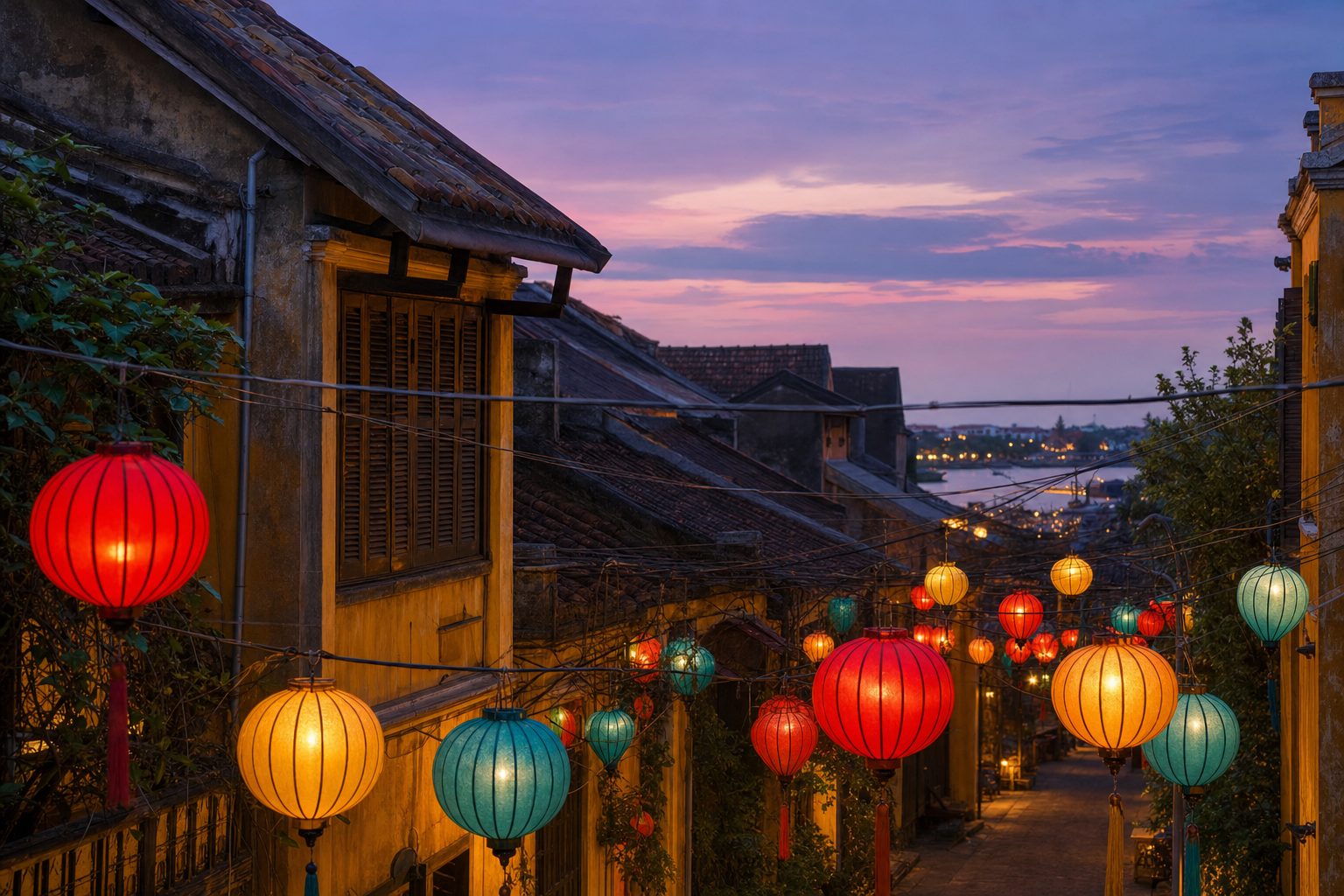
Once a month, Hoi An turns off every light. On the fourteenth night of each lunar month, the shophouses, cafés and tailors inside the protected heritage grid put out their electric lighting, neon signage goes dark, and for roughly four hours the old trading port runs on candlelight and silk lanterns alone. It is the image that fills reels and carousels, and it is real — but it is also monthly, dated by the lunar calendar, and busiest in exactly the two hours most visitors aim for. Planning around it takes more care than the footage suggests.
This guide works through the decisions in order: whether to time your visit to a lantern night at all, how the Ancient Town's two-tier heritage ticket actually works, which of the 22 ticketed monuments deserve your tear-off coupons, what a boat on the Hoai River costs, and when the weather helps rather than hinders. None of it is complicated, but the details are easy to get wrong at a distance — the festival date moves every month, the ticket rules changed for 2026, and the wet season rearranges both the crowds and the riverbank. The streets themselves are free to walk at any hour; everything else involves a choice.
What actually happens on the fourteenth lunar night
Locals call it Dem pho co — old town night. From around 18:00, electric light goes off across the heritage grid and the streets hold on lantern light until roughly 22:00. The evening is not a staged show with a start time and a finale; it is a town-wide practice, with bai choi singing played from bamboo huts near the river, calligraphers at work, folk games in the squares and paper lanterns, called hoa dang, drifting down the Hoai. Lanterns hang and glow every evening of the year, and boats sell floating candles nightly — but the full switch-off belongs to the fourteenth lunar night only.
As checked in August 2026, the remaining lantern nights of 2026 fall on 26 August, 24 September, 23 October, 22 November and 22 December, with electric lights off from around 18:00 until roughly 22:00. [5]
Each date has a character. The night of 24 September coincides with the eve of the Mid-Autumn Festival and is expected to be the fullest — and slowest — of the year, while 22 November and 22 December promise the same darkness with far more room to move. Crowds peak between about 19:00 and 20:00 and thin noticeably after 21:15, and the lanterns are no dimmer late in the evening, so arriving early or staying late are both sound strategies. There is no festival ticket: watching from the Chua Cau end of Tran Phu, or from the footbridges across to An Hoi, costs nothing.
It helps to understand where the custom comes from. The lights-off evenings began as a heritage project in the late 1990s, in the run-up to the town's UNESCO inscription, and have run monthly ever since — less a festival invented for visitors than a restoration of how the port looked before electrification. That is also why the etiquette matters: keep torch and phone light low, do not block the narrow lanes for photographs, and treat the assembly halls and family chapels along the route as the working places of worship they still are.
The heritage ticket, decoded
Walking the Ancient Town's streets requires no ticket. Entering its protected interiors does. The heritage ticket, sold at booths ringing the pedestrian zone, is a booklet of tear-off coupons admitting you to a set number of the 22 listed monuments — merchant houses, assembly halls, museums, temples and the Japanese Covered Bridge. Revenue funds conservation, and the Hoi An World Cultural Heritage Conservation Center asks visitors to buy before entering the grid. Children under 16 enter free.
As checked in August 2026, the official portal lists two tiers: an 80,000 VND ticket covering one iconic site (the Japanese Covered Bridge or Quan Cong Temple) plus two further monuments, and a 120,000 VND ticket adding a museum and three self-selected monuments. One purchase covers your whole stay, valid for up to three days. [2]
For most foreign visitors the 120,000 VND ticket — around five US dollars — is the sensible buy, since it opens five interiors rather than three. Booths sit at the main entrances to the pedestrian zone; as checked in August 2026, counters operate from about 07:00 to 21:30, with the easiest found where Tran Phu meets Hoang Dieu and by the bridge approach on Nguyen Thi Minh Khai. Keep the stub after your coupons are spent — it smooths re-entry at the checkpoints. Compared with the timed-entry systems now common at Venice and other heritage cities, Hoi An's scheme is refreshingly simple: pay once, wander for days.
Where to spend your coupons
The 22 monuments are not equal, and choosing five is genuinely a decision. The Japanese Covered Bridge — an 18th-century wooden bridge with a small pagoda on it, freshly restored — is the town's emblem and the natural first coupon. Of the Chinese assembly halls, Phuc Kien (the Fujian hall) is the grandest, its courtyard heavy with coiled incense; of the merchant houses, Tan Ky is the most complete, still occupied by the same family after seven generations of river trade. The Museum of Trade Ceramics tells the port story through shipwreck cargo, and the daily traditional art performances — folk song and dance at 10:15, 15:15 and 16:15 — are included in the ticket system too.
Hoi An is an exceptionally well-preserved example of a small South-East Asian trading port, active from the 15th to the 19th century, whose intact timber buildings and street plan record a fusion of indigenous, Chinese and Japanese cultures found nowhere else in the region.
— Paraphrased from the UNESCO World Heritage listing
UNESCO inscribed Hoi An Ancient Town on the World Heritage List in 1999 under criteria (ii) and (v); the 30-hectare property contains a preserved complex of 1,107 timber-frame buildings laid out on the original grid beside the Thu Bon River. [1]
- Japanese Covered Bridge — the 18th-century emblem of the town, one of the two 'iconic' options on either ticket tier
- Phuc Kien (Fujian) Assembly Hall — the grandest of the Chinese congregation halls, with coiled incense spirals above the courtyard
- Tan Ky Old House — the best-preserved merchant house, lived in by the same family for seven generations
- Museum of Trade Ceramics — shipwreck porcelain and the clearest telling of the port's trading story
- Traditional art performance — folk song, dance and instruments, staged daily at 10:15, 15:15 and 16:15
The river after dark
The Hoai, the arm of the Thu Bon that runs past the Old Town, doubles every lantern in reflection, and a low wooden sampan is the classic way onto it. Fares are set officially, listed per boat rather than per person, and posted at ticket points along the waterfront — three on Bach Dang and two more near the night market and the An Hoi bridge. Rides last about 20 minutes, life jackets are required, and queues build sharply on lantern nights, so board early or expect a wait.
As checked in August 2026, official lantern-boat fares on the Hoai River are 150,000 VND per boat for one to three passengers and 200,000 VND for four to five, for a ride of roughly 20 minutes; boats operate daily from 16:00 to 21:30. [6]
The floating lanterns themselves are sold separately by vendors along the riverbank, typically for 5,000 to 15,000 VND each, candle included, and one per person is plenty — the ritual carries the meaning, not the quantity. On the fourteenth and fifteenth of the lunar month the floats carry wishes for returning ancestors, which is worth knowing before treating them purely as a photo prop. The paper-and-candle design is biodegradable, but the town still fishes spent floats from the water each night, so resist the temptation to launch a dozen. If you would rather not pay for a boat at all, releasing a lantern from the steps along Bach Dang gives much the same moment for a fraction of the cost.
When to go and how to arrive
Vietnam's national tourism board calls March to May the best window, with June to August workable if you can stand the heat; October to January brings rain and periodic storms, and the low-lying streets by the river do flood in the wettest weeks. The upside of the late-year wet season is emptier lantern nights — the November and December dates fall exactly in it. Whatever the month, the town is at its best in the last two hours of daylight, when the yellow walls hold the low sun and the lanterns come on over still-warm streets.
Hoi An has no airport or railway station of its own. Da Nang, roughly 30 kilometres north, is the gateway, and the drive down the coastal road takes about 45 minutes on an ordinary evening. On lantern nights the approach roads thicken from mid-afternoon and the legal drop-off perimeter moves outward, so drivers advise leaving Da Nang by 16:30 for an 18:00 arrival. The heritage grid itself is a walking-and-cycling zone: no cars enter at any hour, and even motorbikes are excluded from 09:00 to 21:30 in summer, 21:00 in winter.
Beyond the grid
The Ancient Town rewards a stay of two or three nights precisely because the surroundings carry the daytime. An Bang beach is ten minutes away by taxi for seafood lunches and a swim; the Tra Que and Cam Thanh countryside is flat, green cycling ground at sunrise; and My Son Sanctuary, the Cham temple complex 40 kilometres inland, makes an easy half-day for anyone drawn to older stones. Food is the other anchor — cao lau noodles, white rose dumplings and the central market stalls justify a day on their own, and the town's famous overnight tailors need a first fitting early in your stay rather than on the last morning. Travellers building a wider island-and-coast itinerary through the region often pair central Vietnam with the limestone seascapes of El Nido in Palawan, a straightforward hop via Manila or Ho Chi Minh City.
Prices, dates and access rules shift with the lunar calendar and with policy, so verify the current ticket structure on the official portal before you travel, and check the next lantern date against your itinerary rather than assuming a weekend. If the appeal of Hoi An is the way a living town wears its history after dark, the natural next step inland is the temple plain across the border — our Angkor Wat guide covers how to plan sunrise, tickets and temple etiquette for South-East Asia's other great heritage stage.
Sources & further reading
- 1. UNESCO World Heritage Centre — Hoi An Ancient Town
- 2. Da Nang Fantasticity (official tourism portal) — Hoi An Ancient Town Entrance Tickets 2026
- 3. Hoi An World Cultural Heritage Conservation Center — Announcement of the Visiting in Hoi An Ancient Town
- 4. Vietnam National Authority of Tourism — Hoi An
- 5. Hoi An Driver — Hoi An Lantern Festival 2026: Dates, Times, Tickets and the Drive In
- 6. VinWonders — Hoi An Lantern Boat Ride: A Must-Try Activity at Night
- 7. Da Nang Pointer — Hoi An Old Town Guide
- 8. Da Nang Pointer — Lantern Release Boat Pier on the Hoai River