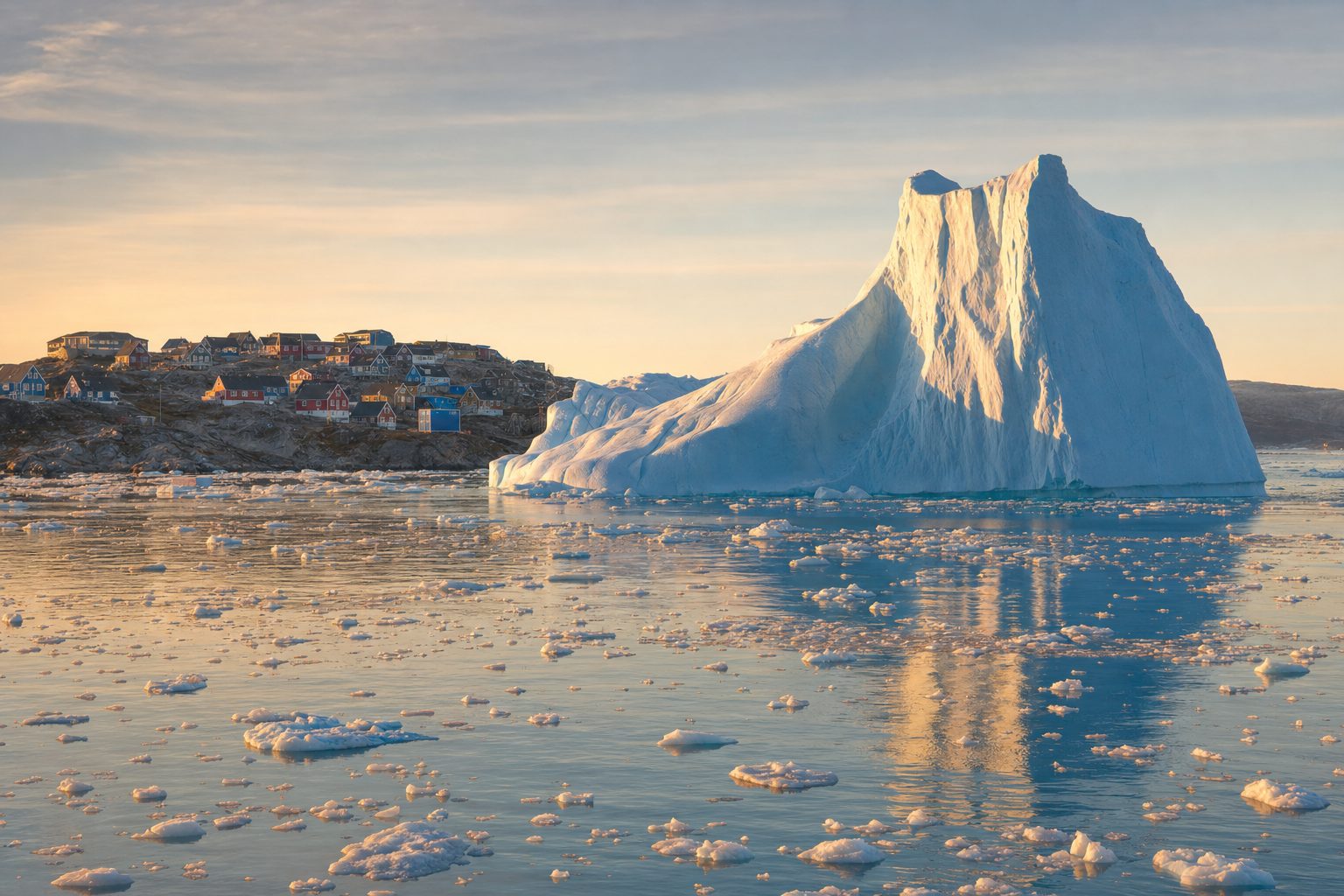
A trip to Ilulissat starts with a decision most travellers never have to make: there is no road that leads there. Greenland has no roads connecting its towns, so every visitor arrives by plane, occasionally by helicopter, or by coastal ferry, and every itinerary has to be built around that fact rather than around it. The reward for the extra planning is the Ilulissat Icefjord itself, a UNESCO World Heritage Site where an ice stream from the Greenland ice sheet calves directly into Disko Bay, filling the water with icebergs visible from the edge of town.
The choices that matter for a first visit are practical rather than aesthetic: when to go, how to get in and out reliably, whether to pay the new site fee and which trail to walk, and how to build a schedule that survives Arctic weather. None of this requires a guide for most of it, but all of it requires booking earlier than a typical European trip and accepting that delays are part of the experience, not a failure of it.
Why there are no roads and what that means for planning
Greenland's towns are separated by fjords, ice cap and open water, and the Canadian government's travel advisory confirms there are no roads or railways between them, so travel between settlements is only possible by air, sea, or in winter by dog sled and snowmobile. Air Greenland covers most inter-town routes with Dash 8 turboprops and helicopters where there is no landing strip, while the passenger ferry Sarfaq Ittuk and regional operators such as Disko Line cover the coast between April and December, as detailed on Visit Greenland's transport guide. Inside Ilulissat itself, walking covers almost everything a visitor needs, since the town and its trailheads sit within a few kilometres of each other.
There are no roads connecting any two towns in Greenland; travel between them is only possible by air, sea, or in winter by dog sled and snowmobile. [3]
When to go: midnight sun, whales, and the shoulder seasons
Summer, roughly mid-June to early September, is the default window for a first Ilulissat trip, and for good reason: this is when the hiking trails are clear of snow, boat tours run daily, and the midnight sun keeps the Icefjord lit long after a normal evening would go dark. Operators run open-boat cruises into Disko Bay through the night hours, timed to catch the low, warm-coloured midnight sun on the icebergs, with a reasonable chance of seeing humpback or minke whales feeding near the ice edge. Outside summer, dog sledding, snowmobiling and the northern lights become the draw instead, but flight frequency drops and several tour categories pause entirely.
- June to August: midnight sun boat tours in Disko Bay, whale sightings likely, all three hiking trails accessible, peak prices and bookings.
- September: hiking and boat tours continue on a reduced schedule as days shorten; fewer crowds than midsummer.
- Late September to March: aurora season and dog sledding become the main activities; the Icefjord site fee is not charged.
- Year-round: the icebergs themselves are visible from town in every season, though access to the trails depends on snow and ice conditions.
The Icefjord site fee: what it covers and how to pay
Since June 2025, Avannaata Municipality has charged visitors who do not live in Greenland a fee to walk the land between Ilulissat town and the Icefjord. As checked in August 2026, the fee is 10 EUR per visitor, valid from 1 June to 31 October, and covers the entire protected area rather than a single trail, so it applies whether a visitor sticks to the marked paths or wanders off them, according to the official Ilulissat Icefjord site. It is a one-time payment that covers a visitor's entire stay for that season, bought either from a ticket machine at the Icefjord Centre car park or online in advance.
As checked in August 2026, non-resident visitors pay a 10 EUR site fee valid June 1 to October 31 for the land area between Ilulissat town and the Icefjord, including the yellow, red, and blue trails; travellers under 18 are admitted free, and winter access has no charge. [2]
The logic behind the fee, according to Avannaata Municipality, is that residents already fund trail maintenance and ranger patrols through local taxation, so the charge on non-residents is framed as the equivalent contribution from visitors who use the same paths and boardwalks.
Everyone contributes to the upkeep of the Icefjord area, either through taxation for Greenlandic residents or through the 10 euro entrance fee for visitors, which grants access to the protected area for the entire season.
— Paraphrased from the Ilulissat Icefjord site fee FAQ, kangia.gl
Choosing a trail: boardwalk, yellow, red, or blue
Ilulissat lays out its Icefjord access as one easy boardwalk plus three colour-coded trails, all converging near the Icefjord Centre and the old heliport, and choosing between them is really a question of time and mobility rather than difficulty. The Sermermiut World Heritage Trail is a wooden boardwalk running about 1.3 kilometres each way, wheelchair- and stroller-accessible, and the fastest route to a clear view of the Icefjord; it passes the site of Sermermiut, an Inuit settlement occupied for millennia before its last resident left in the mid-19th century.
The Ilulissat Icefjord World Heritage boardwalk runs about 1.3 km each way from the Icefjord Centre to Sermermiut and takes roughly 30 minutes each way on boardwalk terrain accessible to wheelchairs and strollers; the Blue Trail is the longest at 6.9 km and 4-5 hours. [7]
From Sermermiut, the Blue Trail continues about 6.9 kilometres over uneven rocky ground to the Quarry, roughly four to five hours, and is the closest option to a full day's hike. The Red Trail runs about 1 kilometre to Holms Hill, a short add-on rather than a standalone outing, while the Yellow Trail covers 2.7 kilometres between the old power plant and the Icefjord Centre with elevated views over Disko Bay, typically 1.5 to 2 hours. A single afternoon is enough for the boardwalk plus either the Yellow or Red trail; a full day is needed to add the Blue Trail as well.
Getting there and around: flights, ferries, and the new airports
Most travellers reach Ilulissat by connecting through Reykjavik, Copenhagen, or Nuuk, and the picture is changing quickly. Nuuk's new international airport opened on 28 November 2024, ending the need to transit through Kangerlussuaq for many routes, and Visit Greenland confirms that Qaqortoq's new airport opened on 16 April 2026, with Ilulissat's own international airport upgrade due to open by the end of 2026. As checked in August 2026, Air Greenland has scheduled its first direct Ilulissat-Copenhagen flight for 29 October 2026, which would end the current requirement to route through Nuuk or fly seasonally from Reykjavik with Icelandair.
Nuuk's new international airport opened on 28 November 2024, Qaqortoq's opened 16 April 2026, and Ilulissat's expanded runway and international terminal is due to open by the end of 2026, enabling a direct Air Greenland route to Copenhagen from 29 October 2026. [4]
Until the new terminal is fully running, the practical routing for most visitors remains a flight to Reykjavik or Copenhagen, then onward to Nuuk or directly to Ilulissat depending on season, since Guide to Greenland's first-time traveller advice recommends booking flights, tours, and accommodation at least six months ahead for the June-to-August season, when demand for the limited seats and day-tour capacity regularly outstrips supply.
Living with Arctic weather: delays are routine, not exceptional
Fog, wind, and icing cause frequent short delays to flights and boat departures around Ilulissat, and both official and first-hand sources treat this as normal rather than unusual. Guide to Greenland's own advice to first-time visitors is blunt about it: do not schedule tours or onward flights back-to-back, and expect that a boat or vehicle running ten minutes late is not a sign anything has gone wrong. The same unpredictability applies to cruise ship arrivals and rescue capability, and the Canadian government's travel advisory notes that rescue operations for vessels in distress can be very limited, especially in winter, reinforcing that adventure activities should be arranged through established local operators rather than improvised independently.
Beyond Ilulissat: settlements, glaciers, and the wider Disko Bay
Ilulissat is also a base for reaching smaller settlements around Disko Bay by boat, including Oqaatsut to the north and multi-day trips to the actively calving Eqi Glacier roughly 80 kilometres away, both run as day or overnight excursions from the harbour. These trips depend on the same booking and weather caveats as everything else in the region, and travellers with only two or three days should prioritise the Icefjord trails and a boat tour before adding a glacier excursion. For travellers weighing Greenland against other remote North Atlantic and Nordic trips, the logistics compare more closely to the Faroe Islands, where ferries and weather windows likewise shape the itinerary, than to a conventional European city break.
Putting together a realistic first itinerary
A workable first trip runs four to five days in Ilulissat at minimum: one day to allow for arrival delays, one for the boardwalk and a shorter trail, one for a Disko Bay boat tour with whale-watching potential, and a spare day to absorb whatever the weather does to the schedule. Travellers combining Greenland with a wider Nordic trip often pair it with Norway's Lofoten Islands or an Icelandic stopover such as Reykjavik and the Ring Road, both of which share the short high-Arctic summer window and benefit from the same early-booking discipline. Whichever route gets a traveller to Ilulissat, the Icefjord itself rewards patience: the ice has been moving and calving for a very long time, and it is in no hurry to perform on anyone's fixed schedule.
Sources & further reading
- 1. Ilulissat Icefjord official site (Kangia)
- 2. Ilulissat Icefjord site fee ticket page
- 3. Visit Greenland: How to get around in Greenland
- 4. Visit Greenland: How to get to Greenland
- 5. Guide to Greenland: First-time traveler to Greenland and the Arctic
- 6. Government of Canada travel advice for Greenland
- 7. Isfjordscentret: Hiking trails at Ilulissat Icefjord