
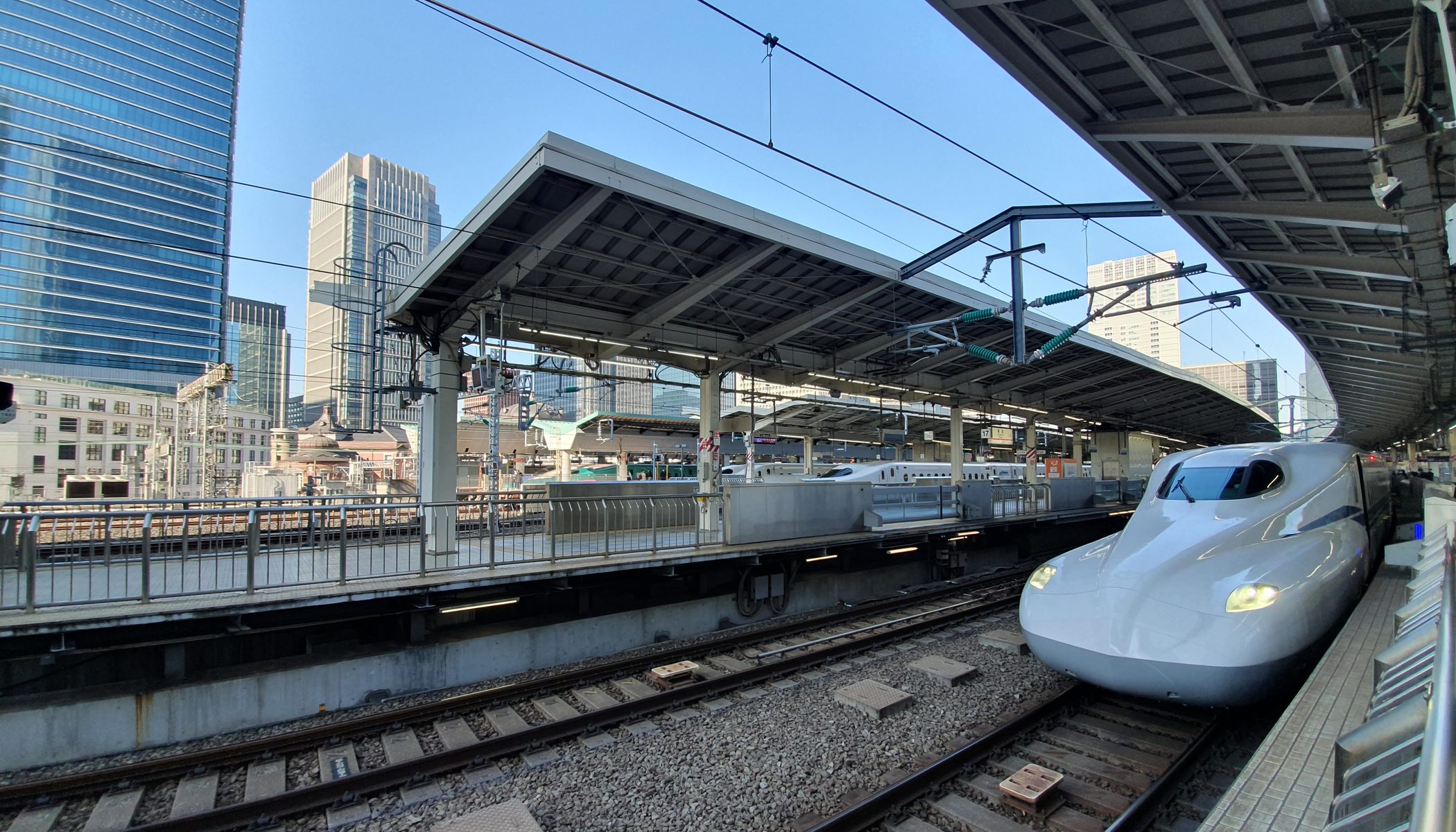
Japan rewards travellers who sort out their transport before they arrive, and it punishes the ones who assume a single purchase will cover everything. The country's railways are fast, punctual and unusually legible once you understand the pieces — but those pieces are owned by different companies, priced by different logics, and governed by a handful of rules that are easy to miss until a gate refuses to open. This is a guide to the decisions worth making early: whether a nationwide pass is right for your route, what an IC card quietly handles for you, and the baggage rule that surprises visitors on the Shinkansen.
First decide whether the nationwide pass fits your route
The JAPAN RAIL PASS is the default recommendation in most trip-planning threads, and it is genuinely excellent value for some itineraries and poor value for others. It comes in Standard and Green (first-class) grades, each sold in 7-, 14- and 21-day terms, according to the official JR Group overview. The right question is not whether the pass is good, but whether your particular set of journeys costs more than the pass does.
As of July 2026, ordinary adult passes bought through the official website cost ¥50,000 for 7 days, ¥80,000 for 14 days and ¥100,000 for 21 days. Green Car adult passes cost ¥70,000, ¥110,000 and ¥140,000 for the same durations. [3]
Those are the web-sale figures published on the official price page, which also announces a separate, higher price scale for passes bought through overseas travel agents from 1 October 2026. Check the current figure on the day you buy rather than relying on a number quoted in an older article — including this one.
The arithmetic is straightforward. Price your actual planned journeys as individual tickets, add them up, and compare. A fortnight spent mostly in one city with a couple of day trips will rarely justify a nationwide pass. A route that crosses the country repeatedly usually will. Between those poles sit the regional passes, which cover one area for a lower price and are frequently the better answer for trips that stay within, say, Kansai or Kyushu.
- Leaning towards the nationwide pass: several long intercity hops, a route that doubles back, or a plan that keeps changing.
- Leaning towards individual tickets: one or two cities, a linear route, or a trip built around a single region.
- Leaning towards a regional pass: concentrated travel inside one area, where the nationwide network is mostly wasted.
- Undecided: price the exact journeys both ways before booking anything. The gap is often larger than expected in both directions.
Check that you are actually eligible
The pass is not sold to everyone in Japan. It is aimed at overseas visitors, and the JR Group's conditions of use are specific about the immigration status required. This matters at the exchange counter, where staff inspect the passport rather than take the traveller's word for it.
The pass can be exchanged and used only by travellers whose passport carries a stamp or sticker showing “Temporary Visitor” status. Other statuses, including Trainee, Entertainer and Reentry Permit, do not qualify. [2]
Reserve seats early, and know the Nozomi exception
Reserved seats cost nothing extra with a pass, and reserving is the difference between boarding calmly and standing in a vestibule with luggage during a holiday weekend. Buying through the official website brings a practical advantage here: it allows reserved seats to be booked before the physical pass has been collected, which is useful when a trip opens with a long transfer on the first morning.
Pass holders riding NOZOMI or MIZUHO services on the Tokaido, Sanyo or Kyushu Shinkansen must obtain a special ticket issued only to JAPAN RAIL PASS holders. Buying the pass on the official website also allows reserved seats to be booked before the pass itself is picked up. [1]
Nozomi and Mizuho are the fastest services on those lines, so this is not an obscure edge case — it is the difference between the quickest Tokyo–Kyoto run and a slower alternative. Plan on either buying the supplementary ticket or taking the Hikari and Sakura services the pass covers outright. If Kyoto is on the itinerary, our guide to Kyoto's temples and food culture covers what to do once the train arrives.
An IC card handles everything the pass does not
A rail pass is for long-distance travel. The daily business of subways, local lines, buses and the occasional vending machine is handled far more easily by a prepaid IC card, tapped at the gate rather than calculated at a ticket machine. The JNTO's IC card guide sets out how broadly they now work.
IC cards can be used across much of the country and normally carry a ¥500 refundable deposit. Welcome Suica and TOURIST PASMO are sold to visitors without a deposit. Beyond transport, the cards work at many vending machines and convenience stores. [5]
Interoperability is wide but not absolute, and acceptance at shops varies. Treat the card as the default for short hops and small purchases, keep some cash for the places that still want it, and top up at a station machine before a long day rather than at a barrier with a queue behind you.
The oversized baggage rule that catches people out
This is the rule most first-time visitors have never heard of, and it applies precisely where large suitcases are most likely to appear: the Shinkansen lines running between Tokyo, Kyoto, Osaka and Kyushu. Large baggage is not banned, but above a certain size it requires a specific reservation, and turning up without one has a price. The details are published by JR Central.
On the Tokaido, Sanyo and Kyushu Shinkansen, baggage whose three dimensions total 160 cm or less needs no reservation. Between 161 cm and 250 cm, a seat with an oversized baggage area must be reserved in advance; boarding with such baggage unreserved incurs a ¥1,000 fee including tax. Baggage exceeding 250 cm cannot be brought on board at all. [6]
Stations, operators and the transfer you did not expect
Japanese cities are served by several rail companies at once, and a station name shared between two operators does not always mean a short walk between them. The JNTO's transport guide notes that Tokyo alone combines JR with the Tokyo Metro and Toei subway networks, while Osaka adds Hankyu, Hanshin and Keihan to the mix.
Because railway companies and fares differ, especially in larger cities, journey-planning apps such as Japan Travel by NAVITIME, Japan Transit Planner by Jorudan and Google Maps are the practical way to compare routes and fares. [4]
A rail pass covers JR services, not the private operators or most subway lines, so a route that looks direct on a map may involve a paid leg the pass does not touch. Let the app show the operator for each segment before assuming a journey is already paid for. Anyone who has planned a multi-country European trip will recognise the pattern from our guide to travelling around Europe by train, plane and ferry.
Rural lines, buses and the limits of turning up
Frequency is the quiet difference between city and country travel in Japan. In the major cities a missed train costs a few minutes. On a rural branch line it can cost half a day, and the last departure is often much earlier than visitors expect. Check the return timetable before committing to a remote destination, not after arriving.
Trains in Japan's larger cities run every few minutes, while services in rural areas can be considerably more limited and need more planning. Not all buses accept IC cards, so carrying cash remains necessary; most buses provide coin-exchange machines. [4]
Buses fill the gaps the railways leave, and they follow their own conventions — some charge a flat fare, others issue a numbered ticket on boarding and calculate the fare by distance travelled. Neither is complicated, but both are easier when the correct coins are already in hand.
Etiquette that keeps a crowded carriage calm
Japanese trains are quiet by shared agreement rather than by enforcement, and visitors who match the prevailing register are barely noticed. The conventions are few and easy to follow.
- Do not take phone calls in the carriage; long-distance trains have vestibule areas set aside for them.
- Leave priority seating for those entitled to it, and stand rather than occupy it at busy times.
- Smoking is not permitted; where smoking rooms exist, they are clearly marked.
- Keep luggage out of the aisle and use the racks, particularly on services running at capacity.
A pre-trip checklist
- Price your planned journeys as individual tickets and compare against nationwide and regional passes.
- Confirm the current pass price on the official site on the day you buy, and note the October 2026 change for overseas-agent purchases.
- Ensure your passport will carry a Temporary Visitor stamp or sticker — use a staffed immigration lane if needed.
- If buying a pass, buy officially online so seats can be reserved before collection.
- Budget a supplementary ticket for Nozomi or Mizuho services, or plan around Hikari and Sakura.
- Measure your largest suitcase; reserve an oversized baggage seat if the three dimensions total 161–250 cm.
- Pick up an IC card on arrival for subways, buses and small purchases, and keep cash for buses that refuse it.
- Install a route-planning app and check which operator runs each leg before assuming a pass covers it.
- Check last-train times for any rural segment before you travel out.
None of this takes long, and doing it in advance converts Japan's rail network from something to be decoded into something that simply works. The pass question resolves into arithmetic, the IC card removes the daily friction, and the baggage rule stops being a surprise. What remains is the part worth travelling for — including, if the timing suits, arriving in a city with an appetite and consulting our guide to eating late in Tokyo.