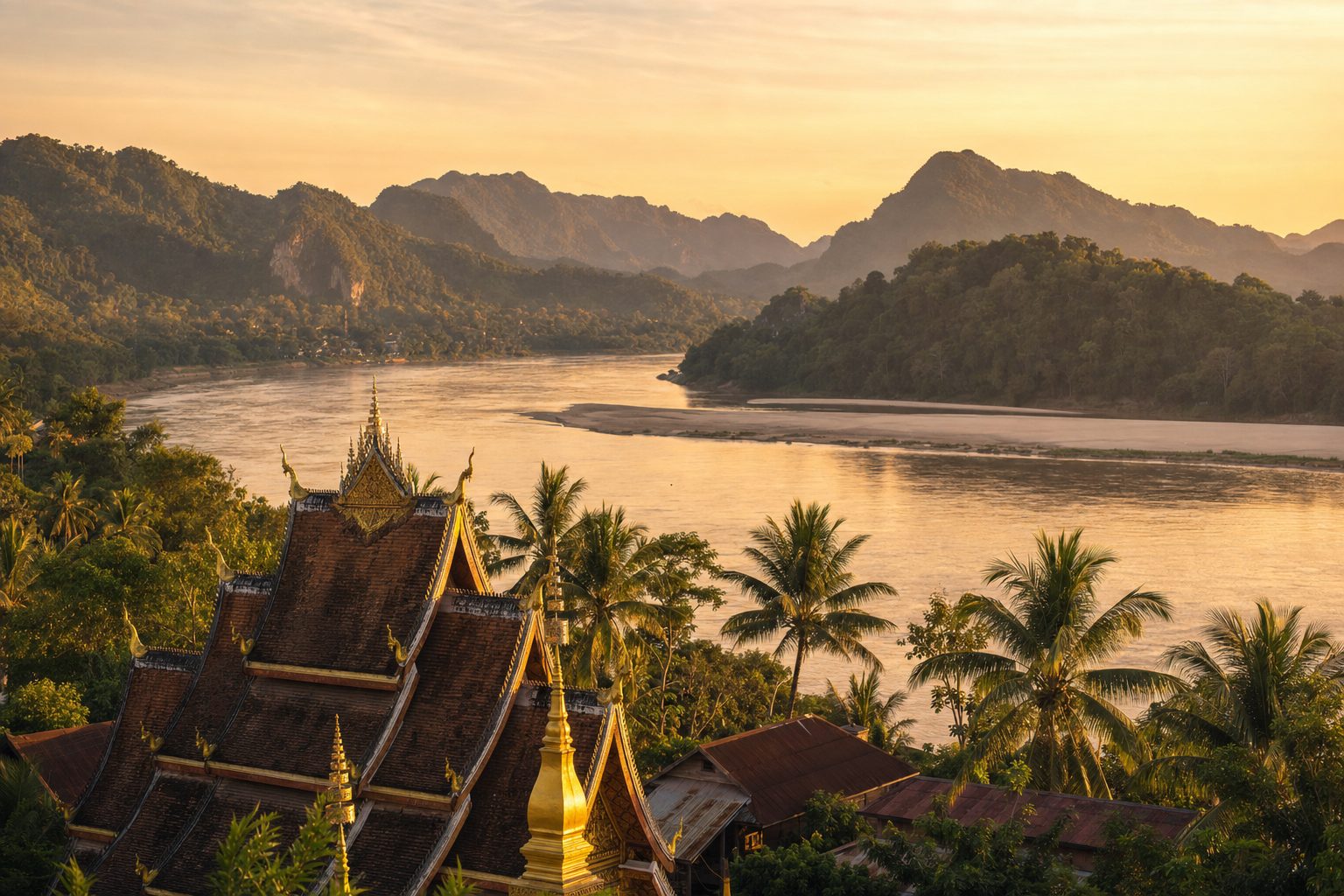

The first thing you notice in Kyoto is not a temple but a sound: the dry scuff of a bamboo broom on gravel, somewhere behind a wall you cannot see over. For eleven centuries this was Japan's imperial capital, and the city still moves to the rhythm of that older time — the shuffle of geta over cobbles in Gion, the clap of hands before a shrine, the hiss of dashi coming to temperature in a kitchen at dawn. Kyoto rewards the traveller who slows down, because almost everything worth seeing here was built to be looked at slowly.
To understand Kyoto is to understand that its temples and its food are the same project by different means. Both are exercises in seasonality, restraint and the careful framing of beauty. The moss garden and the lacquer bowl, the raked stones and the single grilled river fish — each is an argument that less, arranged perfectly, is more. Spend a few days here and you begin to eat the way you look, and look the way you eat.
Getting there and getting around
Kyoto sits at the heart of the Kansai region, a little over two hours from Tokyo on the Tokaido Shinkansen and roughly 75 minutes by train from Kansai International Airport. The city itself is best understood as a grid laid against hills: the mountains rise to the east, north and west, and most of the great temples cling to those slopes while the flat centre holds the markets, the machiya townhouses and the tangle of dining lanes. Buses reach everywhere but crawl in traffic; the two subway lines and the JR loop are faster, and for the temple districts of Higashiyama and Arashiyama a bicycle or your own two feet will serve you best.
A useful mental map: Higashiyama in the east for the postcard temples and Gion's teahouses; the central wards of Nakagyo and Shimogyo for Nishiki Market and the dining warrens of Pontocho and Kiyamachi; Arashiyama to the west for bamboo and riverside ryotei; and the southern edge of the city for Fushimi Inari. You can string a temple morning and a market afternoon together without ever feeling rushed.
The temples: a short course in looking
Begin, as the guidebooks insist and for once are right, with the Golden Pavilion. Kinkaku-ji was first built in 1397 as the retirement villa of the shogun Ashikaga Yoshimitsu and converted to a Zen temple after his death; its upper floors are sheathed in gold leaf, and on a still morning the whole thing doubles itself in the mirror pond below. It is the survivor of a lost estate and a lesson in how Kyoto turns power into serenity.

Kinkaku-ji was designated a UNESCO World Heritage Site in 1994 and is an official National Special Historic Site of Japan; the Golden Pavilion is the only surviving building from the original 14th-century estate. [1]
South of the city, Fushimi Inari Taisha is the antidote to any temple fatigue. Dedicated to Inari, the Shinto deity of rice and prosperity, its trails climb the wooded slope of Mount Inari beneath thousands of vermilion torii gates, each donated by a family or a business and inscribed on the reverse with the donor's name. Come at dawn — the grounds never close — and you can have the lower tunnels almost to yourself before the day-trippers arrive.
Fushimi Inari Taisha is one of Kyoto's oldest shrines, with its first buildings dating to 711 on the nearby Inariyama hill, founded by the Hata clan to enshrine the gods of rice and sake production; the grounds are open 24 hours a day. [2]
Save an afternoon for Higashiyama's slope temples — Kiyomizu-dera on its great wooden veranda, the raked-gravel Zen quiet of Ryoan-ji across town, the moss and maples of Nanzen-ji. The trick is not to tick them off but to sit in one long enough to feel the garden do its work. These places were designed for contemplation, and they reward the traveller who gives them ten unhurried minutes over the one who photographs and flees.
It helps to understand what you are looking at. Kyoto's gardens fall into a handful of grammars, and once you can read them the whole city opens up. There is the kare-sansui, the dry landscape of raked gravel and set stones perfected at Ryoan-ji, where fifteen rocks are arranged so that you can never see all of them at once — a puzzle in stone that Zen monks have contemplated for five centuries. There is the stroll garden, designed to be walked in a set sequence so that each turn reveals a composed view, as at the villa gardens of the northern hills. And there is the borrowed-scenery garden, which frames a distant mountain as if it were part of the design. None of it is accidental; every moss bank and every pine has been placed, pruned and tended for generations.
The other thing worth grasping is the layering of faith. Kyoto's great sites are a mix of Buddhist temples (-ji, -dera, -in) and Shinto shrines (-jinja, -taisha), and the two traditions have coexisted and intertwined here for well over a millennium. You will find a small Shinto shrine tucked inside a Buddhist compound, and pilgrims moving between the two without a flicker of contradiction. Understanding which is which — and the different manners each calls for, the bow and clap at a shrine, the quiet incense at a temple — turns a sightseeing tour into something closer to participation.
When to go
Kyoto has two headline seasons and both are worth the scrum. Cherry blossom arrives in late March and early April, turning the Philosopher's Path and the Kamo River banks into corridors of pale pink; the maples of Tofuku-ji and Arashiyama flame red through mid to late November. Both windows are gorgeous and crowded, and hotels book out months ahead. The knowing traveller often chooses the shoulders instead — early summer green before the rains, or the crisp clarity of early December — when the same gardens are quieter and the kaiseki kitchens are turning to hamo eel or winter crab.
Nishiki Market and the idea of Kyoto's kitchen
If the temples teach you how Kyoto looks, Nishiki Market teaches you how it eats. A narrow covered arcade running roughly 400 metres through the centre of town, it is lined end to end with stalls selling pickles, tofu, dried fish, tea, seasonal vegetables and knives. Locals call it Kyoto no daidokoro — Kyoto's kitchen — and the name is literal: for centuries this is where the city's restaurants and households bought their ingredients, kept fresh by cold groundwater beneath the street long before refrigeration existed.

Nishiki Market's roots run back around 400 years; it officially received permission from the Bakufu government to operate as a fish market in 1615, and today its narrow arcade houses roughly 130 shops, many family-operated for multiple generations. [3]
Graze rather than sit. A skewer of grilled octopus, a cube of freshly made tofu, a slice of tamagoyaki still warm from the pan, a paper cup of pickles to snack on as you walk — this is how the market is meant to be eaten. Stop at the venerable knife-maker Aritsugu, whose blades have been forged by the same lineage since the sixteenth century, even if you only intend to look. And do observe the etiquette: the arcade is too narrow to walk and eat at once, so buy, step aside, and eat where you stand.
Kaiseki, obanzai and the two ends of Kyoto cooking
Kyoto's cuisine, kyo-ryori, spans an enormous range between two poles. At the summit sits kaiseki: a multi-course seasonal meal descended from tea-ceremony cuisine and temple kitchens, served in a private tatami room over eight to fourteen exquisitely composed plates. It is expensive, formal and reservation-only, and at its finest it is among the great dining experiences on earth. In 2013 the broader tradition of washoku — Japanese food culture — was inscribed on UNESCO's Intangible Cultural Heritage list, an honour Kyoto's chefs worked hard to secure.
Kaiseki is the poetry of the seasons — you are not simply eating dinner, you are eating a particular week of a particular month that will never come again.
— Aoi Nakamura
At the other pole is obanzai, Kyoto's home-style cooking: simmered vegetables, tofu, small fish and pickles, plated without ceremony and eaten every day. Between the two lies yudofu, the silken hot-tofu dish perfected in the Buddhist kitchens around Nanzen-ji, and shojin ryori, the vegetarian temple cuisine that first shaped so much of what Kyoto considers delicious. You do not need a three-star budget to eat brilliantly here; you need only to know which door to open.
Much of what makes Kyoto cooking distinct comes down to water and geography. The city sits in a basin fed by exceptionally soft groundwater, and that water — low in minerals — is the secret behind the clarity of its dashi, the delicacy of its tofu and the smoothness of its sake and tea. Landlocked and historically far from the sea, old Kyoto also learned to prize preserved and dried ingredients, freshwater fish and, above all, vegetables: the heirloom kyo-yasai, from the knobbly ebi-imo taro to the sweet Kamo aubergine, are grown on the city's fringes and treated with the reverence other cuisines reserve for prime cuts of meat. To eat here in autumn, when the matsutake mushrooms arrive and the kitchens turn to chestnut and persimmon, is to taste a place thinking hard about a single season.
That range is also why Kyoto punches so far above its weight in the Michelin firmament — the format was born here, and the city's diners and evaluators treat it with a seriousness that no other Japanese city can match. Book the grand kaiseki houses weeks ahead through a hotel concierge; for everything else, a little patience and an early arrival will carry you a long way.
Where to Eat
Kyoto's tables run from three-Michelin-star ceremony to counter kaiseki you can afford and market stalls you eat standing up. This is a spread across the whole spectrum — book the top end well in advance, and treat the rest as an invitation to wander.

Kikunoi HontenKyo-kaiseki
The formal centre of Kyoto's kaiseki tradition, founded in 1912 in a teahouse estate in Higashiyama and run by third-generation chef Yoshihiro Murata. Named after the 'chrysanthemum well' from which its water is drawn, it has held three Michelin stars for well over a decade.
Why it’s so good: Murata was central to washoku's recognition by UNESCO and is regarded as one of the world's great custodians of Japanese cuisine; a meal here is the definitive Kyoto kaiseki experience.
Top picks: Seasonal multi-course tasting menu · Hamo (conger eel) shabu in summer · Winter crab from the Sea of Japan

Roan KikunoiModern kaiseki
Murata's more relaxed, two-Michelin-star sibling on Kiyamachi-dori, offering the same seasonal precision in a slightly less formal register, occasionally accented with Western touches like olive oil or truffle.
Why it’s so good: A way into the Kikunoi ethos at a more approachable pace and price than the flagship, while retaining the meticulous plating and hyper-seasonal ingredients.
Top picks: Counter-side seasonal kaiseki · Dashi-forward simmered courses · Lidded-bowl (wanmono) course

Giro Giro HitoshinaCasual modern kaiseki
A lively, chatty counter spot just south of Shijo serving an eight-course modern kaiseki at a fraction of the grand houses' prices, with online booking a couple of weeks out.
Why it’s so good: The best-value introduction to the kaiseki format in the city — the experience and seasonal rhythm without the several-hundred-dollar bill or the hushed formality.
Top picks: Eight-course set menu · Seasonal appetiser assortment · Grilled fish course

Nanzenji JunseiYudofu / tofu cuisine
A garden restaurant beside Nanzen-ji temple specialising in yudofu, the delicate simmered tofu perfected in the surrounding Zen kitchens, served in a historic setting.
Why it’s so good: The classic place to taste Kyoto's Buddhist-rooted tofu tradition; the pairing of a Higashiyama temple morning with a yudofu lunch here is one of the city's quintessential experiences.
Top picks: Yudofu (simmered tofu) set · Tofu-based multi-dish courses · Seasonal vegetable tempura

MenamiObanzai
A long-running obanzai counter on Kiyamachi where the day's home-style dishes — simmered vegetables, tofu, small fish, pickles — are laid out along the bar for you to choose from.
Why it’s so good: One of the most authentic windows into how Kyoto actually eats day to day, warm and unpretentious, and a perfect counterweight to a splurge kaiseki dinner.
Top picks: Assorted obanzai from the counter · Simmered seasonal vegetables · Grilled fish of the day

Nishiki Market stalls (Aritsugu and the arcade)Market food
Not a single restaurant but the whole 400-metre arcade — grilled octopus, fresh tofu and soy milk, tamagoyaki, pickles and tea from stalls run by families for generations, plus the storied knife-maker Aritsugu.
Why it’s so good: The most immediate, hands-on taste of Kyoto's food culture, grazing your way through what has supplied the city's kitchens for four centuries.
Top picks: Tako tamago (baby octopus with quail egg) · Freshly griddled tamagoyaki · Kyoto tsukemono (pickles)
Reserve the grand rooms weeks ahead; keep the rest loose. Carry cash for the market and the smaller counters, learn the phrase for 'chef's choice,' and let the seasons — bamboo shoots in spring, hamo in summer, matsutake in autumn, crab in winter — decide the rest for you.
Sources & further reading
- 1. World History Encyclopedia — Kinkakuji
- 2. Discover Kyoto — Fushimi Inari Taisha
- 3. Wikipedia — Nishiki Market
- 4. MICHELIN Guide — Kikunoi Honten
- 5. Japan National Tourism Organization — Kikunoi
- 6. National Geographic — Where to eat in Kyoto
- 7. Asia Undiscovered — What to Eat in Kyoto
- 8. Kikunoi official site