
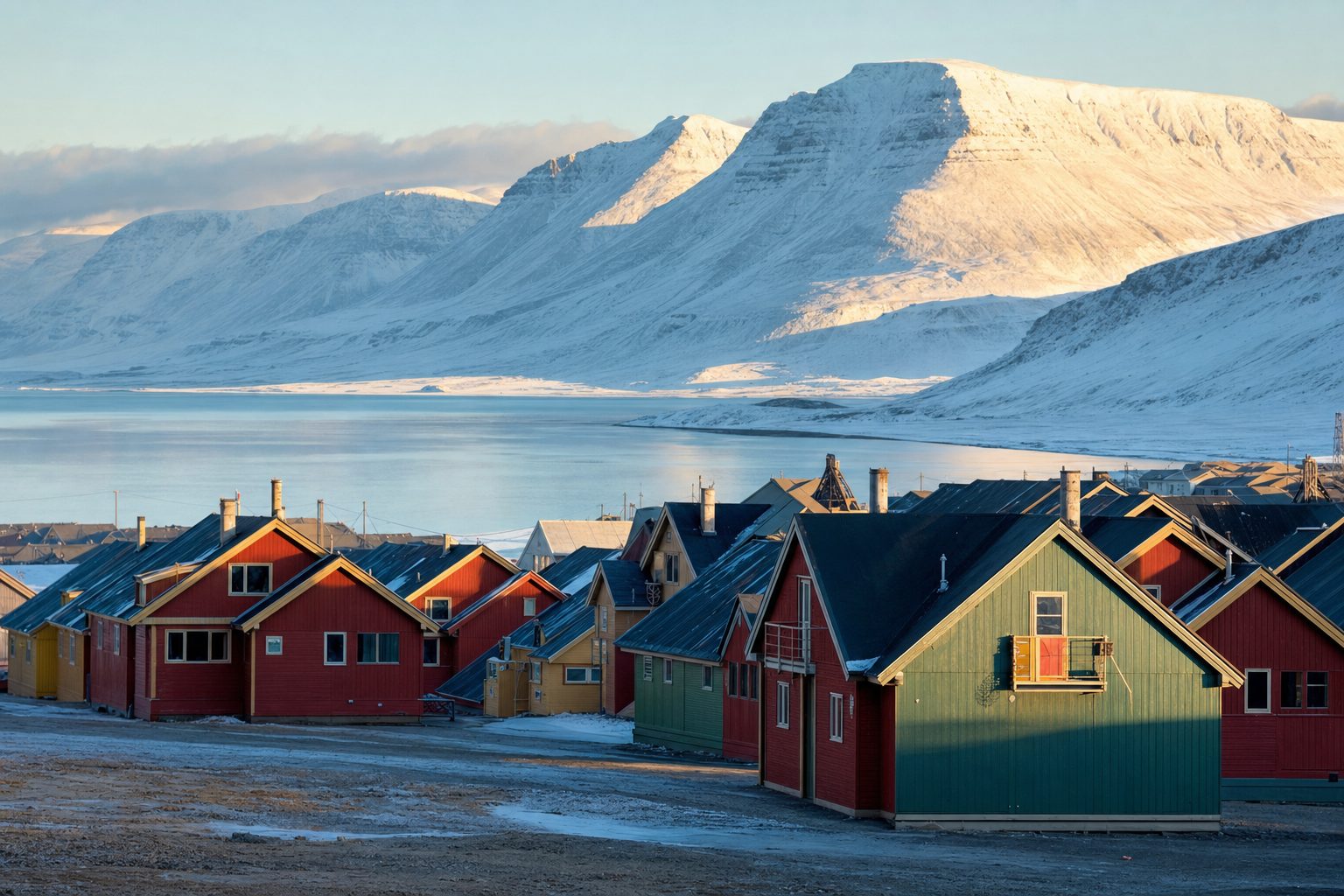
Most travel decisions come down to budget and taste. A trip to Longyearbyen comes down to something blunter: what happens the moment you step past the last streetlight. This is the only town in the world where the local government advises ordinary visitors to carry a rifle, yet forbids anyone from carrying a loaded one inside the settlement itself. That contradiction is not a quirk of local colour; it is the organising fact of any Svalbard itinerary, and it shapes where you can walk, who you should book with, and how far in advance you need to plan.
The decisions that matter here are not the usual ones about restaurants or viewpoints. They are about how you will get in and out of an archipelago with no roads to the mainland, how you will handle the polar bear question once you leave the town boundary, which of a shrinking number of landing sites your ship or tour is allowed to use, and which season's light -- endless sun or total darkness -- you actually want. Get those right first, and the rest of the trip mostly plans itself.
The polar bear rule that overrides everything else
Svalbard has roughly as many polar bears as people, and the law treats that fact as a planning constraint, not trivia. The Governor of Svalbard (Sysselmesteren) states plainly that anyone travelling outside the settlements must be equipped with suitable means of scaring off a polar bear, and separately recommends carrying a firearm for the same trips. Inside Longyearbyen, the opposite rule applies: carrying a loaded firearm within the settlement area is forbidden, weapons must be visibly unloaded, and they may not be brought into shops or public buildings. The practical result is that a weapon is treated as field equipment to be picked up on the way out of town and secured again on the way back in, never as something to walk around with on Main Street.
The Governor of Svalbard requires anyone travelling outside the settlements to carry suitable polar bear deterrents and recommends also carrying a firearm, while carrying a loaded firearm inside the Longyearbyen settlement area is forbidden. [1]
For a first-time visitor, the realistic answer to "do I need a rifle" is almost always no, because you will not be applying for a firearm and processing it through an eight-week administrative queue for a one-week holiday. Visit Svalbard's official guidance is explicit that visitors should never head outside the settlements without the necessary knowledge, deterrents and firearms, and equally explicit that the practical way most people meet that bar is by joining an organised tour with a local, experienced guide rather than arming themselves. Guides carry the rifle, know the terrain, and are trained in escalation procedures long before a weapon is ever the answer; the same guidance stresses that there is no such thing as a "polar bear safari" aimed at seeking bears out, because doing so is precisely the kind of disturbance the law is designed to prevent.
Legal distances from polar bears, and why they changed in 2025
As checked in August 2026, Svalbard has operated under a formal minimum-distance law for polar bears since it took effect on 1 January 2025: at least 300 metres from 1 July to 28 February, widening to 500 metres from 1 March to 30 June to protect bears during the denning and early cub season. If a bear is seen closer than the threshold, the person is legally obliged to retreat, a rule that does not apply inside inhabited areas or at staffed research stations and cabins. The tightening followed years of rising ship traffic and landings, and the government has said explicitly that environmental protection takes precedence over tourism interests, including the desire to get close for a photograph.
From 1 January 2025, Svalbard's legal minimum distance from a polar bear is 300 metres between 1 July and 28 February and 500 metres between 1 March and 30 June, with a legal obligation to retreat if a bear is spotted closer than that. [2]
The same package of rules reshaped ship-based tourism more broadly. Expedition operators such as Aurora Expeditions confirm that landings in protected areas are now restricted to 43 designated sites, some capping the number of people ashore at once to 39, and that no vessel carrying more than 200 passengers may land people in a protected area at all. Drones are banned outright in protected areas, and from 1 April to 31 August, vessels must also stay 500 metres from land near bird cliffs and keep to 5 knots within that zone. None of this is scenery detail: it determines which operators you can realistically book and what a day's itinerary will look like once you are aboard.
Since the 1 January 2025 rules, organised landings in Svalbard's protected areas are limited to 43 designated sites, vessels carrying more than 200 passengers may not land people there at all, and drones are prohibited throughout protected areas. [3]
- Book excursions and cruises with operators who explicitly reference the 2025 landing-site and passenger-cap rules -- it signals they are current on compliance.
- Expect wildlife viewing at a genuine distance; treat close-up polar bear photography as something that happens with a long lens, not a short walk.
- If travelling independently beyond Longyearbyen's town boundary, budget real lead time for permits, guiding, and equipment rather than assuming you can improvise on arrival.
- Check whether your route touches a bird-cliff zone between April and August, since speed and distance rules apply there on top of the polar bear rules.
Getting to Longyearbyen: flights only, and a short runway that means it
There is no ferry, train, or road connection to Svalbard from mainland Norway; the archipelago is reached exclusively by air or by cruise ship. Scheduled service runs on SAS and Norwegian from Oslo, a flight of roughly three hours, and from Tromso, roughly ninety minutes, landing at Svalbard Airport (LYR) a few kilometres outside Longyearbyen. Because Svalbard sits outside the Schengen area despite being part of Norway, direct Oslo departures use a non-Schengen gate with a passport check before boarding, and connections routed through Tromso can require disembarking for passport control there as well.
Svalbard Airport (LYR) is served only by scheduled flights from Oslo (about 3 hours) and Tromso (about 1.5 hours) on SAS and Norwegian, and is the world's northernmost airport with scheduled public air service. [5]
Once you are on the ground, the absence of roads continues inside the archipelago itself: there is no road network connecting Longyearbyen to Barentsburg, Ny-Alesund, Pyramiden or any other settlement. Movement between them happens by snowmobile in winter, by boat in the open-water season, or by helicopter, and each mode is gated by its own weather, ice and permit conditions. This is worth internalising before building a multi-stop Svalbard itinerary: a same-day hop between two settlements is a logistics project, not a taxi ride.
Choosing a season: midnight sun, polar night, or the shoulder in between
Svalbard's calendar swings between two extremes with almost no ordinary daylight in between. Visit Svalbard's own seasonal breakdown places the midnight sun from mid-May to late August, when the sun never sets and boat trips, hiking and kayaking run on extended daylight; the polar night settles in from mid-November into late January, when the sun does not rise at all and the town's rhythm shifts toward snowmobiling, dog sledding, and aurora viewing. Between these two poles sit the shoulder windows -- late winter's "sunny winter" from March into May, when snow cover is reliable and daylight is returning, and the shorter "golden autumn" at the end of summer.
- Mid-May to late August: midnight sun, best access for boat tours, hiking, and Isfjorden wildlife trips.
- March to mid-May: reliable snow, growing daylight, prime season for snowmobile touring and dog sledding.
- Late August to September: golden autumn light, shortening days, quieter than peak summer.
- Mid-November to late January: polar night and the best conditions for the northern lights, with activity centred on snow-based tours.
The Svalbard year divides cleanly into a polar summer built around the midnight sun, a northern lights winter built around total polar night, and a sunny winter in between when snow and returning daylight combine.
— Paraphrased from Visit Svalbard's official seasons guide
Independent travel beyond Management Area 10
Longyearbyen and the surrounding Isfjorden area fall inside what the Governor designates as the central travel area, long known as Management Area 10, where independent visitors can move without prior notice. Step outside that boundary on your own, rather than with an organised tour, and a separate set of rules applies: the Governor of Svalbard requires advance electronic notification of the trip, along with search-and-rescue insurance sized to the route, because ordinary travel insurance does not typically cover SAR operations. The Governor's office reviews the notification and specifies the required cover before issuing approval, and the insurance must remain valid for two weeks beyond the planned return date to absorb delays.
Independent travellers heading outside Svalbard's central travel area (Management Area 10) must notify the Governor of Svalbard in advance and hold search-and-rescue insurance, since ordinary travel insurance does not normally cover SAR costs, and that cover must remain valid two weeks past the planned return date. [6]
Putting together a realistic itinerary
A workable first visit runs four to six days: a buffer day either side of the flight in case of weather, a day or two based in and around Longyearbyen itself (the Svalbard Museum, the North Pole Expedition Museum, and short guided walks within the safe zone need no special equipment), and the remainder committed to one or two guided excursions -- a boat trip into Isfjorden, a snowmobile or dog-sledding day depending on season, or a multi-day expedition cruise if the landing-site rules and passenger caps suit your dates. Longer trips that push into Nordaustlandet, Barentsburg overland, or glacier country should be built around a licensed operator from the outset rather than layered on afterwards. Travellers assembling a broader Arctic-Nordic trip often pair Svalbard with the Lofoten Islands on the way north through mainland Norway, or with Ilulissat in Greenland for a second high-Arctic leg -- both share Svalbard's core planning logic of flight-only access, short booking windows, and weather that sets the real schedule, not the printed one.
Sources & further reading
- 1. Governor of Svalbard (Sysselmesteren): Firearms
- 2. Visit Svalbard: Polar bears in Svalbard
- 3. Polar Journal: Environment over tourism on Svalbard, new rules from January 2025
- 4. Aurora Expeditions: Svalbard visitation guidelines
- 5. The Hidden North: How to get to Svalbard
- 6. Governor of Svalbard: Notification, application, insurance and reporting obligations
- 7. Visit Svalbard: Seasons
- 8. Visit Svalbard: How to travel to Svalbard