The clip that brings most people here is almost silent. A line of saffron-robed monks moves barefoot along a street of teak houses and French shutters while kneeling residents place a pinch of sticky rice into each passing bowl, and nobody says a word. That is Sai Bat, the morning alms round of Luang Prabang, and it happens every day of the year in a small town in northern Laos where the Mekong and the Nam Khan meet. It is not staged for visitors, which is why how you watch matters more than where you stand.
Luang Prabang rewards a handful of decisions made before you arrive rather than an ambitious itinerary. Which season you choose decides whether Kuang Si runs turquoise or brown. Whether you fly, take the railway or ride the slow boat sets the tone of the whole trip. How you behave at dawn, in temples and at the waterfall decides whether you are a guest or an intrusion in a living religious town that has been on the UNESCO World Heritage List for three decades. This guide works through those choices, with fees and hours as checked in September 2026.
How to witness the alms round without spoiling it
Timing shifts with the light. The town's official tourism office gives the alms round as roughly 05:30 to 06:30 from March to October and 06:00 to 07:00 from November to February, with monks leaving their temples at first light and returning within the hour. The most photographed stretch is the main street of the peninsula around Wat Xieng Thong and the National Museum, and the same office is candid that these spots can be crowded and that quieter streets beyond the peninsula offer a more honest view.
The morning alms round in Luang Prabang runs daily from about 05:30 to 06:30 between March and October and from about 06:00 to 07:00 between November and February, and observers are asked to stay at least five metres from the monks. [1]
The rules are few and unambiguous. Watch in silence. Keep shoulders, chest and legs covered. Do not use flash, do not touch a monk and do not step into the path of the procession or of the people making offerings. If you want to give rice yourself, buy it early at the morning market rather than from vendors along the route, remove your shoes, and, for women, kneel with a scarf over the shoulders. Large buses are banned inside the heritage zone, and following the monks in any vehicle puts you physically above them, a serious discourtesy in Laos.
- Arrive ten minutes before the monks appear and choose a spot on the opposite pavement, at least five metres back, then stay there.
- Dress as you would for a temple: covered shoulders, covered knees, nothing that needs adjusting mid-ceremony.
- Switch your phone to silent and turn off flash before the first monk appears; no shutter sounds, no talking.
- Only make an offering if it means something to you, and buy the rice yourself at the market beforehand rather than from touts on the route.
- Never stand on a wall, step or vehicle to get a higher angle; heads should stay below the monks' heads.
When to go: dry season, green season and cold mornings
The Luang Prabang tourism office divides the year simply. November to March is mostly dry and a little cooler, and it is the period the office itself recommends for exploring. April to mid-October is what it calls the Green Season, with cooling rains, clear mountain views and full waterfalls. Within the dry months, January and February are the coldest; the official advice notes that early mornings can feel like two to five degrees, that most guesthouses have no heating, and that visitors should bring warm layers. For the alms round that means a fleece at 06:00 even when afternoons reach the high twenties.
The seasons trade against each other. Dry-season visitors get the famous milky-blue pools at Kuang Si, reliable sunsets from Phou Si and the busiest streets and highest room rates of the year, especially over Christmas, New Year and Lunar New Year. Late March and April bring heat, regional haze and the Lao New Year water festival, Pi Mai. June to September is quiet and green, the falls are loud rather than pretty, and downpours are usually short. If the turquoise water is the reason you are travelling, plan for December to February and accept the company.
Luang Prabang is an exceptional fusion of traditional Lao architecture and urban structures with those built by European colonial authorities in the nineteenth and twentieth centuries, forming a remarkably well-preserved townscape in which Buddhist practice, including the monks' morning round, remains a living tradition.
— Paraphrased from the UNESCO World Heritage listing for the Town of Luang Prabang
Getting there and getting in: visas, the railway and the airport
Most nationalities need a visa. The Lao Ministry of Foreign Affairs runs an official eVisa at laoevisa.gov.la, which asks for a passport bio page and a recent photograph, quotes a usual processing time of three working days, and lists nine designated entry points, including Luang Prabang International Airport, Vientiane's Wattay airport and the Boten railway station on the Chinese border. The approval letter is exchanged for a visa sticker on arrival, and passports must be valid for at least six months; the town's tourism office also reminds visitors to check they receive an entry stamp, because the fine for lacking one is steep. As checked in September 2026, fees are set by nationality through the portal's own calculator, and the government's tourism fee of 10,000 kip, collected electronically at the border, remains in place; confirm both before you travel.
The arrival choice is between air, rail and river. Luang Prabang's airport is about four kilometres from the centre, with a fixed-fare taxi counter by the exit charging 50,000 kip per group as of the tourism office's latest access notes; tuk-tuks are not permitted to collect passengers at the airport. Direct flights connect the town with Bangkok, Chiang Mai, Hanoi, Siem Reap and Vientiane. The Laos-China Railway, open since December 2021, has changed overland travel entirely: the intercity train covers the 238 kilometres from Vientiane in about two hours, with a stop at Vang Vieng, and the station sits roughly twelve kilometres outside town. The catch is booking: tickets are released only a few days before departure, through the LCR Ticket app or station counters, and popular departures sell out fast in high season.
The third option is the river. Boats run between Luang Prabang and the Thai border at Houayxai in two days, with a night in Pakbeng, and the tourism office describes the journey as a highlight rather than a transfer. It is slow and cold in the early morning, but it is the only way to arrive as the town was reached for centuries. If you are combining Laos with Vietnam, the Hanoi flight pairs neatly with a few days in Hoi An's lantern-lit old town, another riverside heritage site that shares Luang Prabang's scale and its evening rhythm.
The old town on foot: Wat Xieng Thong, Phou Si and the museum
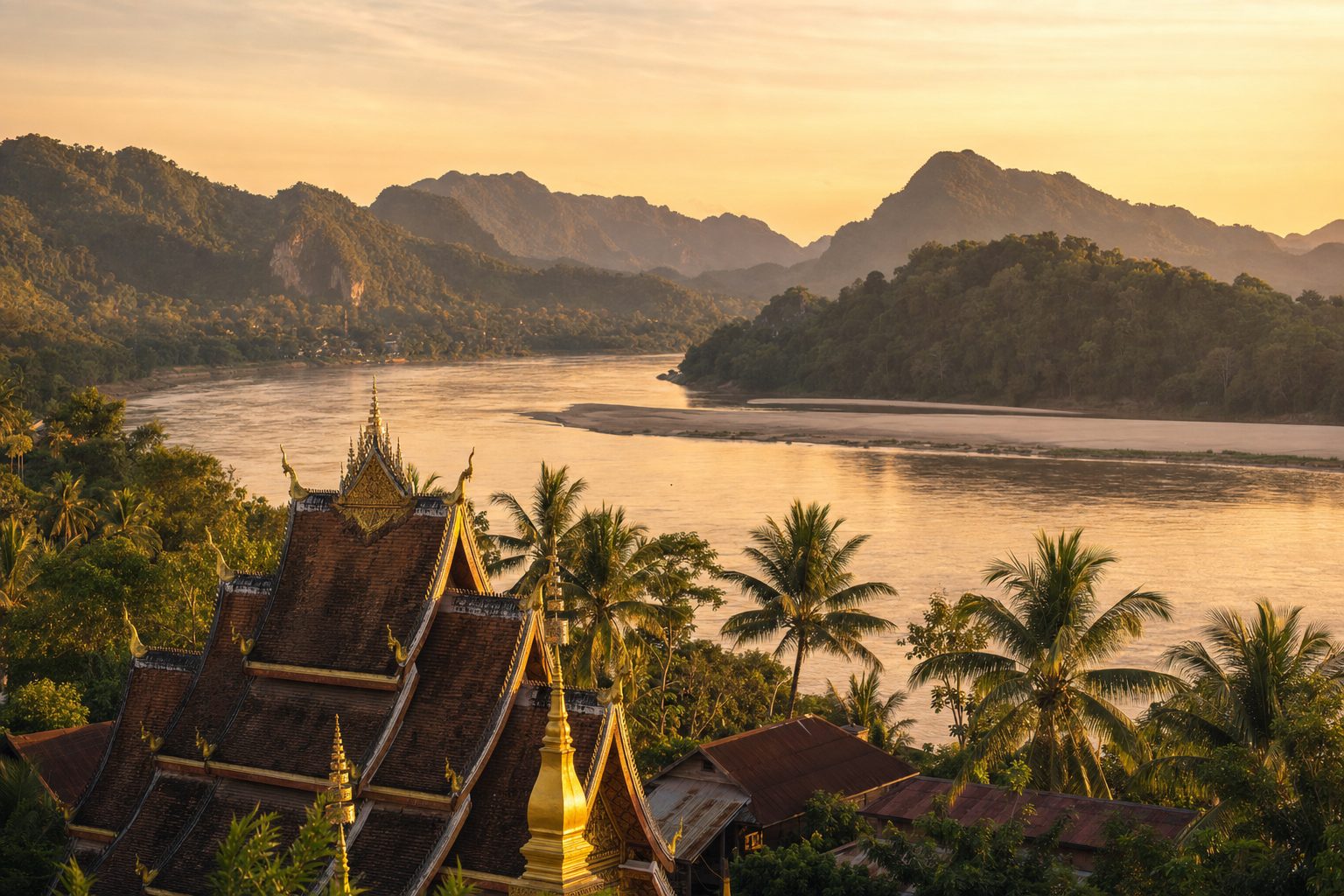
The heritage core is a peninsula barely a kilometre long, so the sensible plan is to walk it early and late and retreat from the midday heat. Start at the tip with Wat Xieng Thong, founded by King Setthathirath in 1560 and the one temple said to have survived the burning of the town in 1887. Its sim, the ordination hall, has the low, sweeping three-tiered roof that defines the Luang Prabang style, a seventeen-segment roof finial signalling royal patronage, and a rear wall covered in a glass-mosaic tree of life. It sits directly above the Mekong near the confluence with the Nam Khan, a natural place to end a late-afternoon walk.
Wat Xieng Thong was founded by King Sayasetthathirath in 1560, is open daily from 08:00 to 17:00, and charges foreign visitors 30,000 kip while Lao nationals enter free. [5]
Phou Si, the sacred hill at the centre of the peninsula, is the town's sunset ritual. The front stairway opposite the National Museum climbs 328 steps under frangipani trees to the gilded stupa of That Chomsi, built in 1804, with the Mekong on one side and the Nam Khan on the other. As checked in September 2026, the official listing gives hours of 06:00 to 18:00, varying with season, and a foreign-visitor ticket of 30,000 kip. Sunset is crowded; a sunrise climb, once the alms round is over, is far quieter and the light on the river is just as good.
Across the road is the former Royal Palace, built between 1904 and 1909 for King Sisavang Vong and turned into the National Museum in 1976. The throne room, the royal apartments and the Ho Pha Bang pavilion, completed in 2013 to house the Pha Bang Buddha from which the town takes its name, justify an hour. Hours are split around a long lunch break, roughly 08:00 to 11:30 and 13:30 to 16:00, and photography is not allowed inside. Knees and shoulders must be covered here as in every temple.
Luang Prabang was inscribed on the UNESCO World Heritage List on 9 December 1995 at the 19th session of the World Heritage Committee in Berlin. [4]
Kuang Si Waterfall: the day trip and what it costs
Kuang Si is the second reason people come, and it is a genuine half-day. The falls lie about 30 kilometres south-west of town: a main drop of around 50 metres feeding a staircase of travertine pools that turn chalky turquoise in the dry months and deep green when the monsoon swells them. Signposted pools are open for swimming, with changing rooms beside them, and a bear rescue centre inside the park is included in the ticket.
Kuang Si Waterfall is open daily from 08:00 to 17:30; as checked in September 2026 the official ticket is 60,000 kip for foreign visitors and 20,000 kip for Lao nationals, with Lao children under 12 free. [2]
Getting there is a choice between shared and private transport. Shared tuk-tuks and minivans leave from the town centre when full and cost about 60,000 kip per person for the round trip, while a private vehicle for a group runs to roughly 250,000 kip, according to the tourism office's current guidance. Cycling is possible on a rented bicycle for about 20,000 kip a day, but there are steep hills and it takes around two hours each way. Arrive at opening time for an hour before the tour groups. Swimwear etiquette is stricter than on a Thai beach: the tourism office asks visitors not to walk around shirtless or in bikini tops away from the water.
If you have a further half-day, the Pak Ou caves, roughly 25 kilometres upstream by boat, hold thousands of Buddha images in two limestone chambers above the Mekong. Heading south to Thailand afterwards, the strict visitor caps at Maya Bay show how differently a headline site can be managed.
Evenings, markets and what to eat
Every evening Sisavangvong Road, the main street, is closed to traffic from the tourism office towards the palace and given over to the night market, which runs from about 17:00 to 22:00 and gathers around 250 handicraft vendors, many of them Hmong and Khmu families from the surrounding hills. Look for hand-woven cotton and silk, mulberry-paper lanterns and indigo textiles; prices are rarely marked and haggling is gentle. Food stalls nearby sell sticky rice, grilled river fish, papaya salad and the town's signature khai paen, sheets of Mekong river weed pressed with sesame and fried, eaten with jaew bong, a smoky chilli paste.
Sunset is best watched from the Mekong bank on the peninsula's western side, where riverside terraces serve Beerlao as ferries cross to the far shore. Then comes the early close: Luang Prabang is not a nightlife town, most restaurants wind down by 22:00 and a town that rises at 05:30 for the alms round goes to bed accordingly. The morning market on the lane behind the palace, open from first light, is where residents buy the rice they offer and a better breakfast stop than any hotel buffet.
How long to stay and where it fits in a longer trip
Three full days is the right minimum: one for the peninsula, its temples and Phou Si, one for Kuang Si, and one that begins with the alms round and stays unplanned. Add a fourth for Pak Ou or a cooking class. Its pace is the point, and most visitors who allow only a night regret it. The town connects easily onwards: Hanoi and Siem Reap by direct flight, Vientiane and Vang Vieng by the two-hour train, northern Thailand by the river. For readers building a Southeast Asian heritage loop, the temples here pair naturally with the far larger complex at Angkor, where the same questions of dawn crowds, dress codes and how to behave among working monasteries arise at ten times the scale.
Sources & further reading
- 1. Tourism Luang Prabang (official) — Morning Alms (Sai Bat): times and rules
- 2. Tourism Luang Prabang (official) — Kuang Si Waterfall: hours, fees and access
- 3. UNESCO World Heritage Centre — Town of Luang Prabang
- 4. Tourism Luang Prabang (official) — UNESCO World Heritage City
- 5. Tourism Luang Prabang (official) — Wat Xiengthong: history, hours and fees
- 6. Tourism Luang Prabang (official) — Phou Si Mountain: hours, fees and the 328 steps
- 7. Tourism Luang Prabang (official) — Basic Information: seasons, currency and visas
- 8. Lao eVisa (Ministry of Foreign Affairs) — Information: ports of entry and processing