Sixty-three tombs are catalogued in the Valley of the Kings, each with a KV number. The standard ticket lets you into three of them. That one rule shapes a first visit to Luxor: which tombs to spend your punches on, whether to pay extra for Tutankhamun or Seti I, whether a Luxor Pass makes the arithmetic disappear, and how early to be at the gate.
The city that grew over ancient Thebes sits on both banks of the Nile some 700 kilometres south of Cairo, and the river is the organising principle: the east bank holds the living town, Karnak and Luxor Temple; the west bank holds the necropolis. This guide takes the decisions in order: when, how to get there, how to split the banks, what tickets cost, and how to behave.
When to go, and what the heat means for your plans
Luxor is one of the hottest and driest inhabited places on the Nile. The comfortable window runs from October to April, when daytime highs sit broadly between 22 and 28°C. December to February is peak season for cruises and hotel rates; March and April bring warmer afternoons, khamsin dust and thinner crowds.
From May to September afternoon highs regularly exceed 40°C, and the enclosed tomb corridors hold that heat. Summer travel is possible and cheap, but it means treating the day as a dawn shift: be at the Valley of the Kings when the gates open at 6am, finish the west bank by late morning, and keep Karnak and Luxor Temple, which stay open into the evening, for after 4pm.
Getting there: fly, take the sleeper, or arrive by boat
Flying is quickest: EgyptAir and Air Cairo link Cairo with Luxor International Airport (LXR) in about an hour, several times a day. The overnight sleeper is the classic alternative, run by a private operator, Abela Trains, and now departing from Cairo's new Upper Egypt (Bashtil) station, opened in October 2024, or from Giza rather than Ramses. Fares for foreigners are set in US dollars, dinner and breakfast are served in the compartment, and bookings open four to five months ahead. As checked in September 2026, budget roughly US$90–150 per person one way, and choose the refurbished Elite-class cars if offered.
The third route is the river. Cruise boats sail between Luxor and Aswan on three- or four-night itineraries via Edfu and Kom Ombo, but most allow only a day here. Adding two hotel nights before or after the sailing is the simplest way to see the tombs properly and fit in the balloon.
As checked in September 2026, British passport holders normally need a visa: an e-visa obtained in advance is valid for up to three months, or a visa on arrival costs US$30 in cash; from 1 August 2026, Cairo airport also sells digital visas on arrival for US$36 by card. Confirm the current position at GOV.UK or your own government's advice.
East bank and west bank: how to divide your days
Two full days is the realistic minimum; three lets you see the second tier of the west bank without rushing. The east bank is the town side. Karnak, built over two thousand years, needs at least two hours. Luxor Temple, compact and elegant, is best after dark, when it is lit, and the reopened Avenue of Sphinxes lets you walk between the two. The Luxor Museum on the Corniche is small and quietly excellent, opening in the morning and again in the evening.
The UNESCO World Heritage property Ancient Thebes with its Necropolis covers 7,390 hectares in three parts: the temples of Karnak and Luxor on the east bank, and a west-bank zone where the Theban Necropolis alone spans about 10 square kilometres. Karnak's Great Hypostyle Hall is 102 metres wide and 53 metres deep, its roof carried on 134 columns; those of the central nave stand 20.4 metres high. [3]
The west bank opens at 6am and closes around 5pm. The core morning is the Valley of the Kings, Hatshepsut's terraced temple at Deir el-Bahari and the Colossi of Memnon, which drivers string together in four to five hours. The second tier, worth a third day, includes the Valley of the Queens, the painted workers' tombs of Deir el-Medina, Medinet Habu, the Ramesseum and the Tombs of the Nobles. A car and driver is the standard arrangement; the public ferry costs a few pounds and takes five minutes.
One planning detail: the Avenue of Sphinxes is not separately ticketed. The Ministry's tariff sheet says you need tickets for both Karnak and Luxor Temple to walk it, so treat the avenue as the link between two paid visits.
The Avenue of Sphinxes, a 2,700-metre processional road between Luxor Temple and Karnak built under Nectanebo I about 2,400 years ago, reopened on 25 November 2021. It is lined with 1,057 recovered ram-headed and human-headed sphinxes, thought to be about a third of the original number. [4]
The Valley of the Kings: 63 tombs, three punches
The royal necropolis of the New Kingdom lies in a dry limestone valley beneath the pyramid-shaped peak of el-Qurn. Tombs were cut here for roughly five centuries, and the standard catalogue runs from KV1 to KV63. At any one time roughly eight to twelve are open, rotated so that others can rest. Your general ticket is a card with three punch-holes; each tomb costs one punch, you cannot revisit or swap a choice, and when the card is full you buy another or leave. A small tram covers the kilometre from the entrance to the tombs for a nominal fee.
Four tombs sit outside the punch system with their own tickets: Tutankhamun (KV62), Seti I (KV17), Ramses V and VI (KV9) and, in the West Valley, Ay. Seti I is the most spectacular and by far the most expensive; Ramses V and VI is the best-value add-on, with superb astronomical ceilings. Tutankhamun's own tomb is small and sparsely decorated, but it still holds the king's mummy in a climate-controlled case; his treasures, including the gold mask, are now shown at the Grand Egyptian Museum in Giza, which opened fully in November 2025. Paying the KV62 supplement is a decision about standing in the room, not about what is on the walls.
The Ministry of Tourism and Antiquities' published tariff lists the foreign-adult Valley of the Kings ticket at 750 EGP (375 EGP for students), with separate tickets for the tombs of Tutankhamun (700 EGP), Ramses V and VI (220 EGP), Seti I (2,000 EGP) and Ay (200 EGP). On the same sheet Karnak is 600 EGP, Luxor Temple 500 EGP, Hatshepsut 440 EGP, the Tomb of Nefertari 2,500 EGP and the Luxor Museum 400 EGP. [1]
Those figures match the official egymonuments.com booking page as checked in September 2026, though older guides still quote 600 EGP and prices change without much warning. Payment at the gate is in Egyptian pounds by cash or card; the premium tombs gained self-service machines in June 2026. A sensible first-timer's three are Ramses IX (KV6) for colour, Ramses III (KV11) for a long, richly carved descent, and Merenptah (KV8) for its enormous granite sarcophagus. Guides may not lecture inside the tombs, so take the briefing outside.
Tickets, the Luxor Pass and the student question
Add up two days at published rates and the case for a pass appears quickly: the main sites plus one premium tomb already run to several thousand pounds per person. The Luxor Pass is the Ministry's answer: one card, valid for five days, covering essentially every site and museum on both banks. The Standard tier excludes the painted tombs of Seti I and Nefertari; the Premium tier includes them.
The Luxor Pass is valid for five days and comes in two tiers: Standard at US$130 for adults (US$70 for those under 30 with a valid student card), covering all east- and west-bank sites except the tombs of Seti I and Nefertari, and Premium at US$250 (US$130 for eligible students), which adds those two tombs. As of the December 2025 update, prices were confirmed for 2026; the pass is sold at the Karnak and Valley of the Kings ticket offices, payable in pristine US dollars or euros, with a passport copy and photo. [6]
Whether it pays depends on the exchange rate and your appetite. As checked in September 2026, with the pound weak against the dollar, a traveller who wants only the headline sites spends less on individual tickets; one who wants Seti I and Nefertari finds the Premium pass roughly pays for itself on those two tombs alone. Bring the cash and photos from home, and check current conditions with the Ministry of Tourism and Antiquities, since eligibility and pricing have shifted more than once.
Student discounts are generous but policed: the Ministry's rules require a valid student ID and an age not exceeding 24 for half-price tickets, with an ISIC card the most widely accepted; the pass uses a threshold of under 30. Children under six enter free. Phone photography is free at Ministry sites and personal cameras are generally allowed, but flash is banned inside tombs and museums, tripods need a permit, and premium tombs may post their own restrictions.
Balloons at dawn, feluccas at dusk
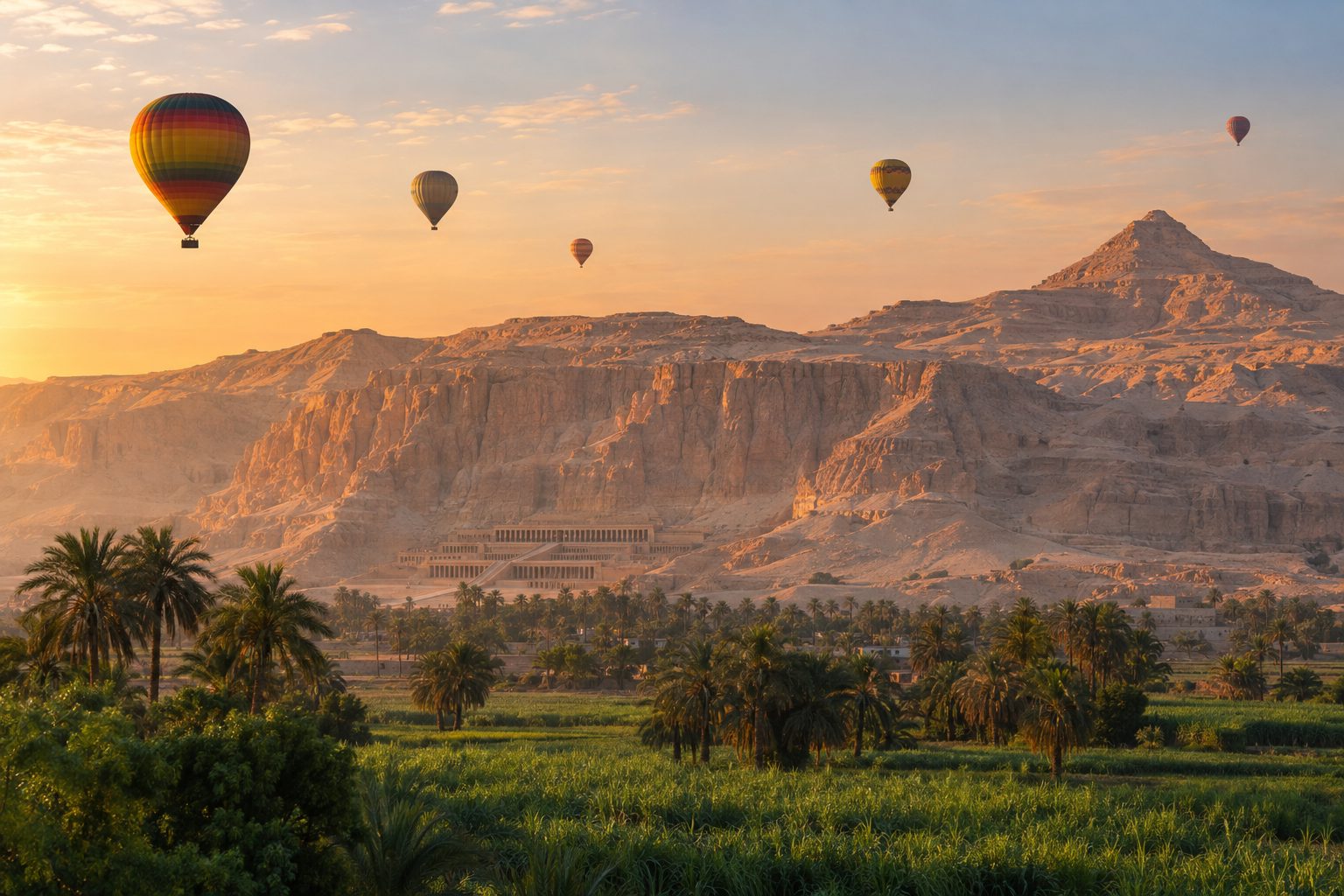
The balloon flight has become a signature of Luxor. Baskets launch from west-bank fields in the half-light and for 45 minutes to an hour you drift over sugar cane and the desert edge, with Hatshepsut's temple and the hills that hide the royal valleys below. There are typically two waves: a pick-up around 4.30am that has you airborne as the sun clears the eastern hills, and a second around 6am. Most passengers are back by 7.30am.
Flights are regulated by the Egyptian Civil Aviation Authority and grounded in winds above about eight knots, so book your first morning and keep a second in reserve. As checked in September 2026, typical prices ran from roughly US$75 to US$120 per person including transfers; the differences mostly reflect basket size and transfer reliability. Operators apply weight limits, usually 100 kilograms per passenger with a surcharge above that. If you have flown in Cappadocia, expect a similar rhythm over a flatter, far older landscape. The ritual at the other end of the day is a felucca sail from the Corniche at sunset: agree the fee per boat and the duration before you step aboard.
Etiquette, tipping and the rules that now have teeth
Luxor's sites are watched more closely than they used to be. Egypt has rolled out e-ticketing and cameras across its monuments, and the Ministry acts when rules are broken, as the August 2026 case below shows. A guard offering to open a closed chamber for a tip is offering you a poor deal and a genuine risk. Stay on the roped routes, keep your ticket until you leave, and never touch painted surfaces.
In August 2026 Egypt's Ministry of Tourism and Antiquities took legal action against security personnel at Luxor archaeological sites who had admitted a foreign content creator to tombs without tickets and to closed areas. The Ministry noted that e-ticketing was operating at 112 museums and sites nationwide, and that self-service ticketing for the tombs of Tutankhamun, Seti I and Ramses V and VI had been introduced at the Valley of the Kings in June. [5]
Tipping, or baksheesh, is woven into daily life and best handled with small Egyptian notes. Attendants who point out a detail expect a modest note, and it is fine to decline unsolicited help politely. Agree a guide's fee in advance. Dress modestly, covering shoulders and knees; add a hat, two litres of water for a west-bank morning and a small torch for the dimmer tombs.
Thebes, the city of the god Amun, was the capital of Egypt in the Middle and New Kingdoms, and its temples and palaces at Karnak and Luxor and the necropolises of the Valley of the Kings and the Valley of the Queens stand as striking testimony to Egyptian civilisation at its height.
— Paraphrased from the UNESCO World Heritage listing for Ancient Thebes with its Necropolis
- Give the Valley of the Kings your first full morning, arrive at 6am, and decide in advance which three tombs and which premium tomb you will pay for.
- If you want both Seti I and Nefertari, price the Premium Luxor Pass against the two tickets; bring crisp US dollars or euros and a passport photo.
- Reserve the balloon for your first dawn so a wind cancellation can roll to the next morning.
- Carry Egyptian pounds in small notes for the ferry, the tram, attendants and the felucca crew.
- Keep Karnak, Luxor Temple and the museum for late afternoon and evening, when the coaches have gone.
Luxor is usually one chapter of a longer route. Most pair it with two or three nights in Cairo for the Pyramids of Giza and the Grand Egyptian Museum, now home to Tutankhamun's grave goods. Southward, the cruise or day train to Aswan adds Philae and a day trip to Abu Simbel. Those heading east often carry the same appetite for carved stone to Petra and the desert of Wadi Rum, a pairing that fits neatly into a fortnight.
However you combine it, give Luxor the two or three days it asks for and organise them around the punch card. Sixty-three tombs are catalogued; you will enter three, perhaps five. Choosing them well, and being at the gate before the heat and the crowds, is the whole art.
Sources & further reading
- 1. Egyptian Ministry of Tourism and Antiquities — Ticket prices for archaeological sites and museums (Luxor tariff, November 2024)
- 2. Egymonuments.com — Valley of the Kings official ticket booking (Ministry of Tourism and Antiquities)
- 3. UNESCO World Heritage Centre — Ancient Thebes with its Necropolis
- 4. Ahram Online — Egypt reopens ancient Avenue of Sphinxes in Luxor (25 November 2021)
- 5. Ahram Online — Egypt sanctions Luxor security staff over unauthorised tomb access (August 2026)
- 6. Earth Trekkers — Luxor Pass and Cairo Pass: are they worth it? (December 2025 update)
- 7. The Man in Seat 61 — Sleeper trains from Cairo to Luxor and Aswan
- 8. GOV.UK — Egypt travel advice: entry requirements