A first Masai Mara trip comes down to three linked decisions: when to go, whether to base inside the Masai Mara National Reserve or in one of the private conservancies that ring it, and how to get there. Each choice affects the other two. Travelling for the Mara River crossings means accepting a busier reserve and paying its highest-season fees; choosing a conservancy trades some of that spectacle for lower vehicle density and activities the reserve does not allow at all. None of this is exotic knowledge, but it is scattered across operator sites and rarely laid out before someone has already booked flights.
This guide sets out the practical framework: what the reserve and its western Mara Triangle sector actually cost in 2026, how the conservancy system differs from reserve rules on vehicles and driving, when the wildebeest herds are most likely to be crossing the river, and how to weigh a scheduled flight from Nairobi against a long day's drive. It also flags where the Mara diverges from its ecological twin across the border, the Serengeti in Tanzania, since travellers often conflate the two parks when in fact they sit under different governments, fee systems, and management rules.
When to go: the migration window versus the rest of the year
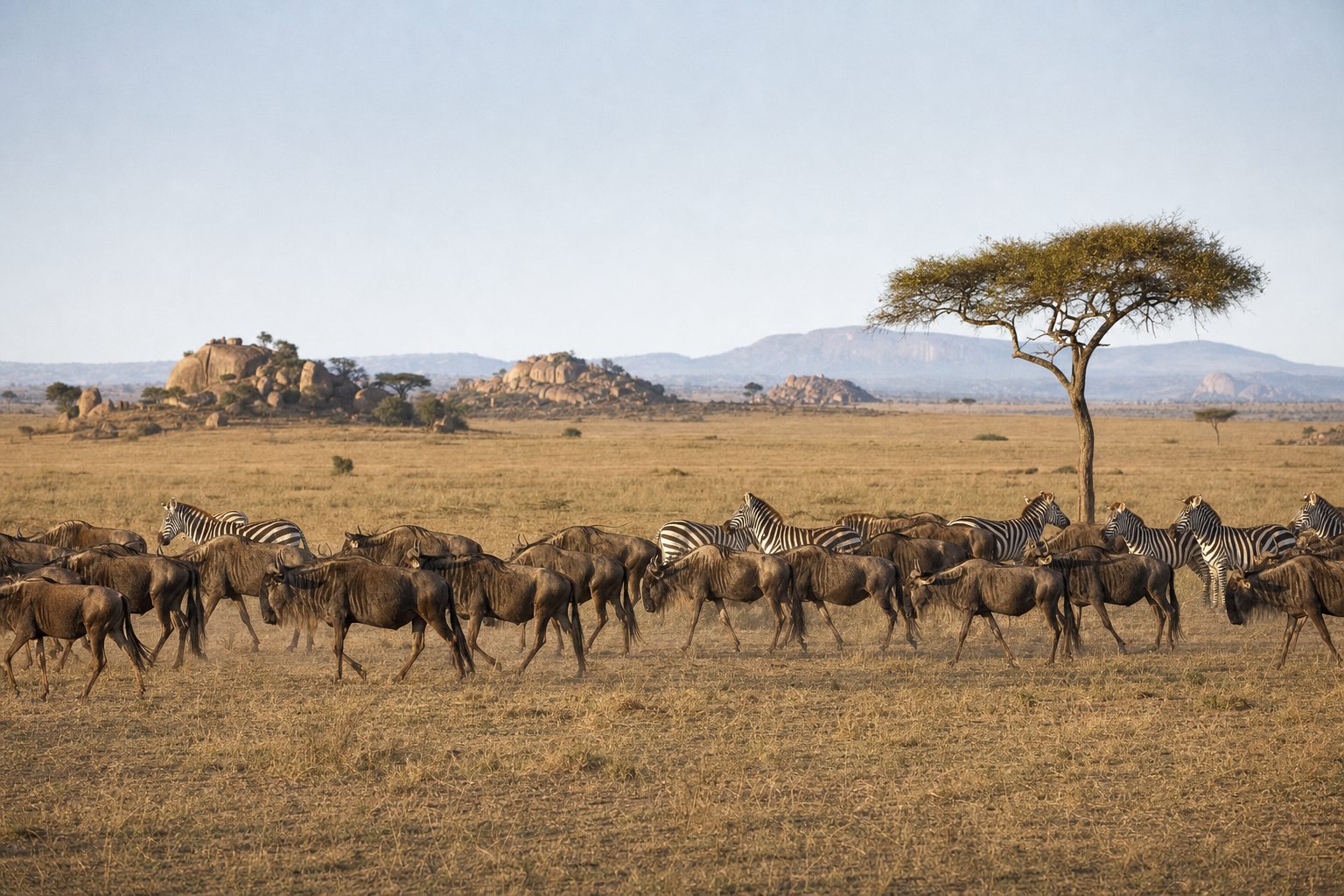
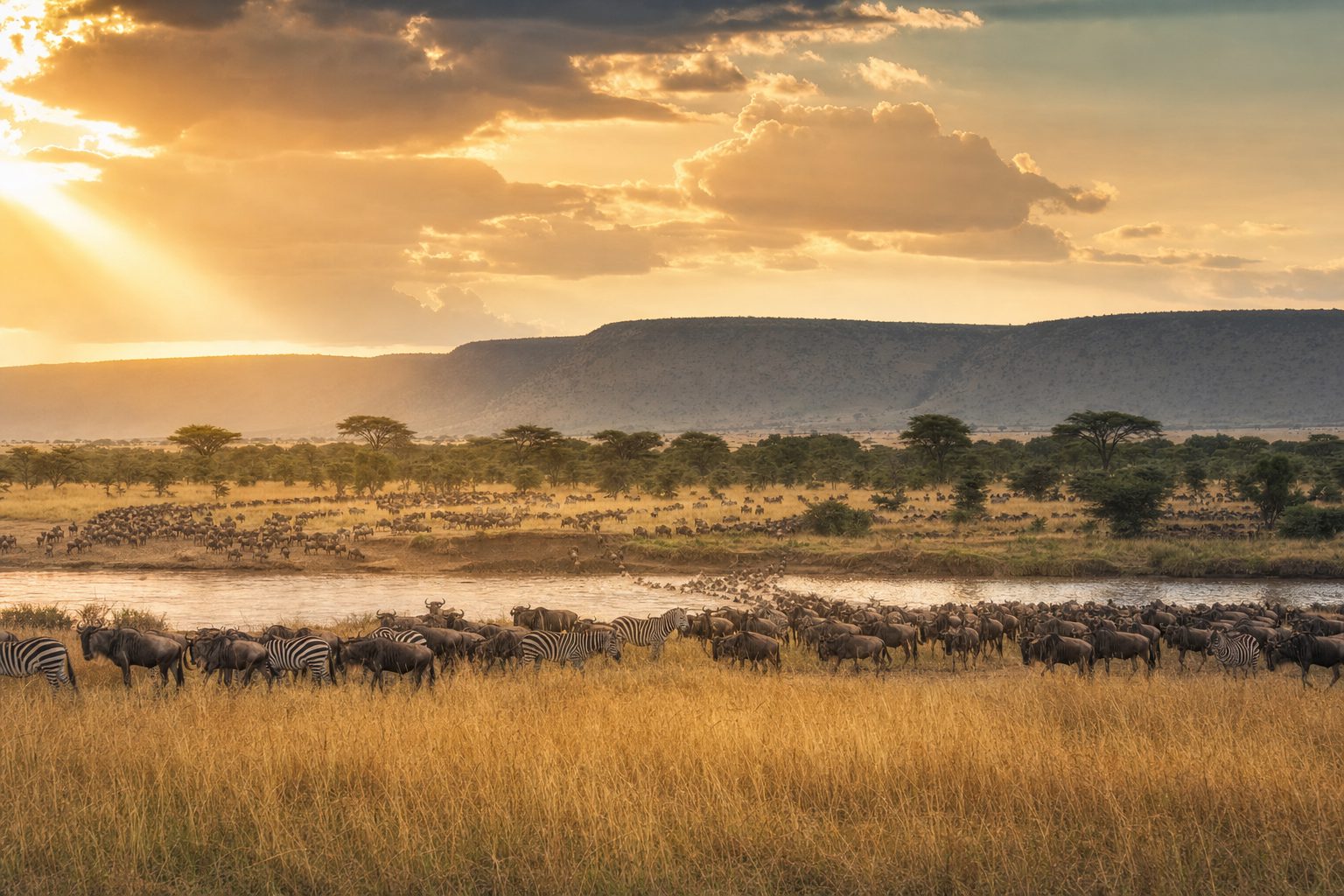
The Masai Mara has resident wildlife year-round, but the reason most first-time visitors choose July through October is the Great Migration: over a million wildebeest, plus large numbers of zebra, moving north from Tanzania's Serengeti in search of grazing, before turning back south later in the year. Herds typically start arriving in the Mara from mid-to-late July, with the Mara River crossings, the single most sought-after sighting in East African safari travel, running most frequently through August and September. By October the animals begin dispersing and drifting back toward the Serengeti as short rains return south of the border. Anyone planning specifically around crossings should build in four to five nights near the Mara River itself, since crossings happen on their own schedule and are not guaranteed on any single day.
Outside the migration window, the Mara is quieter, cheaper, and still productive for general game viewing, since resident lion, elephant, and buffalo populations do not leave with the wildebeest. Green-season months (roughly November to June, excluding a short dry spell) bring lower reserve fees, better photography light in places, and none of the crowding that builds up around crossing points in high season.
Reserve versus conservancy: the choice that shapes everything else
The Masai Mara National Reserve itself is managed jointly by Narok County Government (covering the Sekenani, Talek, Musiara and Oloolaimutia gates) and the Mara Conservancy, which runs the western Mara Triangle sector reached via Oloololo Gate, Purungat Bridge, or Serena Airstrip. Surrounding the reserve on private and community land is a separate system of conservancies, including Naboisho, Mara North, and Olare Motorogi, each leased from Maasai landowners and run by camp operators under their own rules rather than county regulation.
Inside the reserve, private vehicles have been phased out under the current management plan, and only licensed tour vehicles with certified guides operate; off-road driving and night drives are not permitted anywhere in the reserve. Reserve rules cap game-viewing crowding at five vehicles per sighting, with vehicles beyond that limit expected to wait 100 metres back, though during peak migration crossings this limit is difficult to enforce in practice and considerably more vehicles can gather at a single crossing point.
As checked in July 2026, the Mara Conservancy's official park rules for the Mara Triangle state that when more than five vehicles are waiting to view an animal, viewing time is restricted to ten minutes and waiting vehicles must remain 100 metres away. [1]
Conservancies operate under separate, generally stricter, membership-based access: only guests staying at partner camps may enter, which keeps overall vehicle numbers down independent of any per-sighting cap. Mara North Conservancy's own code of conduct permits no more than five vehicles at a sighting, mirrors the reserve's cap on paper, but achieves lower real-world density because day-trippers and outside operators cannot enter at all. Naboisho Conservancy, roughly 50,000 acres and established in 2010 on land leased from Maasai group ranches, restricts game drives to its own registered guides and sets a minimum wildlife-viewing distance of 20 metres, tighter than the reserve's convention. Conservancies also typically permit night drives, off-road tracking, and walking safaris with an armed guide, none of which the national reserve allows.
Naboisho Conservancy describes its access rules as existing to protect wildlife and the environment while ensuring visitors have the most rewarding game experience possible, noting this is achieved by limiting the number of cars at any sighting and restricting game drives to guides based within the conservancy itself.
— Paraphrased from Mara Naboisho Conservancy's official activities page
What it costs: 2026 park fees and the cashless Mara Triangle
Reserve entry fees are seasonal and paid per person, per 12-hour ticket valid from 6am to 6pm on the day of entry; the ticket does not carry over past 6pm. For 2026, non-resident adult fees are set at USD 100 per day from January through June, rising to USD 200 per day from July through December, the period that overlaps almost entirely with migration season. Non-resident children aged 9 to 17 pay USD 50 year-round, and children 8 and under enter free. These rates apply at both the Narok County gates (Sekenani, Talek, Musiara, Oloolaimutia) and the Mara Conservancy's western Mara Triangle sector.
As checked in July 2026, non-resident adult park entry fees for the Masai Mara National Reserve, including the Mara Triangle, are USD 100 per day from 1 January to 30 June 2026 and USD 200 per day from 1 July to 31 December 2026, with non-resident children charged USD 50 per day. [7]
The clearest operational difference between the two management areas is payment method. Narok County's gates still accept cash in US dollars or Kenyan shillings alongside card and mobile-money options. The Mara Triangle, run separately by the Mara Conservancy, does not: it accepts only cashless payment, via Visa, Mastercard, or M-Pesa mobile money, and its own guidance states plainly that cash is not accepted for park fees at all. Travellers entering via Oloololo Gate, Purungat Bridge, or landing at Serena Airstrip should arrive with a working card or mobile-money option rather than assuming dollars will do.
As checked in July 2026, the Mara Conservancy states on its official conservation fees page that it does not accept cash for park fee payment in the Mara Triangle and requires cashless transactions via M-Pesa or credit card. [2]
- Carry a passport, not a driving licence, for identity checks at any gate; unverifiable identity defaults to the non-resident rate.
- If staying in the Mara Triangle but routed through Sekenani Gate, do not pay at Sekenani; fees are settled on entering the Triangle itself at Purungat Bridge.
- Bring a card or mobile-money option specifically for Mara Triangle entry, since cash is refused there even if you are carrying dollars.
- Budget the higher July-December rate if any part of your stay falls after 1 July, even if you booked before the season change.
- Confirm with your camp in advance whether park fees are included in your rate or billed separately on arrival.
Getting there: fly-in versus the drive from Nairobi
Most non-resident visitors choose between a scheduled flight from Nairobi's Wilson Airport and a road transfer. Flights run roughly 45 minutes to an hour depending on the airstrip and any additional stops, with several operators running twice-daily return schedules to the main Mara airstrips. Driving covers about 225 to 275 kilometres depending on which gate is used, and typically takes five and a half to six and a half hours; the route to the Narok-side gates is now tarred for most of its length, though the final stretch into the reserve, roughly the last hour, runs on gravel and can be rough, while the road to the western Musiara and Oloololo gates is rougher still and best suited to a 4x4.
As checked in July 2026, road transfers from Nairobi to Masai Mara gates cover roughly 225 to 275 kilometres and take about five and a half to six and a half hours depending on the entry gate, while scheduled flights from Wilson Airport take approximately 45 minutes to one hour. [8]
Balloon safaris and the fee that catches people out
A pre-dawn hot air balloon flight followed by a champagne bush breakfast is one of the most widely marketed Mara experiences, and Magical Kenya's official tourism site lists it among its recommended Mara activities alongside walking safaris, night game drives, and cultural visits to a Maasai manyatta. What is less consistently advertised is that balloons take off and land inside the national reserve boundary, which means a balloon morning constitutes reserve entry in its own right, even for guests based in a conservancy that never otherwise enters the reserve. That entry is billed at the same seasonal non-resident rate as any other reserve day, and whether it is bundled into your balloon operator's quoted price varies; it is worth confirming in writing before paying rather than discovering the gap at the gate.
The flight itself typically covers about an hour in the air from first light, with shared-basket pricing in the region of USD 450 to 600 per adult depending on the operator and season, and higher rates common in the July-to-October peak window when demand is highest. Private baskets cost considerably more and suit groups wanting the whole flight to themselves.
How the Mara differs from the Serengeti
Travellers frequently plan the Mara and the Serengeti as a single ecosystem, which is ecologically true but administratively misleading. They sit in different countries with separate governments, fee structures, and entry logistics: Kenya's Masai Mara is managed jointly by Narok County and the Mara Conservancy under the fee and cashless rules described above, while Tanzania's Serengeti National Park operates under its own park authority, fee schedule, and seasonal patterns, covered in detail in the Serengeti safari guide. The migration itself moves between the two, generally in the Serengeti for the first half of the year and pushing into the Mara from around July, so the choice of which park to prioritise often comes down to which months you can actually travel, rather than a preference for one landscape over the other.
Crossing between the two by land is not a same-day option given border logistics and drive times; travellers wanting both typically treat them as two distinct legs of a longer Kenya-Tanzania itinerary rather than a single loop.
Planning the length and shape of your stay
A minimum worthwhile Mara stay runs three nights, enough for four or five game drives and a realistic chance at strong sightings even outside migration season. For migration-focused trips, four to five nights near the Mara River improve the odds of catching an actual crossing, since they happen irregularly rather than on a fixed timetable and a single-night stopover can easily miss the action entirely. Combining two bases, a night or two in the reserve near the river during peak crossing weeks, followed by a few nights in a conservancy such as Naboisho or Olare Motorogi for quieter, more flexible game drives, is a common way to get both the spectacle and the calmer wildlife-watching conservancies are built for. Anyone extending a Kenya trip afterward with beach time might reasonably pair the Mara with the coast, along similar lines to how travellers combine Zanzibar's beaches with an East African safari, or look south to the Cape Town and Garden Route guide for a very different second stop on the same continent.
Sources & further reading
- 1. Mara Conservancy: Park Rules (Mara Triangle)
- 2. Mara Conservancy: Conservation Fees
- 3. Magical Kenya: Maasai Mara
- 4. Mara Naboisho Conservancy: About Us
- 5. Mara Naboisho Conservancy: Activities and Game-Viewing Rules
- 6. Mara North Conservancy: Game Drive Etiquette
- 7. Masai Mara Reserve Entry Fees & Park Rules (2026)
- 8. Nairobi to Masai Mara by Road & Air