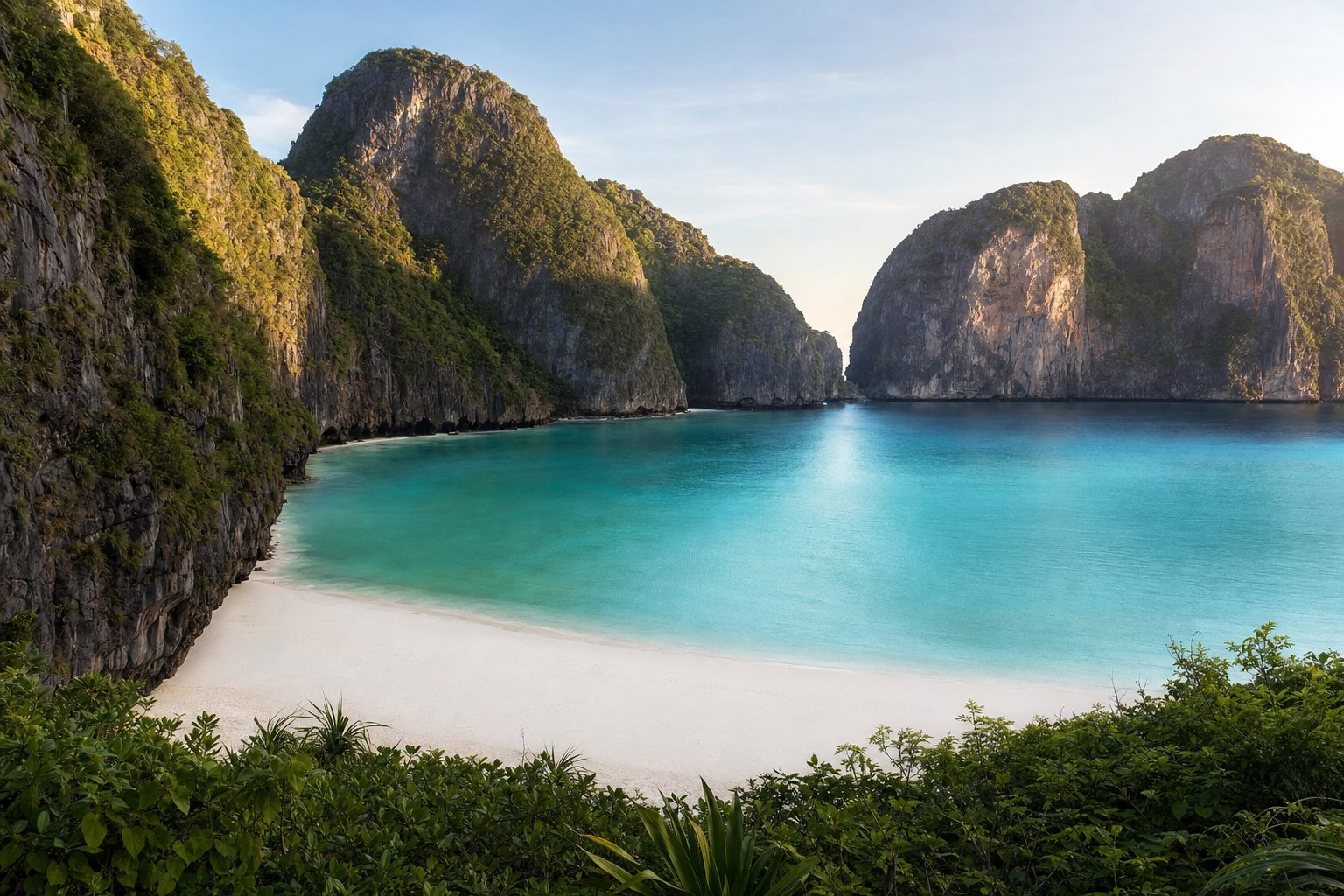
Maya Bay looks like an easy beach stop: boats, pale sand and a swim between Phi Phi islands. It no longer works that way. A first visit turns on a few decisions: whether dates sit outside the annual closure, whether to leave from Ko Phi Phi Don or join a tour from Phuket or Krabi, and whether a brief, dry beach visit is enough. The conservation system is not fine print added to the beach; it is the current experience.
As checked in August 2026, Maya Bay is closed to landings from 1 August through 30 September 2026 and reopens on 1 October. During that period, a Phi Phi tour may continue with stops such as Bamboo Island or Pileh Lagoon, but it cannot enter the bay; it may only be viewed from the water at a distance. Travellers booking chiefly for the beach should move the trip to October or later. Confirm the latest annual closure notice and the operator’s live itinerary before paying, since rough southwest-monsoon seas can also stop landings outside the scheduled break.
Let the annual closure decide the trip dates
The calendar distinction is simple. November to April is the usual window for calmer Andaman Sea conditions and clearer visibility; February to April is also busiest. August and September are different: the national-park closure takes Maya Bay out of the landing itinerary entirely. A visitor travelling then can still choose a Phi Phi boat day, but should choose it for the other islands and lagoons, not as a substitute for stepping on to Maya Bay. That framing prevents the most avoidable disappointment on this coast.
Maya Bay is closed to visitor landings each year from 1 August to 30 September for coral and beach recovery during the southwest monsoon. In 2026, the closure began on 1 August and the bay reopens on 1 October. [1]
The rules make more sense against the recent history. Visitor pressure reached roughly 5,000 people a day before Maya Bay closed in June 2018. What began as a four-month intervention was extended, and the beach reopened in January 2022 after about three and a half years of reef and beach rehabilitation. The post-reopening visit is therefore deliberately limited, not rebuilt around boats, crowds and unrestricted water access. The relevant question is whether a structured hour on a recovering coast is valuable enough to shape the trip around.
Maya Bay’s closure and managed reopening show a tourism model in which access is allowed only alongside reef and beach recovery, rather than at the expense of it.
— Paraphrased from CNN Travel reporting on Maya Bay’s recovery and reopening
For many travellers, the answer is yes, provided the visit is given the right role. This is a protected beach reached under a system, not a place to claim for an afternoon. Book the date around its opening, accept the landing limit and give the tour’s other stops equal weight. If the trip cannot move beyond August or September, choose a different Phi Phi day rather than treating a distant water view as the equivalent of the beach itself.
Choose the departure point before choosing the tour
Boat is the only way in. From Ko Phi Phi Don, a longtail takes about 20 minutes to the Maya Bay area and a speedboat about 10 minutes. That makes Phi Phi Don the logical starting point for a shorter, focused outing. From Phuket, the crossing is a much larger part of the day: the bay lies about 45 kilometres away and speedboat journeys are commonly around 45 minutes. Krabi is another day-tour departure point. The sensible choice is the one that avoids adding a long transfer merely to reproduce an itinerary available from the place where you are sleeping.
A shared island-hopping package typically bundles boat travel, lunch, snorkelling stops and the Maya Bay slot. As checked in August 2026, the quoted range is generally 1,500–3,500 THB, while a private longtail from Ko Phi Phi Don is commonly about 1,500–2,500 THB return. Those are planning figures, not a promise of an identical route or inclusion: confirm whether the national-park entry fee is included, which stops depend on sea conditions, and whether the operator has a confirmed Maya Bay allocation. A low price is not helpful if the itinerary only views the bay offshore when landing was the aim.
Advance booking is the safer approach, particularly in the busier February–April period, when the available places are managed rather than infinitely expandable. Some booking channels request a passport number for the national-park slot. That is worth checking before a group commits to a non-refundable transfer. An early-morning departure is the most useful practical preference: it places the beach before later boat traffic, while still leaving room for the rest of a Phi Phi day. It is a preference, not a guarantee; the park’s capacity system, weather and the operator’s sequence remain the governing conditions.
Arrive from Loh Samah Bay and accept the one-hour visit
The defining conservation rule is physical as well as behavioural: boats do not enter or anchor in Maya Bay. Visitors land instead at Loh Samah Bay, on the back of Ko Phi Phi Leh, using a floating pier. From there, a wooden boardwalk leads through forest to the beach in roughly five to ten minutes. Build this walk into the visit rather than expecting a direct transfer from bow to sand. It explains why the old photograph of boats parked across the bay no longer describes the experience, and why a carefully timed arrival has more value than a nominally faster boat.
Under the current system, boats may not enter or anchor in Maya Bay. Visitors land at Loh Samah Bay via a floating pier and walk a wooden boardwalk through forest for about five to ten minutes to reach the beach. [3]
The time limit is part of the same design. Capacity is managed at roughly 300–380 people in an hourly slot, with an overall daily limit of about 4,125; operators and rangers keep beach time to roughly an hour. The first slot is around 07:00, and normal hours outside the annual closure are approximately 07:00–18:00. Rather than trying to extend the stop informally, use the hour well: walk in ready, take the beach in at an unhurried pace, and keep a return to the boardwalk in mind. The limited visit is the trade-off that makes the bay available at all.
Maya Bay’s managed visits allow roughly 375–380 people per one-hour slot, within a daily cap of about 4,125. Beach time is limited to about one hour, and the first slot begins at around 07:00. [3]
This is also why the small group decision matters. A private boat may change the pace between islands, but it does not remove the national-park queue, landing route or time on the beach. Conversely, a shared tour can be a sound choice if its sequence reaches the early slot and its staff are clear about the rules. Do not read “Maya Bay included” as a promise of private or unlimited access. Read it as confirmation that the operator has a place in the controlled visitor system.
See Maya Bay as a beach to visit, not a place to swim
The reel angle is literal: there are no boats in the bay and there is no swimming in it. Wading is permitted only to about knee depth. Rangers enforce that boundary, and the reported fine for repeat violations has reached 5,000 THB. The clear water can make the distinction feel counterintuitive, which is exactly why it is worth making before leaving the boat. Pack and dress for a short walk, shallow wade and observation, not for an open-water beach session. Respecting the waterline is not merely good manners; it is the core condition of access.
Swimming in Maya Bay is prohibited; visitors may wade only to roughly knee depth. Rangers enforce the restriction, and a repeat offender has been fined 5,000 THB. [4]
That does not mean leaving snorkelling out of the day. It means locating it correctly. Snorkelling is done from boats or pontoons outside Maya Bay, including nearby areas such as Loh Samah and Pileh Lagoon. Decide in advance which experience is the priority: the protected beach is a short, land-based stop; the water time belongs to the designated snorkelling stops. This division usually produces a better day than trying to bend the rules at the beach and it lets a guide choose conditions appropriate to the water activity rather than forcing it into the bay.
The same logic applies to what goes in the bag. Drones, standing on coral, collecting shells, littering and anchoring in coral zones are prohibited, and the visitor guidance also rules out non-reef-safe sunscreen. Bring drinking water if the operator allows it, take every item back out, and ask about reef-safe sun protection before departure rather than applying a product on the pier. The rules can feel numerous when listed together, but on site they reduce to a clear idea: keep contact light, keep the beach clean, and let the park’s designated routes do the work of protecting the place.
Use the season to set expectations, not just a weather forecast
For a first visit built around reliable access, November to April is the stronger choice. Calmer Andaman Sea conditions and clearer visibility make it easier for a boat itinerary to work as planned, although February to April brings the most demand. Book one to two weeks ahead if those months are the only available dates, particularly when an early Maya Bay slot matters. That lead time should be used to check what the price includes, submit any information requested for the park allocation and choose a refundable option where practical, rather than assuming the beach itself can be booked on arrival.
May to October is more exposed to rough monsoon seas, which can affect day-to-day landing decisions even when Maya Bay is not in its fixed August–September closure. The productive way to travel in the shoulder months is to allow a buffer: avoid placing an inflexible onward connection or the only special occasion of the trip on a single boat day. Ask an operator what happens if the landing is called off after departure, and understand whether the alternative is another Phi Phi stop, a rescheduled trip or no refund. Those terms matter more than a staged itinerary description when the sea makes the final decision.
The annual closure deserves the same clarity. A tour may still run in August or September and can remain a worthwhile way to see Phi Phi’s other waters, but it is not a Maya Bay landing tour. Plan a beach-led Thailand itinerary for a later date, or move the attention to another island experience. The editorial choice is simple: let the protected beach be genuinely unavailable when it is closed, instead of treating the protection as a loophole to navigate.
Budget the park fee and travel with a conservation-ready plan
The national-park fee is separate enough to ask about explicitly. As checked in August 2026, entry is 400 THB for a foreign adult and 200 THB for a child; Thai citizens are charged 200 THB. The fee is paid in cash and is often included in a tour price, but “often” is not the same as “always”. Confirm the inclusion before booking and carry cash as a contingency, especially if the itinerary has been assembled from a boat transfer and separate park visit. Do not turn a small entrance fee into a pier-side delay for the group.
A good Maya Bay booking has fewer moving parts than it first appears. It names the departure point, confirms the landing date is outside the closure, makes the national-park fee clear, includes or accounts for the managed slot, and says which water stop replaces the forbidden swim. Everything else is secondary. The beach is still worth the journey when its limits are treated as the point: a chance to see how a celebrated shore is being used differently after a period of restoration, rather than a stage set that must reproduce an old image.
- Travel after 1 October if a Maya Bay landing is non-negotiable; the bay is closed from 1 August through 30 September 2026.
- Choose Ko Phi Phi Don for a shorter focused boat outing, or Phuket or Krabi only when their day-tour logistics fit the wider trip.
- Confirm the operator has a Maya Bay landing slot and ask whether the 400 THB foreign-adult park fee is included and how it is paid.
- Expect to land at Loh Samah Bay, walk the boardwalk and spend about one hour on the beach within the managed capacity system.
- Plan to wade only to knee depth at Maya Bay, then snorkel at a permitted stop outside the bay.
Maya Bay rewards a traveller who does less, more deliberately: one confirmed landing date, one clear understanding of the no-swim rule, and enough time for the rest of the Phi Phi waters to be more than a substitute. Its conservation-era system makes the visit different from the film-era fantasy, but not lesser. For another Southeast Asian coastal destination where the rules are part of getting the day right, continue with our El Nido planning guide; for a beach holiday shaped by a different set of managed-access decisions, compare our Boracay island guide.
Sources & further reading
- 1. Asian Trails — Annual Closure of Iconic Island Bay
- 2. CNN Travel — Maya Bay’s recovery and tourism return
- 3. Bangkok Post — Maya Bay’s visitor-management rules
- 4. Phuket 101 — Maya Bay in Phi Phi Island
- 5. Simba Sea Trips — Maya Bay reopening and visitor information
- 6. Railay Eco Tour — Maya Bay, Phi Phi Leh opening information
- 7. Beach Verdict — Maya Bay travel and boat-access guide
- 8. Maya Tour Phi Phi — Current Maya Bay access and snorkelling guidance