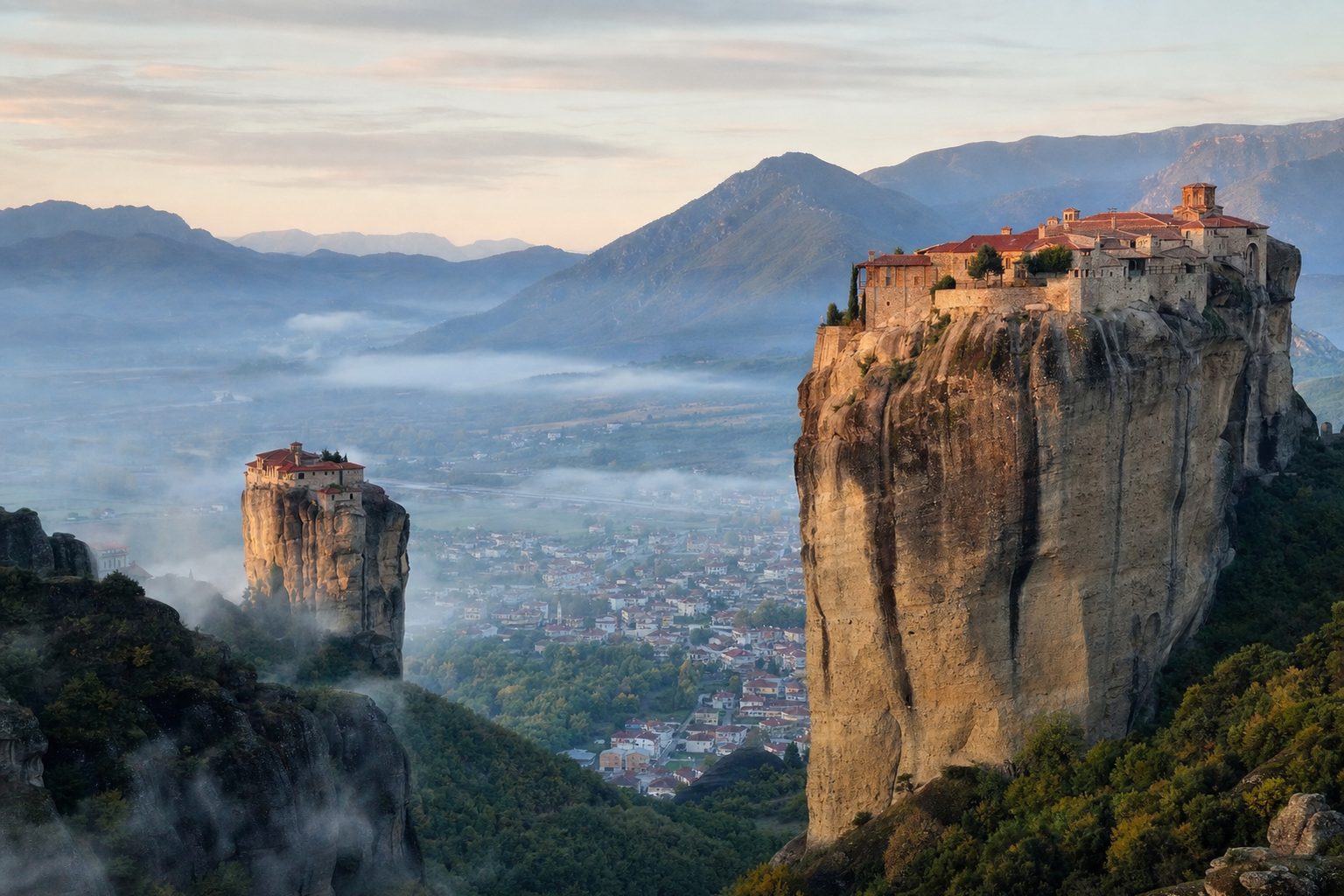
Meteora is not a place to treat as a single monument. It is a circuit of six living monasteries on sandstone pinnacles above Kalambaka and Kastraki, with separate gates, stair counts, closures and rules. The attractive part of a first visit is the contrast between rock landscape and painted church; the difficult part is choosing a day that does not leave the monastery you most wanted to see behind a locked door.
Start with the rotation, then choose a base and only then decide how many interiors to visit. The useful plan is usually two or three monasteries in a morning, unhurried viewpoints later, and a second morning if the aim is all six. That approach makes room for the dress code, cash payments and the coach traffic that can otherwise turn a short visit into a queue.
Understand what makes Meteora different
Meteora is a mixed cultural-and-natural World Heritage landscape rather than a museum complex. The six visitor monasteries sit within a much larger monastic story: hermits settled among these rocks from the eleventh century and, by the late fifteenth century, 24 monasteries had been built. The present circuit therefore rewards a little restraint. Go inside the churches to see the religious and artistic context, but leave time to look outward from the terraces and roadside belvederes.
Meteora has been on the UNESCO World Heritage List since 1988. UNESCO describes the property as monasteries on almost inaccessible sandstone peaks, with both outstanding natural beauty and post-Byzantine religious art. [1]
The six open to ordinary visitors are Great Meteoron, Varlaam, Roussanou, St Nicholas Anapafsas, Holy Trinity and St Stephen. Great Meteoron and Varlaam are the obvious first choices for a first-timer, but they also attract the biggest groups. Roussanou is compact and photogenic; Holy Trinity requires a more committed approach on foot; St Stephen is the gentlest physical access, reached over a bridge rather than by a long staircase. Do not make stair count the whole decision: a strong viewpoint day can be as satisfying as trying to tick off every interior.
The monasteries transform a dramatic natural site into places of retreat, meditation and prayer, while the rock formations remain integral to the experience.
— Paraphrased from the UNESCO World Heritage listing
Choose the day by the closing-day rotation
This is the non-negotiable part of planning. Each monastery keeps its own timetable, rather than operating as one attraction, and the published summer pattern is not a promise for a feast day or a late-season visit. The practical weekly rotation is St Stephen closed Monday, Great Meteoron Tuesday, Roussanou Wednesday, Holy Trinity Thursday, and Varlaam Friday. St Nicholas Anapafsas is commonly listed as Friday too, so Friday leaves only four of the six; it is not a day for a complete circuit. That is why the shorthand that the six have ‘different’ closing days needs checking against the current notice rather than being treated as a rule.
As checked in August 2026, the summer schedule is broadly 1 April–31 October, with most monasteries opening around 09:00 and closing between 16:00 and 17:30; Great Meteoron is published as closed Tuesdays, Roussanou Wednesdays, Holy Trinity Thursdays and St Stephen Mondays. Schedules can change without notice. [2]
In winter, shorter hours and extra closure days make a two-night stay more valuable. Great Meteoron and Varlaam in particular can lose several winter opening days, while the exact changeover dates vary. Saturdays and Sundays are useful if the priority is maximum choice, but they are not automatically quiet. Before setting out, read the current timetable, then check any notice at the first gate; Orthodox Easter, patronal feasts and operational decisions can override the standard pattern.
- Monday: start with Great Meteoron or Varlaam; St Stephen is normally shut.
- Tuesday: keep Great Meteoron for another day and use Varlaam, Roussanou and Holy Trinity instead.
- Wednesday or Thursday: the strongest weekday pair for combining Great Meteoron and Varlaam.
- Friday: treat as a viewpoint, walking or four-monastery day, because Varlaam and St Nicholas Anapafsas are commonly closed.
- Saturday or Sunday: choose these for widest access, then offset the busier atmosphere with a 09:00 start.
Carry cash and dress for a working monastery
The entry gate is a religious threshold, not a beach-side ticket booth. Bring euros in small notes, a shoulder-covering layer and clothing that will pass at every monastery you want to enter. The simplest outfit is long trousers and a T-shirt or overshirt for men; for women, a long skirt or dress with covered shoulders. Shorts, bare shoulders and sleeveless tops are liable to stop the visit before it begins. Several entrances lend wrap skirts for women, but that is a courtesy, not a reason to arrive without a compliant layer; men should not expect an equivalent workaround.
As checked in August 2026, the published per-person admission is €5 at Grand Meteoron and €3 at Varlaam, Roussanou, Holy Trinity, St Nicholas Anapafsas and St Stephen; payment is cash at the gate and there is no combined ticket. [3]
One important caveat belongs beside that budget: another local 2026 timetable lists €5 at every monastery. Fees are time-sensitive and the monasteries set them independently, so carry more cash than the €18 total implied by the €5-plus-five-€3 schedule and treat the current gate notice as definitive. Kalambaka has services and cash machines; the monastery road does not offer a reliable payment fallback. This is a modest expense, but it is inconvenient to discover after a climb.
Photography needs the same restraint. Courtyards, terraces and approaches are generally where cameras are welcome and where the landscape does most of the work. Inside churches, photographs are not allowed; museum rooms may also restrict them. Put the phone away before crossing the church door and follow the signs at each interior. That keeps the visit respectful and avoids wasting a rare quiet moment negotiating a rule that is clearly posted.
Beat the coaches without racing the site
The useful crowd strategy is early, not frantic. Be at the first monastery for its 09:00 opening, particularly if it is Great Meteoron or Varlaam. Organised day tours from Athens and Thessaloniki make the core sites busy from about 10:00; by roughly 10:30–11:00 the coach pattern is usually unmistakable. An early interior, followed by a second monastery before midday, is calmer than arriving at the marquee stop after the main group wave.
Do not try to outpace every coach on the same road. Once groups build, change the kind of visit: choose a quieter monastery, take the scenic road slowly, stop at a signed viewpoint, or pause for lunch in Kastraki. Later afternoon is useful for exterior light and less group pressure, provided the specific monastery is still open. Great Meteoron and Varlaam are the busiest; Roussanou, St Nicholas Anapafsas and Holy Trinity can feel less compressed, though none should be assumed empty in July or August.
If arriving from Athens only for the day, accept that the transport timetable works against this strategy. A coach or long drive often brings visitors to the rocks when the first gates are already busy. An overnight stay changes the equation more than an elaborate itinerary does.
Pick Kalambaka or Kastraki, then decide how to move
Kastraki is the atmospheric base: a village below the towers, close to the start of the circuit and convenient for an early car or taxi departure. Kalambaka is the practical base: it is larger, has the train station, more restaurants, shops and cash machines, and a broader spread of rooms. The towns are close enough that this is a preference rather than a sacrifice. Choose Kastraki for proximity and a village evening; choose Kalambaka if arriving by rail or if facilities matter more.
Athens is about 350 km from Meteora: published planning guidance puts the drive at roughly 3.5–4 hours, while the rail journey to Kalambaka is roughly 4.5–5 hours before the transfer to the monasteries. The six are linked by a road circuit, but several entrances still involve substantial steps. [4]
A rental car gives the cleanest early-start plan and makes it easy to swap monastery order when a gate is closed. Taxis, guided minibus tours, cycling and walking can work from either base, but build in the climb and heat rather than reading the map as if every stop were level. Rail travellers should use the Hellenic Train journey planner for the live itinerary, then arrange the final local transfer separately. The rail site lists Athens and Kalambaka but the precise service pattern should not be assumed from older travel articles.
For a wider mainland route, Meteora works best as a deliberate stop rather than a rushed detour between islands. Pairing it with a travertine landscape in Türkiye or using it to slow an unhurried Europe itinerary makes more sense than treating the monasteries as a photo break.
Choose shoulder season for the easiest version
April to June and September to October offer the best balance of access, temperature and daylight. Spring brings green to the Thessaly plain and makes the walks between viewpoints more comfortable; early autumn lowers the summer pressure without yet imposing the winter timetable. July and August can still work, but use the 09:00-first rule, protect time for shade and water, and make the evening viewpoints the visual centre of the day.
Weather also changes the order of the day. In warm months, take the longest exposed approach while the air is cool, then use the middle hours for an interior or a village lunch. In wet or foggy weather, do not assume a viewpoint will deliver the long view on cue; concentrate first on a monastery that is open, then return to the road overlooks if the cloud lifts. A compact rain layer is more useful than a rigid schedule.
November to March is not a bad choice if a quieter, moodier landscape matters more than a full collection of interiors. Fog and occasional snow can make the rocks memorable, but daylight is shorter and monastery schedules contract. Build a spare morning rather than betting the trip on one sequence of gates. Travellers drawn to lake-and-mountain shoulder seasons may find the same measured pace useful at Lake Bled, though Meteora's dress rules and closures are far more specific.
The lasting decision is to give Meteora enough time to operate on its own terms. Sleep in Kalambaka or Kastraki, choose a day after checking the rotation, arrive at the first gate at opening and carry the clothing and cash that make entry uncomplicated. After the monasteries, leave one clear evening for the sandstone skyline. From there, a slower Greek journey can continue towards the sea with the Greek islands guide, but Meteora is strongest when it is allowed its own morning.
Sources & further reading
- 1. UNESCO World Heritage Centre — Meteora
- 2. Visit Meteora — monastery opening hours and days
- 3. Maptrotting — Meteora monasteries opening hours 2026
- 4. Athens Glance — Meteora Greece visitor guide
- 5. Meteora.com — 2026 monastery timetable
- 6. Hellenic Train — journey planner
- 7. Travel Conscious — visiting Meteora