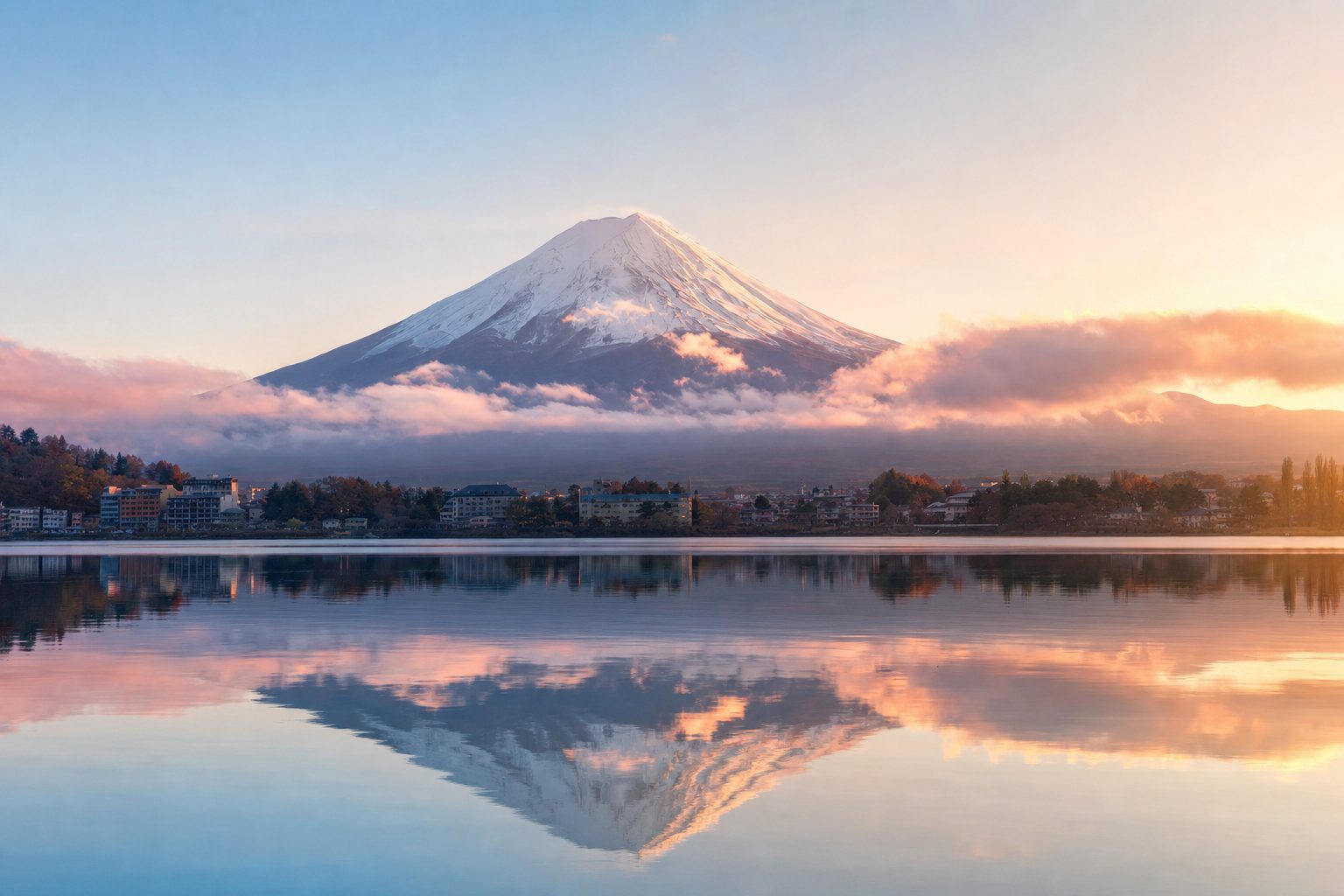
Mount Fuji looks like a single, simple cone from Tokyo. Climbing it is not a simple day out. The first decision is which side to use: busy Yoshida in Yamanashi, or Fujinomiya, Subashiri or Gotemba in Shizuoka. The next is more pressing in 2026: each approach has a controlled-entry system, a 4,000-yen hiking fee and a rule intended to stop people forcing an overnight ascent without a proper rest.
For most first-time visitors, the sensible version is a daylight start, an overnight mountain-hut booking and a summit attempt after rest. A fit walker can make a day ascent, but the gate clock, weather and altitude leave little margin. This guide separates the rules from the route choice, so that the famous sunrise is a plan rather than a reason to take an unsafe shortcut.
Start with the 2026 season and the rule that changes everything
The climb only belongs in a summer Japan itinerary. Paths, huts, transport and safety arrangements are geared to a short official season; beyond it, snow, ice, closures and rescue limitations make an apparently clear forecast a poor substitute for an open route. Do not equate a view from a fifth station with permission to continue uphill. The rules begin at the trail entry point, while fifth-station sightseeing outside the Yoshida gate is treated separately.
As checked in August 2026, the Yoshida Trail season runs from 1 July to 10 September, subject to a possible delayed start for weather or remaining snow. The official site says summit access is not permitted until 30 June, provisionally. [1]
The reel-friendly number is real but it applies specifically to Yoshida. Its fifth-station gate closes from 2pm until 3am the next day and also closes when 4,000 climbers have entered. The design is to deter bullet climbing: an all-night push to the summit without a mountain-hut stay, often made with too little rest, inadequate clothing and little time to adjust to altitude. It is not a ban on ambition; it is a demand to match the mountain with a credible plan.
As checked in August 2026, Yoshida Trail entry is limited to 4,000 climbers a day. Once that number is reached, climbers without advance passage reservations cannot enter; the gate is normally closed from 2pm to 3am, but confirmed mountain-hut guests may pass during a restriction. [1]
A hut booking is not the same thing as a Yoshida passage reservation. Reserve the bed directly with the hut first, then treat it as the evidence that allows a late passage if necessary. The official guidance still asks hut guests to arrive before 2pm where possible, because every hut has its own check-in arrangements. A reservation does not turn a late, exhausted or badly equipped ascent into a good idea. If transport delay makes that the only plan, postpone rather than race the clock.
Choose Yoshida for facilities, or a Shizuoka trail for a different climb
Yoshida is the practical first choice for many visitors coming from Tokyo or the Fuji Five Lakes. Its Fuji-Subaru Line fifth station sits at 2,305 metres, the ascent is 6.8 kilometres and the official estimate is about six hours up and four down. There are numerous huts and services on the climbing route, which makes it the easiest option to organise but also the one most likely to feel crowded. Build the itinerary around a booked hut, rather than assuming a same-day sunrise push will be comfortable.
Fujinomiya is the short, steep alternative from the Shizuoka side. Its fifth station is higher, at 2,400 metres; the official estimate is around five hours up and three down over a rocky route. It suits a walker who values a shorter summit day and can manage steep ground, but ascent and descent share the same line, so patience matters in busy weather. It is not a loophole around regulation: the Shizuoka system has its own entry process and fee.
Subashiri begins lower, at 2,000 metres, and starts through forest before the route joins the upper mountain; expect roughly seven hours up and four down. It is a good middle option for someone who prefers a less developed first stretch but still wants a conventional fifth-station start. Gotemba is for walkers who actively want a longer, quieter challenge, not merely fewer people. From 1,440 metres, it is the longest approach: about nine hours up and four down, with sparse early facilities and volcanic gravel underfoot.
The official route guide lists four trails: Yoshida, Fujinomiya, Subashiri and Gotemba. Its standard ascent estimates are about 6, 5, 7 and 9 hours respectively from their fifth stations; the stated trailhead elevations range from 1,440 metres on Gotemba to 2,400 metres on Fujinomiya. [2]
- Choose Yoshida for the deepest hut and service network, direct access from the Tokyo/Fuji Five Lakes side, and the clearest first-time logistics; accept crowding and the 4,000-person cap.
- Choose Fujinomiya if a shorter, steeper rocky route from Shizuoka fits your fitness and transport plan better than Yoshida.
- Choose Subashiri for a forested lower section and a longer, less urban-feeling approach, while allowing the extra ascent time.
- Choose Gotemba only with a long daylight window, sufficient water and comfort with a 9-hour ascent, sparse facilities and volcanic gravel.
Pay and register on the side you will actually climb
On Yoshida, the 4,000-yen hiking fee is mandatory. Advance online payment makes a passage reservation, which is useful because reservations remain possible until the day of the climb unless the cap has already filled. The reservation is for the gate, not a bed. Hut guests are exempt from the daily cap and gate-time restriction when they can show their booking, but they still owe the fee; the official instructions say they pay it locally in Japanese yen. Carry the booking confirmation, fee record and a charged phone, but do not rely on a screen alone in mountain conditions.
The Shizuoka side is equally regulated, just differently. Fujinomiya, Subashiri and Gotemba have no daily climber cap, so do not describe them as uncapped alternatives with no preparation. Every climber must pre-register with the Shizuoka Prefecture FUJI NAVI app, complete its safety-and-etiquette e-learning and quiz, register the climb and pay the same 4,000-yen fee. The resulting QR permit is checked on site and a wristband is issued. Mountain-hut accommodation is required for anyone whose planned entry is between 2pm and 3am.
As checked in August 2026, Shizuoka's three trails require FUJI NAVI pre-registration, e-learning, a 4,000-yen fee and a QR-code entry permit. Shizuoka has set no daily climber limit; Subashiri opens 1 July at 9am, while Fujinomiya and Gotemba open 10 July at 9am, with all three scheduled to close 10 September at 5pm. [3]
Use the exact trail name consistently when booking: a Yoshida hut, a Shizuoka QR permit and a bus to a different fifth station are not interchangeable. If there is no smartphone, the Shizuoka authority says the procedure can be completed at the fifth station, but it takes about 30 minutes and may involve a queue. That is a backup, not a strategy for a tight bus connection. All fees, opening dates and digital procedures are time-sensitive; reopen the official Yamanashi notice or official Shizuoka notice immediately before travel.
Build an overnight plan, even if you could finish in a day
The tempting itinerary is a late arrival, a continuous night ascent and sunrise at the crater. It makes the mountain harder, not more authentic. The gate-hours rule is deliberately aimed at this pattern because sleep loss compounds altitude stress, cold, poor judgement and congestion near the summit. A hut stop turns the day into stages: climb in light, eat and rest, then leave in the pre-dawn window according to the hut's instructions. Sunrise is still not guaranteed, but the decisions are calmer.
A day climb can work on Yoshida for a prepared, acclimatised walker who starts early enough to pass the gate well before 2pm, accepts the full return time and is willing to turn around. The official schedule of roughly six hours up, one hour resting and four hours down is already around 11 hours before delays. Add queues, weather, photos, toilets and a slower companion, then work backwards from the last practical transport rather than from an ideal summit time. A hut remains the lower-risk choice for most first ascents.
Give yourself a fifth-station pause before climbing. You arrive well above the city altitude and there is no prize for being first onto the rocks. Eat, drink, put on the layer that will be needed higher up and check the route colour. On descent, Yoshida and Subashiri separate near the eighth station; the official site specifically warns climbers to verify the fork before heading down. Save energy for loose ground, because descending when tired is often the point at which a small misstep becomes the day’s real problem.
Treat weather, altitude and volcano warnings as route decisions
Fuji rises to 3,776 metres and stands exposed above the surrounding landscape. A hot start can become wind, rain and near-freezing conditions at the summit in the same climb. Pack warm layers, separate waterproof jacket and trousers, gloves, headwear, food, water, headlamp and proper walking boots; this is not a place for fashion trainers or a plastic poncho. Yamanashi's gate procedure includes equipment checks and warns that climbers without sufficient kit may be refused use of the route.
The mountain's beauty and cultural force come with a harsh, high-altitude environment, so a successful climb depends on choosing a route that matches fitness and experience and preparing thoroughly.
— Paraphrased from the Official Web Site for Mt. Fuji Climbing
Headache, nausea, dizziness, unusual fatigue or confusion are not milestones to push through. Stop, tell a companion or hut staff, rest and descend if symptoms do not settle or become severe. Hydration, steady pacing and a hut night can reduce stress, but none replaces judgement. Follow ranger directions, stay on the marked track, take rubbish down and keep an eye on people who are quieter or moving less steadily than usual. Those new to mountain travel should consider a qualified guide rather than making altitude their first solo experiment.
Fuji is also an active volcano. Check the official alert and weather information on the day, not just a city forecast, and accept closure or a turnaround without bargaining with the schedule. The official mountain forecast information warns that terrain can make conditions differ sharply from calculated values. Rain, lightning, high wind, cold and poor visibility are each enough to alter the plan. In every case, getting safely back to the fifth station is a better outcome than reaching the summit on a deteriorating day.
Make room for the mountain beyond the summit photo
Fuji is a World Heritage cultural landscape, not only a sporting objective. UNESCO frames the 3,776-metre mountain and its pilgrim routes, crater shrines, Sengen shrines, lakes, springs and other associated places as a sacred and artistic landscape. That is a good reason to add a quieter day around the foot of the mountain, especially if weather closes the summit route. It also puts the request to stay on trail and carry out litter in the right perspective: the climb passes through a revered place, not an adventure-park queue.
If weather, timing or fitness say no to the summit, visit a fifth station during its permitted access period, use the lower walks, or shift attention to the Fuji Five Lakes and shrines. There is no need to convert a closed season into an unofficial climb. Outside the official summer opening, the facilities and normal safety framework are not operating; admire the shape from below and save the ascent for an open, properly prepared visit.
Mount Fuji works best as one deliberate overnight in a wider Japan trip, not as a line item squeezed between trains. Use the country’s rail network to reach the area with the preparation set out in this Japan train travel guide, then let the weather decide whether the mountain day goes ahead. For a quieter cultural counterweight afterwards, Kyoto's temples and food culture rewards the same unhurried approach. The right Fuji success is a safe descent, a clear understanding of the rules and, if conditions allow, a summit earned without a bullet climb.
Sources & further reading
- 1. Official Web Site for Mt. Fuji Climbing — Yamanashi Prefecture notice
- 2. Official Web Site for Mt. Fuji Climbing — routes and safety guidance
- 3. Official Web Site for Mt. Fuji Climbing — Shizuoka Prefecture notice
- 4. Japan National Tourism Organization — Mount Fuji
- 5. UNESCO World Heritage Centre — Fujisan
- 6. Yamanashi Prefecture — 2026 Mount Fuji climbing rules