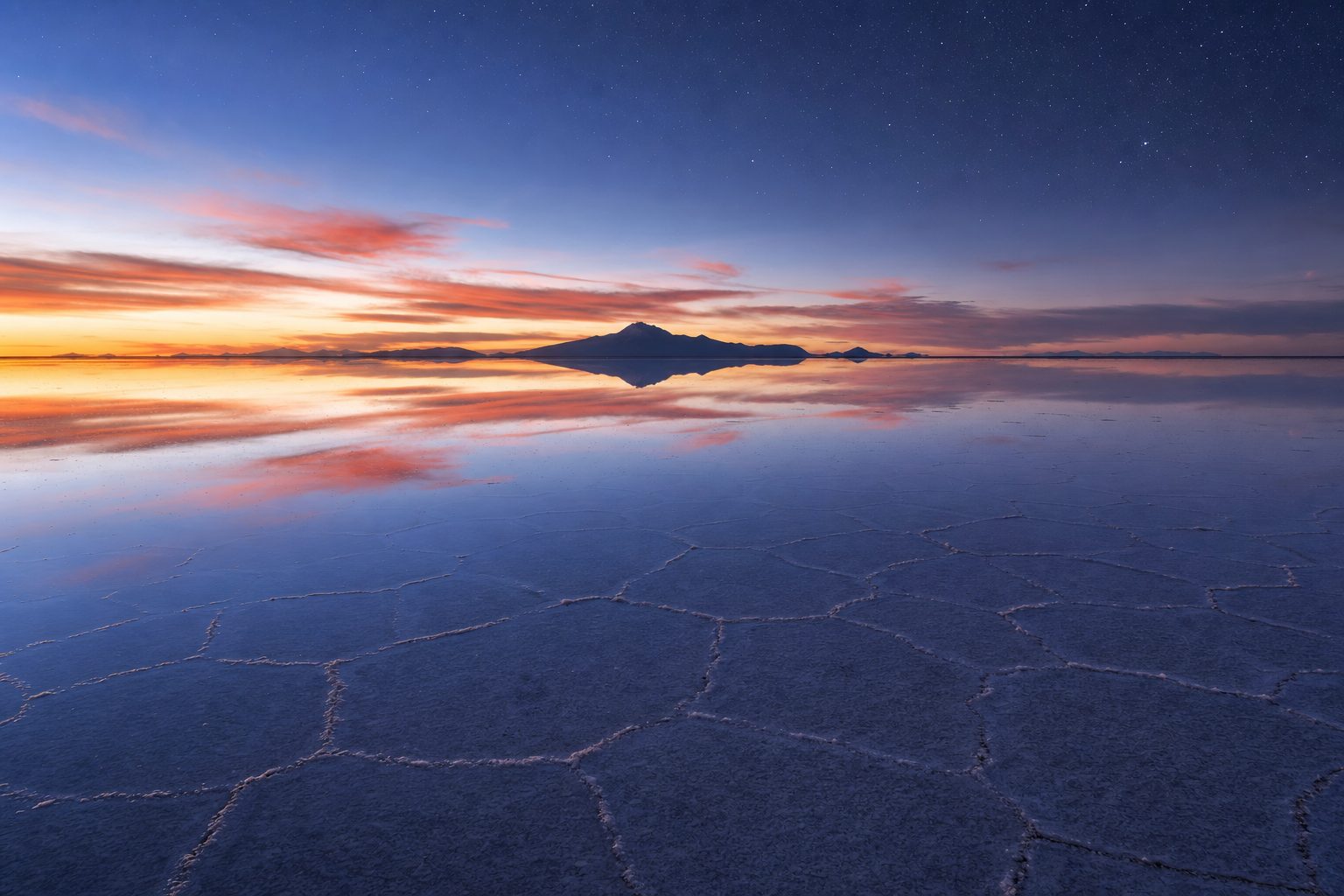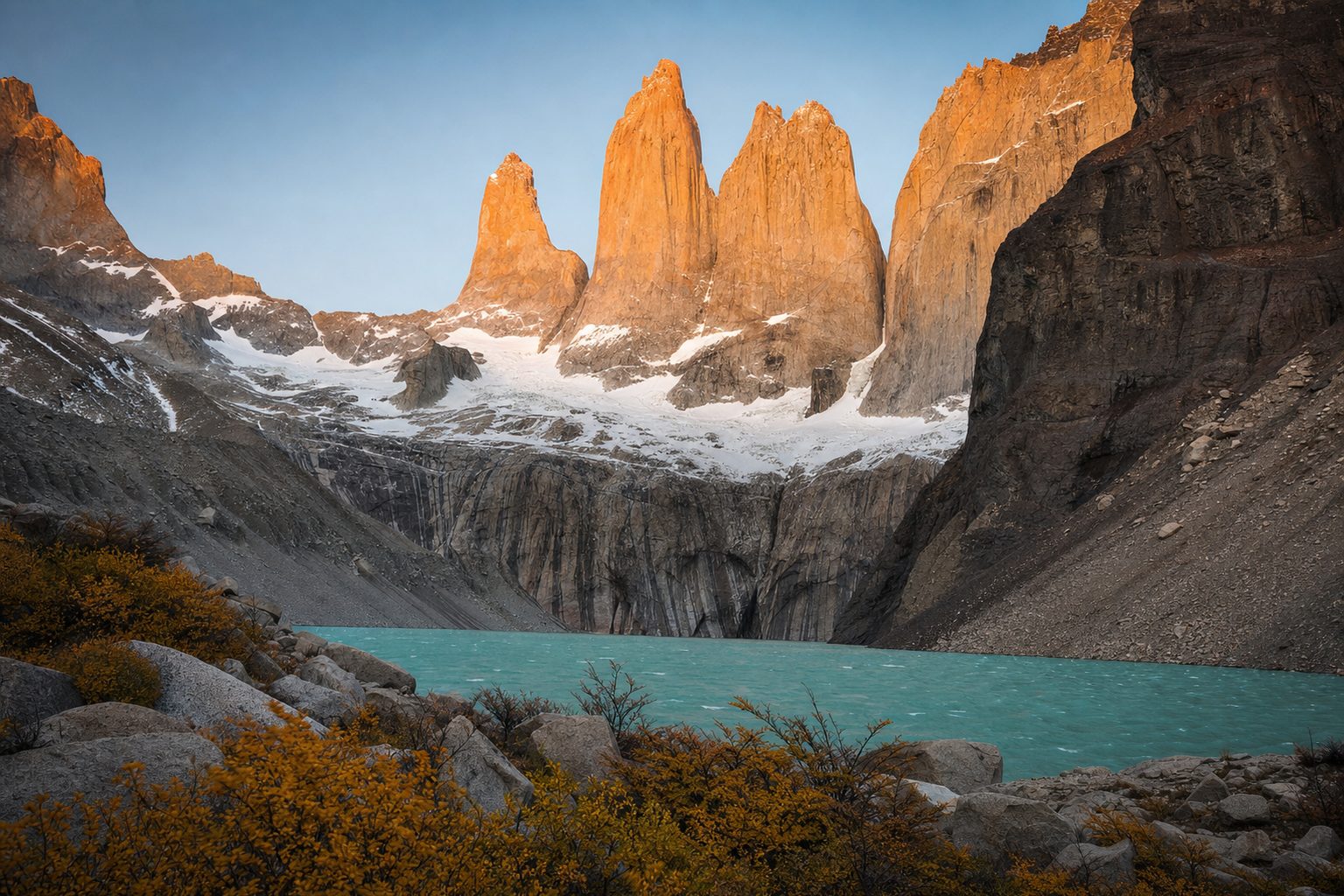

There is a particular light in Patagonia that photographers chase and rarely catch: the moment before dawn when the granite of the Torres or the spire of Fitz Roy flares a deep, molten red, as if the mountains themselves were briefly lit from within. To witness it, you have to earn it — climbing a boulder field in the dark, wind driving sideways, headlamp bobbing, betting that the clouds will part. Sometimes they don't. That gamble, repeated across days of walking, is the essence of trekking at the bottom of the Americas.
Patagonia is not one place but a vast, shared frontier straddling southern Chile and Argentina — a land of ice fields, turquoise lakes, wind-bent lenga forest and steppe that runs to the horizon. For hikers, it distills into two great pilgrimage sites: Torres del Paine on the Chilean side, and the trails around El Chaltén in Argentina's Los Glaciares National Park. Do one and you'll understand why people come. Do both and you'll spend the rest of your life plotting a way back.
Torres del Paine was designated a UNESCO Biosphere Reserve in 1978; the reserve covers 770,889 hectares spanning four distinct ecological zones between the Andes and the Patagonian steppe, from Magellanic forest to Andean desert. [1]
Getting There and Getting Around
The gateways sit far south. For Torres del Paine, most trekkers fly into Punta Arenas, Chile, then transfer roughly three hours north to Puerto Natales, the tidy fjord-side town that serves as the park's basecamp — the place to rent gear, buy supplies and eat one last proper meal before the trail. For El Chaltén, the hub is El Calafate, Argentina, home of the thundering Perito Moreno glacier and a three-hour bus ride from the mountain village itself. Crossing between the two countries overland is entirely doable, and many combine both parks into a single multi-week trip.
Distances here are real and services thin. Book buses, park entry and — crucially — refugios or campsites well in advance; Torres del Paine's accommodation sells out months ahead in peak season. Park entry to Torres del Paine and to Los Glaciares is paid, and increasingly must be purchased online before you arrive.
Two decisions shape everything else about a Torres del Paine trek: which direction to walk, and whether to camp or use the refugios. The refugios — mountain lodges offering dormitory bunks, hot meals and, at some, private rooms — let you travel light and sleep dry, but they book out astonishingly early, often the moment reservations open the previous season. Camping is cheaper and more flexible, though you must reserve pitches in advance and carry more gear. Wild camping is not permitted; you must sleep at designated sites, a rule that protects one of the planet's most fragile alpine environments. Whichever you choose, treat the booking process as the single most important part of your planning.
A note on fitness and honesty with yourself: these are long days over rough, root-tangled and frequently muddy ground, with significant ascents and descents. You do not need to be an athlete, but you should be able to walk six to eight hours a day for several consecutive days carrying at least a daypack. Trekking poles save knees on the descents; broken-in waterproof boots save the entire trip. And because the weather can turn a straightforward walk into a genuine test in minutes, layering — base, insulation, hard shell — is not optional but a safety system.
Torres del Paine: The W and the O
The park's trail network resolves into two classic routes. The W trek — named for the zigzag shape it traces across the map — is the headline hike, linking the park's three great set-pieces: the granite Torres themselves, the hanging glaciers and horns of the French Valley, and the vast blue tongue of Grey Glacier. It is the most popular multi-day trek in Patagonia and, for good reason, the one most first-timers choose.

The W trek in Torres del Paine covers roughly 100 kilometers (about 62 miles) with around 2,730 meters of cumulative elevation gain, and takes most hikers four to five days to complete. [2]
The route can be walked east-to-west or west-to-east, sleeping in a mix of serviced refugios (with bunks and hot meals) and campsites. The single most demanding and rewarding day is the ascent to the Mirador Las Torres: a steep, boulder-strewn final climb to the glacial lagoon beneath the three towers, best timed for sunrise when the rock ignites. Those with more time and stamina take on the full O circuit, which loops around the entire Paine massif over roughly eight to nine days, adding the remote, wilder back side of the range and the jaw-dropping John Gardner Pass overlooking the Southern Patagonian Ice Field.
The park is also one of the best places on the continent to see wildlife on foot. Herds of guanaco graze the steppe, Andean condors ride the thermals, and Torres del Paine has become world-renowned for its population of pumas — though sightings, thrilling as they are, are best left to guided trackers and a respectful distance.
A Land Shaped by Ice
To walk here is to move through a landscape still actively under construction by ice. The Southern Patagonian Ice Field, the third-largest reserve of fresh water on the planet after Antarctica and Greenland, feeds the glaciers that both parks are built around. On the W trek, the payoff is Grey Glacier, whose blue-white face calves icebergs into a lake you can cross by catamaran or paddle by kayak, threading between floating chunks of centuries-old ice. Across the border in Los Glaciares, the star is Perito Moreno, one of the few advancing glaciers left on earth, whose 70-meter wall periodically ruptures with a crack like cannon fire as house-sized blocks collapse into the milky water below.

This ice is the reason the water here is so improbably colored. The turquoise and milky jade of the lakes comes from glacial flour — rock ground to powder beneath the moving ice and suspended in the meltwater, scattering light into those unreal hues. Understanding that transforms the view: those colors are not decoration but evidence, the visible signature of glaciers grinding mountains into sediment over millennia. It is humbling, and a little sobering, to trek beneath ice that is measurably retreating within a single human lifetime.
El Chaltén: Argentina's Trekking Capital
Across the border, the tiny frontier village of El Chaltén was purpose-built as a trekking town, and it wears the identity proudly: trails begin at the ends of its streets, and you can hike world-class routes as day trips without ever shouldering a full pack. Presiding over it all is Cerro Fitz Roy (Cerro Chaltén), a serrated granite spire that ranks among the most demanding — and most beautiful — mountains on earth.
The essential walk is the trek to Laguna de los Tres, which delivers you to the foot of Fitz Roy itself. The trailhead sits at the edge of town; the route climbs through beech forest and past viewpoints of the Río de las Vueltas valley before a brutally steep final section — roughly 400 meters of ascent in the last stretch — tops out at a moraine ridge above an electric-blue lagoon and its hanging glacier. It is, without exaggeration, one of the great mountain reveals in the world.
The Laguna de los Tres / Fitz Roy hike from El Chaltén is a full-day trek of roughly eight to nine hours graded moderate-to-demanding, with a steep final climb of about 400 meters from the Río Blanco base camp up to the lagoon. [3]
El Chaltén's brilliance is its range. If Laguna de los Tres is too much, the easier Laguna Capri (4–5 hours) still delivers a stunning Fitz Roy vista, while Laguna Torre (7–8 hours) leads to a glacial lake beneath the impossibly slender needle of Cerro Torre. All are accessible from town, all are free to walk, and all can be strung together over several days from a single warm bed and a nightly Argentine steak — a luxury the Torres del Paine trekker only dreams of.
People ask which mountain is better, Paine or Fitz Roy. It's the wrong question. One teaches you endurance, the other teaches you patience. Patagonia will hand you both whether you ask for them or not.
— Tomás Errázuriz
That unpredictability is the whole game in El Chaltén. Fitz Roy and Cerro Torre spend much of their lives shrouded in cloud, and many trekkers complete the walk without ever seeing the summits clear. Locals talk about the mountains “coming out” the way others talk about a rare bird sighting — a matter of patience and luck as much as effort. The traveler who allows several days here, rather than a single do-or-die attempt, vastly improves the odds and, not incidentally, gets to enjoy one of the most charming trail towns in the Andes at an unhurried pace.
Crossing the Border, Combining the Parks
The great temptation — and the great reward — is to link both parks into a single journey. The two sit only a few hundred kilometers apart as the condor flies, but a world apart in character: Torres del Paine is a self-contained wilderness of guanaco-grazed steppe and serviced refugios, while El Chaltén is a village you sleep in and hike out from each morning. Most travelers connect them by bus, crossing the Chile–Argentina frontier at one of the remote Andean posts, with a night in Puerto Natales and another in El Calafate bookending the transfer. Build in buffer days: border formalities, weather closures and the sheer scale of the distances mean nothing here runs to a tight schedule.
If time is short and you must choose one, the decision comes down to style. Torres del Paine suits those who want a committing, multi-day point-to-point trek with the romance of hut-to-hut travel and a genuine sense of expedition. El Chaltén suits those who prefer to base themselves in one comfortable spot, sleep in a real bed, and cherry-pick day hikes according to the weather — a flexibility that, in a place this meteorologically volatile, is worth a great deal. Neither is wrong. Both will ruin you, pleasantly, for lesser mountains.
When to Go
The Patagonian trekking season runs roughly from November to March — the austral spring and summer, when the passes are clear of snow and the refugios are open. December through February bring the longest days and the most reliable trail conditions, but also the fiercest winds, the biggest crowds and the highest prices. The shoulder months of November and March reward flexible walkers with thinner trails, autumn color in the lenga forests (March) and, if you're lucky, calmer air. Whatever the month, come prepared for all four seasons in a single afternoon: sun, sleet, wind and rainbows, often within the same hour.
Where to Eat
Trekking food may run to trail mix and dehydrated dinners, but the basecamp towns reward a good appetite. Puerto Natales has quietly developed a serious food scene built on king crab and Magellanic lamb, while El Chaltén trades in hearty Argentine grill fare, homemade pasta and craft beer. These are the places to celebrate a summit — or console yourself for a clouded-out one.

AfrigoniaAfrican-Chilean fusion
An unexpected and celebrated fusion restaurant in Puerto Natales blending Chilean Patagonian ingredients with East African spicing, and consistently rated among the town's very best tables.
Why it’s so good: One of the highest-rated restaurants in Puerto Natales across major review platforms, prized for adventurous flavor combinations and a warm, intimate room — a genuine special-occasion meal at the end of the earth.
Top picks: Lamb steak · Fusion seafood dishes

SantollaSeafood
A Puerto Natales seafood specialist built inside repurposed shipping containers, focused on the region's prized king crab (centolla) and other cold-water shellfish.
Why it’s so good: Repeatedly ranked among the top restaurants in Puerto Natales, celebrated for some of the best king-crab legs and seafood tapas in Chilean Patagonia.
Top picks: King crab legs · Seafood tapas selection

Cangrejo RojoLatin / Seafood café
A small, much-loved café-restaurant in Puerto Natales serving generous, well-priced Patagonian seafood and comforting local plates.
Why it’s so good: One of the highest user-rated eateries in Puerto Natales, valued for excellent seafood, friendly service and strong value — an ideal first meal off the trail.
Top picks: Lamb cooked in calafate sauce · Fresh local fish and shellfish

Hostería SenderosArgentine steakhouse-style
El Chaltén's place to splurge, where the kitchen turns local lamb and beef into refined plates paired with a broad Argentine wine list.
Why it’s so good: Recommended by Patagonia specialists as the town's fine-dining option, praised for mouth-watering steak and a chef who works local ingredients skillfully — a proper reward after Laguna de los Tres.
Top picks: Bife de chorizo · Local Patagonian lamb · Trout

La TaperaArgentine / Patagonian
A rustic wooden El Chaltén eatery with seating around a fire pit, serving hearty tapas, stews and steaks in a cozy après-trek atmosphere.
Why it’s so good: A local favorite for warming, generous Argentine fare and good wine after a long day on the Fitz Roy trails, with an atmosphere built for tired, hungry hikers.
Top picks: Patagonian lamb stew · Tapas plates with Argentine wine

Cervecería Artesanal El ChalténBrewpub
A tiny, snug craft beer house in El Chaltén with rustic wooden décor, house-brewed beer and a short menu of pizza and pasta.
Why it’s so good: The town's essential après-trek beer stop — congenial, often full to bursting, and the natural place to compare notes on the day's hike over a house brew.
Top picks: House-brewed ale · Wood-fired pizza
Wherever you land, order the lamb and don't skip the local dessert made with calafate, the tart Patagonian berry. Legend holds that anyone who eats it is destined to return — and after a few days walking under these mountains, you'll want the insurance.
Sources & further reading
- 1. UNESCO Man and the Biosphere — Torres del Paine (1978 designation, area, ecosystems)
- 2. Brooke on Foot — How to Hike the W Trek in Torres del Paine (distance, elevation, days)
- 3. El Chaltén (Los Glaciares publishers) — Laguna de los Tres / Fitz Roy trek
- 4. Swoop Patagonia — Places to Eat in El Chaltén
- 5. Tripadvisor — Best Restaurants in Puerto Natales (Afrigonia, Santolla, Cangrejo Rojo)
- 6. Laidback Trip — Guide to Hiking Laguna de los Tres