Plitvice Lakes National Park does not reward improvisation. Visitor numbers are managed through timed online tickets that regularly sell out in summer, the park is split across two entrances that lead to different experiences, and a short list of rules, foremost a total ban on swimming, is strictly enforced across the whole site. None of this makes the park difficult to visit; it means the useful planning happens before arrival rather than at the gate. This guide works through the decisions in the order they need to be made: which ticket and time slot to book, which entrance to start from, when in the year and day to go, and what the rules mean in practice once you are on the boardwalks.
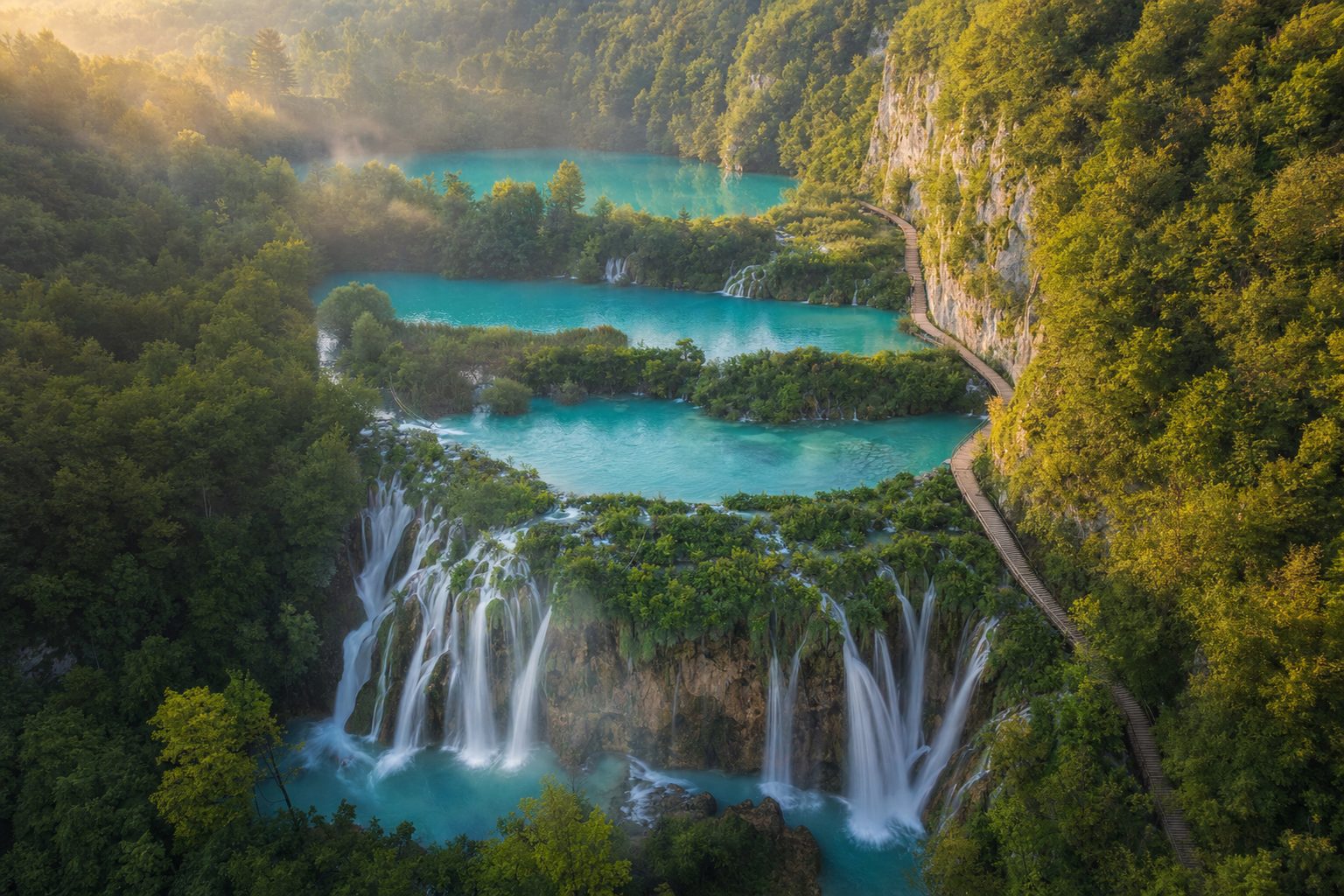
The reward for getting this right is one of Europe's most distinctive landscapes: a chain of sixteen interconnected lakes cascading through travertine barriers into waterfalls, all crossed by wooden walkways that put visitors directly above and beside the water. The park has held UNESCO World Heritage status since 1979, and that status is precisely why the rules exist. Every decision below traces back to the same goal the park authority states outright: protect a living, slow-forming geological process from a million-plus annual visitors without closing it off from them.
Booking the right ticket for the right day
Plitvice Lakes National Park was inscribed on the UNESCO World Heritage List on 26 October 1979, one of the first Croatian sites to receive the designation. [2]
Every visitor to the lake system and hiking trails needs a valid entrance ticket, purchased either through the park's official webshop or, if slots remain, at the ticket desks at Entrance 1, Entrance 2 or the auxiliary Flora entrance. As checked in August 2026, day tickets purchased online are tied to a specific entrance and a specific time window, and that ticket becomes invalid if you show up outside the period you selected. The price list itself changes with the season: from 1 April to 31 May and again in October, the standard adult day ticket runs to roughly EUR 23; from 1 June to 30 September, the same ticket rises to EUR 40, reflecting the far heavier demand and longer opening hours of peak summer.
As of the park's 2026 price list, a standard adult one-day ticket costs around EUR 23 during the shoulder periods of 1 April–31 May and October, and around EUR 40 during the peak season of 1 June–30 September, with a separate late-entry rate after 4pm in summer. [4]
A cheaper late-day ticket exists specifically to spread out demand: the park's own price list sets a discounted late rate that applies after 4pm from June through August, and after 3pm in September, priced at roughly EUR 25 for adults. This is worth building a visit around rather than treating as an afterthought, since arriving in the last few hours of opening avoids the worst of the midday crush on a lower entry fee. Whichever slot you choose, book it before finalising flights or accommodation. During July and August, popular morning windows can sell out days ahead, and the park's official guidance for group bookings, along with widely reported visitor experience, both point the same direction: buy online, buy early, and treat a printed or downloaded ticket as mandatory, not optional.
Entrance 1 or Entrance 2: two different first impressions
The park has two main gates roughly three kilometres apart on the same road, and the choice between them shapes the entire day. Entrance 1 (Rastovača) sits beside the Lower Lakes and puts Veliki Slap, Croatia's tallest waterfall, almost immediately in view; it is also the gate served by intercity and international buses, making it the default choice for anyone arriving without a car. Entrance 2 (Hladovina) opens onto the Upper Lakes, a quieter, more forested stretch of the park reached by a longer walk in from parking, and it tends to see noticeably lighter foot traffic than Entrance 1 in the first hour or two of the day.
Neither gate is objectively better; they simply front different halves of the same lake system, and the right choice depends on what a visitor most wants to see first. Starting at Entrance 1 means walking gradually uphill toward the Upper Lakes with the Lower Lakes' waterfalls facing you for most of the initial stretch, which several guides who have walked both directions rate as the more photogenic approach. Starting at Entrance 2 flips that sequence, opening with quieter forest trail before descending toward the busier lower section later in the day, an order some visitors prefer specifically because it front-loads the calmer walking and saves the signature waterfall views for last.
The park sells access by numbered walking programmes rather than letting visitors simply wander, and those programmes are tied to entrance. Routes A, B and C all begin at Entrance 1: Route A is a short Lower Lakes loop of around 3.5 km, Route B adds an electric boat crossing of Lake Kozjak, and Route C, the most commonly chosen option, links the Lower and Upper Lakes into a full circuit of around 8 km. Route K1, the longest option at 18 km or more, is built for visitors who want to see the entire lake system on foot in a single demanding day. Every routed ticket includes the boat crossing of Lake Kozjak and the panoramic shuttle train that link the more distant sections, so the fee covers transport as well as entry.
- Choose Entrance 1 for the shortest route to Veliki Slap and the Lower Lakes canyon, and if arriving by bus
- Choose Entrance 2 for a quieter start through the Upper Lakes, especially in the first hour after opening
- Pick Route C (roughly 8 km) from Entrance 1 for a full first-time circuit of both lake groups in one day
- Reserve Route K1 (18 km or more) only if you want a full-day hike and are comfortable with several hours of walking
- Confirm your ticket's entrance and time slot match your actual arrival plan before you leave your accommodation
When to go: season and time of day both matter
The park is open year-round, but conditions differ sharply by season. Summer brings the longest opening hours and the largest crowds, with boardwalks that can become genuinely congested by mid-morning as coach parties and independent travellers converge on the same narrow walkways. May and the September-to-October window are consistently recommended as the more comfortable middle ground: mild weather, fuller waterfalls than late summer typically offers, and visibly thinner crowds on the same trails that feel packed in July. Winter has the lightest visitor numbers of all and a genuine appeal of its own, with frozen cascades in cold snaps, though some routes and boat or train services may be reduced or suspended depending on conditions.
Time of day is just as important as time of year. Arriving close to opening, generally 7am in the warmer months, buys several hours of comparatively open boardwalks before the trails fill up around mid-morning, a pattern widely reported by visitors and guides who have walked the park across multiple seasons. The alternative is the late-afternoon slot described above: entering after the 4pm (or 3pm in September) price change trades away a couple of hours of daylight for both a lower fee and a calmer walk as day-trip coach groups head out.
Paraphrased from the UNESCO World Heritage Centre listing: Plitvice Lakes is presented as a karst river landscape whose sixteen interconnected lakes, formed and continually reshaped by living travertine-depositing organisms, represent an active geological process rather than a static scenic backdrop.
— Paraphrased from the UNESCO World Heritage Centre listing for Plitvice Lakes National Park
The rules that shape every visit
Swimming, wading and bathing have been strictly banned in every lake and waterfall at Plitvice since 2006, a rule enforced to protect the travertine-forming process that continues to build the park's barriers today. [7]
The swimming ban is the single most consequential rule for a first-time visitor, precisely because the water looks so inviting. The lakes' colour and clarity come from an active biological process: mosses, algae and bacteria depositing calcium carbonate to build the travertine barriers that separate one lake from the next, a process that has been forming and reshaping the park's terraces for thousands of years and that human contact with the water can disrupt. Fines are issued for swimming, wading or touching the water from the boardwalks, and rangers patrol accordingly. The same logic underpins the wider set of park rules: no picking plants, no feeding wildlife, no drones, no leaving the marked wooden walkways, and dogs permitted only on a leash, including while riding the boat or train.
Visitors move through the park on an 18 km network of wooden boardwalks and footbridges that follow the lakes and waterfalls, in addition to longer marked hiking trails through the surrounding forest. [7]
Staying on the boardwalks is not simply courtesy; it is the only way most of the park is accessible at all, since the walkways cross directly over water and wetland with no solid ground alongside in many sections. They can be narrow, occasionally without handrails, and shared in both directions, which is part of why an early or late time slot makes a practical difference beyond comfort: less congestion on a walkway that cannot easily be widened or rerouted. Weather can also close individual sections at short notice, particularly after heavy rain, so checking current trail status on the official site on the morning of a visit is worth the two minutes it takes.
Planning the rest of the trip around the park
Plitvice sits roughly midway between Zagreb and the Dalmatian coast, around two to two and a half hours' drive from either Zagreb or Zadar, which makes it a natural stop on a longer Croatian loop rather than a standalone destination. Most visitors budget a single full day, using an overnight stay near one of the entrances to make an early or late timed slot practical without a long drive beforehand, and a two-day ticket is available for anyone who wants to split the Upper and Lower Lakes across separate mornings rather than compress everything into one circuit. Parking at both entrances is paid on exit and can fill during peak summer weekends, another reason an early arrival pays off twice over: it secures both a parking space and a quieter boardwalk.
Anyone building out a wider itinerary around a single well-managed but rule-bound landmark will recognise the same trade-offs at work in the Dolomites, where trail access and hut bookings similarly reward planning weeks ahead rather than on arrival, and travellers assembling a broader European route can compare how much lead time different countries expect in a guide to travelling around Europe. The common thread across all of these destinations is the same: a landscape this fragile stays open to the public only because visitor numbers and behaviour are actively managed, and a traveller who plans around that management sees more of the park, in better conditions, than one who arrives expecting to buy a ticket at the gate and wander freely.
Sources & further reading
- 1. Plitvice Lakes National Park — Official Price List 2026
- 2. Plitvice Lakes National Park — Official Site (English)
- 3. UNESCO World Heritage Centre — Plitvice Lakes National Park
- 4. Travel Plitvice — Complete Plitvice Lakes Travel Guide (2026)
- 5. Travel Plitvice — Entrance 1 vs Entrance 2 Guide
- 6. Earth Trekkers — How to Visit Plitvice Lakes
- 7. Absolute Croatia — Plitvice Lakes Guide: Routes, Tickets & Tips
- 8. Wikipedia — Plitvice Lakes National Park