Praslin is Seychelles' second-largest island, and almost every first-time visitor arrives with the same instinct: see the giant seed, then find the beach everyone photographs. Both are legitimate reasons to come, but the order in which you plan them matters. The Vallee de Mai Nature Reserve, home to the coco de mer palm, keeps fixed hours and closes on two days a year; Anse Lazio, the northwest-tip beach that shows up on every Seychelles reel, is manageable before mid-morning and difficult after. Getting to Praslin at all means choosing between a ferry that takes just over an hour and a short domestic flight, a decision that shapes your first and last day regardless of what you do in between.
This guide sets out those decisions in order: how to reach Praslin from Mahe, how the Vallee de Mai works and what its entry fee actually covers, why the coco de mer is legally protected in a way that surprises most visitors who assume any souvenir stall sells the real thing, and how to time a visit to Anse Lazio and its quieter neighbours so the crowds are someone else's problem. None of it requires expert planning, but skipping it tends to mean a rushed reserve visit or a beach day spent looking for parking.
Getting to Praslin: ferry or short flight from Mahe
Most visitors reach Praslin from Mahe, Seychelles' main island and the location of the international airport, by one of two routes. The Cat Cocos ferry runs daily between Victoria's Inter Island Quay on Mahe and Baie Sainte Anne on Praslin, taking approximately one hour and fifteen minutes, with fares starting around €60 for a standard lower-deck seat. Morning departures from Mahe now start as early as 7:30am, and because the route is popular, particularly in high season, booking ahead rather than turning up on the day is the safer approach; seats do sell out (Cat Cocos route details).
The alternative is Air Seychelles' domestic hop from Mahe's domestic terminal, a flight of roughly fifteen to twenty minutes in a small propeller aircraft, priced in the region of €130-150 depending on how far ahead it is booked. It is the faster option by a wide margin once you account for ferry check-in and transfer time, and worth the premium if your Praslin stay is short or you are connecting onward to La Digue. Whichever you choose, book in advance during the high season stretch from around July through early September and over the Christmas and New Year period, when both ferry seats and flight seats compress quickly.
The Vallee de Mai: hours, fees, and what the ticket actually buys
The Vallee de Mai Nature Reserve, a UNESCO World Heritage Site since 1983, sits inland in the centre of Praslin and is the reason most people schedule a full day, rather than a quick stop, on the island. It opens daily from 8:30am to 4:30pm, with last entry at 3:30pm, and closes only twice a year, on 25 December and 1 January. Entrance costs SCR 450 per person, payable in Seychelles rupees, euros, US dollars, or British pounds, in cash or by card at the visitor centre ticket office.
As checked in July 2026, the Seychelles Islands Foundation's official Vallee de Mai page lists opening hours of 8:30am to 4:30pm with last entry at 3:30pm, an entrance fee of SCR 450, and closure only on 25 December and 1 January. [1]
That fee is not solely a Vallee de Mai admission charge. According to the reserve's own visitor information, it also funds the operation of both of Seychelles' UNESCO World Heritage Sites managed by the Seychelles Islands Foundation: the Vallee de Mai on Praslin and the remote Aldabra Atoll far to the south. Framed that way, the ticket is less a park entry fee than a contribution to two protected sites at once, which is worth knowing if the price seems high for a walk through a palm forest.
Inside the reserve, the rules are simple and consistently enforced: stay on the marked trails, and do not pick up or remove any fallen nuts, fronds, or plant material, however tempting a giant coco de mer husk on the forest floor might look. The reserve exists specifically to protect a habitat found nowhere else at this scale, and casual souvenir-taking undermines that in a way visitors sometimes do not realise until it is explained by a guide at the gate.
The coco de mer: the seed that only grows wild in two places
The coco de mer, scientific name Lodoicea maldivica, produces the largest seed in the plant kingdom, and it grows wild almost nowhere else in the world besides Praslin and the small neighbouring island of Curieuse. It is one of six palm species endemic to Seychelles, and its trees can live for well over two centuries, growing more than 25 metres tall over that span. The female nuts, which can weigh up to 20 kilograms, take five to six years to mature on the tree and then a further three to six months to germinate once they fall.
As checked in July 2026, the Seychelles Islands Foundation states that the coco de mer occurs only on the islands of Praslin and Curieuse, is one of six endemic Seychelles palms, and bears the largest seed in the plant kingdom, with mature nuts weighing up to 20 kilograms. [1]
The Seychelles Islands Foundation describes the coco de mer's female nut as taking around five to six years to mature on the tree, with the tree itself not reaching reproductive maturity until somewhere between fifteen and fifty years of age, and living for an estimated two centuries or more.
— Paraphrased from the Seychelles Islands Foundation's official Vallee de Mai visitor page
The rarity explains the second thing every visitor learns quickly: you cannot simply buy a coco de mer nut and take it home. Seychelles restricts the processing, trade, and export of unprocessed coco de mer kernel under a dedicated statutory instrument, and any legitimate export of a whole nut requires an export permit from the Department of Environment, a CITES certificate, a letter of approval from the designated authority, and a copy of the nut's official tag made available at the point of export. Vendors selling tagged, licensed nuts through recognised outlets can usually arrange the paperwork on your behalf, but an untagged nut bought informally cannot legally leave the country, and travellers who try risk confiscation at customs.
As checked in July 2026, Seychelles' Statutory Instrument 86 of 2020, published in the Official Gazette, restricts the export of unprocessed coco de mer kernel and requires a permit issued by the Minister, with exportation otherwise prohibited without one, on penalty of a fine up to SCR 20,000 or up to two years' imprisonment. [3]
Seychelles' own export guidance is explicit on the accompanying documents: an export permit application for CITES-listed species, including coco de mer nuts, must be submitted to the Department of Environment along with a CITES certificate and a letter of approval, and for coco de mer nuts specifically, a copy of the nut's tag must also be produced (Seychelles customs guidance for visiting boats and travellers). In practice, this means the safest way to bring one home legitimately is to buy from an established, licensed vendor who can supply the tag and handle, or clearly explain, the permit process, rather than from an informal roadside stall.
Anse Lazio and the beaches without a connecting road
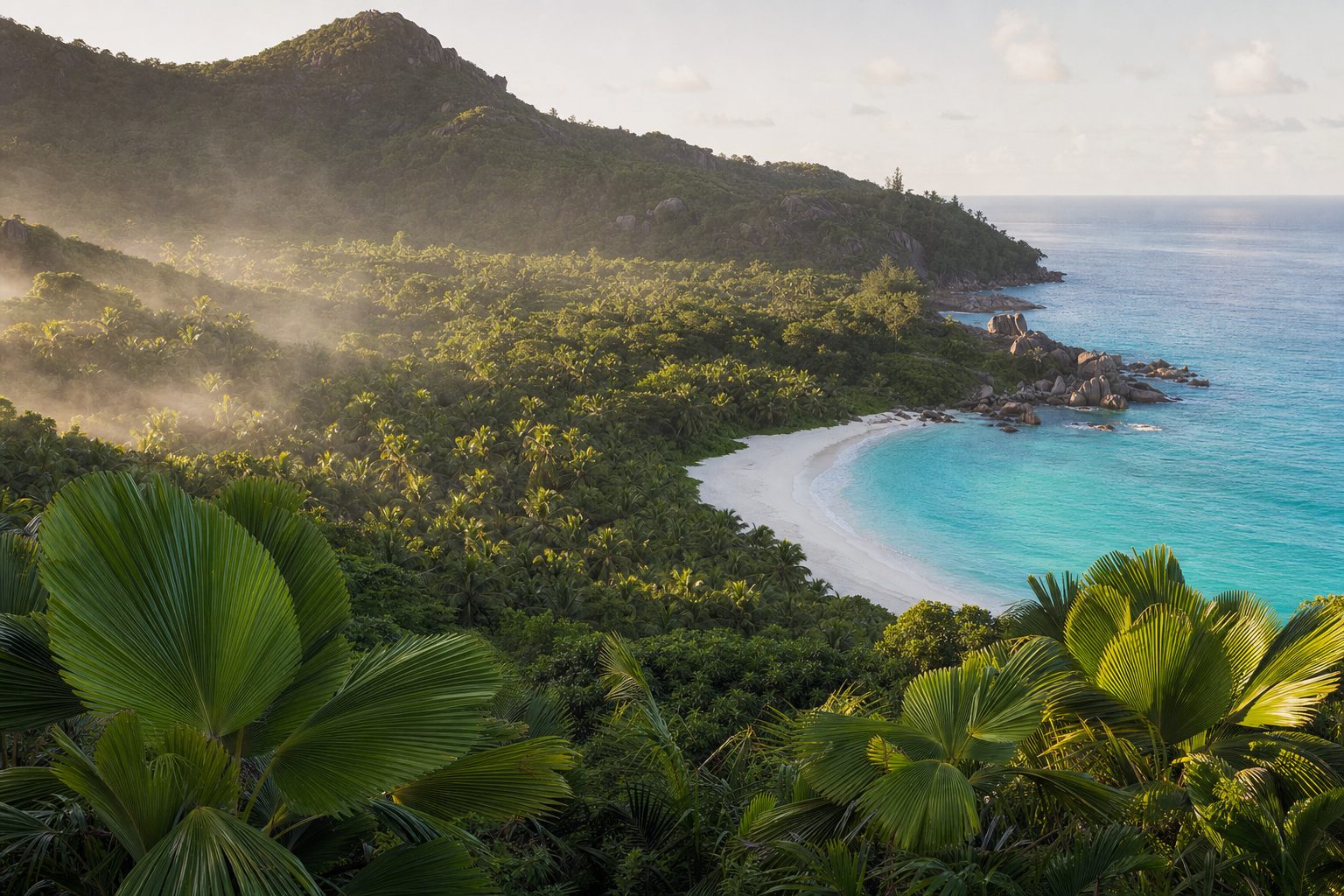
Anse Lazio, at Praslin's northwestern tip, is the beach most visitors picture when they picture Seychelles: a long curve of pale sand framed by granite boulders and takamaka trees, reached by car, taxi, or bus. There is a paved car park at the entrance charging SCR 100 per day, which accepts cards as well as cash. The beach is comfortable in the early morning but fills steadily from around 10am, and by midday, especially in high season, finding shade or open sand becomes genuinely difficult.
A short walk of about ten minutes over the headland leads to Petite Anse, a smaller, quieter cove that absorbs some of the overflow, and it is a reasonable fallback if Anse Lazio itself looks packed on arrival. What catches some visitors out is Anse Georgette, the equally photogenic beach just around the same headland to the north: despite Praslin having what looks like a near-complete ring road on a map, the road actually stops at the northern tip on both sides, and there is no direct route between the two beaches on foot or by car along the coast. Reaching Anse Georgette means driving all the way around the island to the Constance Lemuria resort, whose grounds provide the only practical access, followed by a walk of twenty to twenty-five minutes from the golf course to the beach itself; the beach remains public despite the private-resort access point.
- Arrive at Anse Lazio before 10am, or after roughly 3:30pm, to beat the tour-group window and have a realistic shot at open sand.
- Bring a card or small cash for the SCR 100 daily parking fee; the paved lot is the only sanctioned parking at the entrance.
- If Anse Lazio is crowded, walk about ten minutes over the headland to the smaller Petite Anse rather than waiting it out.
- Plan a full loop of the island, not a short detour, if Anse Georgette is on your list, since no coastal road connects it to Anse Lazio.
Getting around once you're there
Praslin is small enough to cross end to end by car in under an hour, but its ring road disconnects at the northern tip in the same way that limits beach access, and its interior hills make walking between destinations impractical for most itineraries. A rental car is the most flexible option for reaching Vallee de Mai, Anse Lazio, and the ferry jetty on your own schedule. Public buses run the length of the island and are a genuinely cheap way to cover shorter hops, with single fares generally falling somewhere between SCR 5 and SCR 15 depending on the route and service type, though frequency drops off in the evenings and on Sundays, so it is worth checking the last return service rather than assuming one will be along shortly.
Planning the shape of your stay
Three to four nights on Praslin is enough to cover the Vallee de Mai properly, spend a full morning at Anse Lazio, and fit in either Anse Georgette or a boat trip to Curieuse or St Pierre without rushing any of it. Arriving on an early ferry or the first flight of the day, rather than a midday one, buys back the better part of your first afternoon for the reserve or a beach visit before the light softens. Travellers combining Praslin with the Seychelles' outer-island character more broadly, or contrasting it with other Indian Ocean island stops such as Zanzibar, will find the same core planning questions recur: how you get between islands, what is genuinely protected versus what is simply marketed as rare, and how early you need to move to stay ahead of the day's crowds. Anyone building a longer East Africa itinerary around Praslin might also look at how a mainland safari, such as the Masai Mara, pairs with island time on the back end of a trip, or browse how Seychelles' beaches compare by type before deciding how many days to allocate to sand versus forest.
Sources & further reading
- 1. Seychelles Islands Foundation: Vallee de Mai visitor information
- 2. Noonsite: Seychelles customs and coco de mer export rules
- 3. Seychelles Official Gazette: SI 86 of 2020, Coco-de-Mer (Restriction on Processing, Trade and Export) Regulations
- 4. Seychelles Trade Portal: Export Guidebook (CITES and coco de mer export procedure)
- 5. We Seek Travel: How to get to Praslin Island from Mahe or La Digue
- 6. Johnny Africa: The Ultimate Praslin, Seychelles Travel Guide
- 7. Air Seychelles: A guide to Praslin, Seychelles