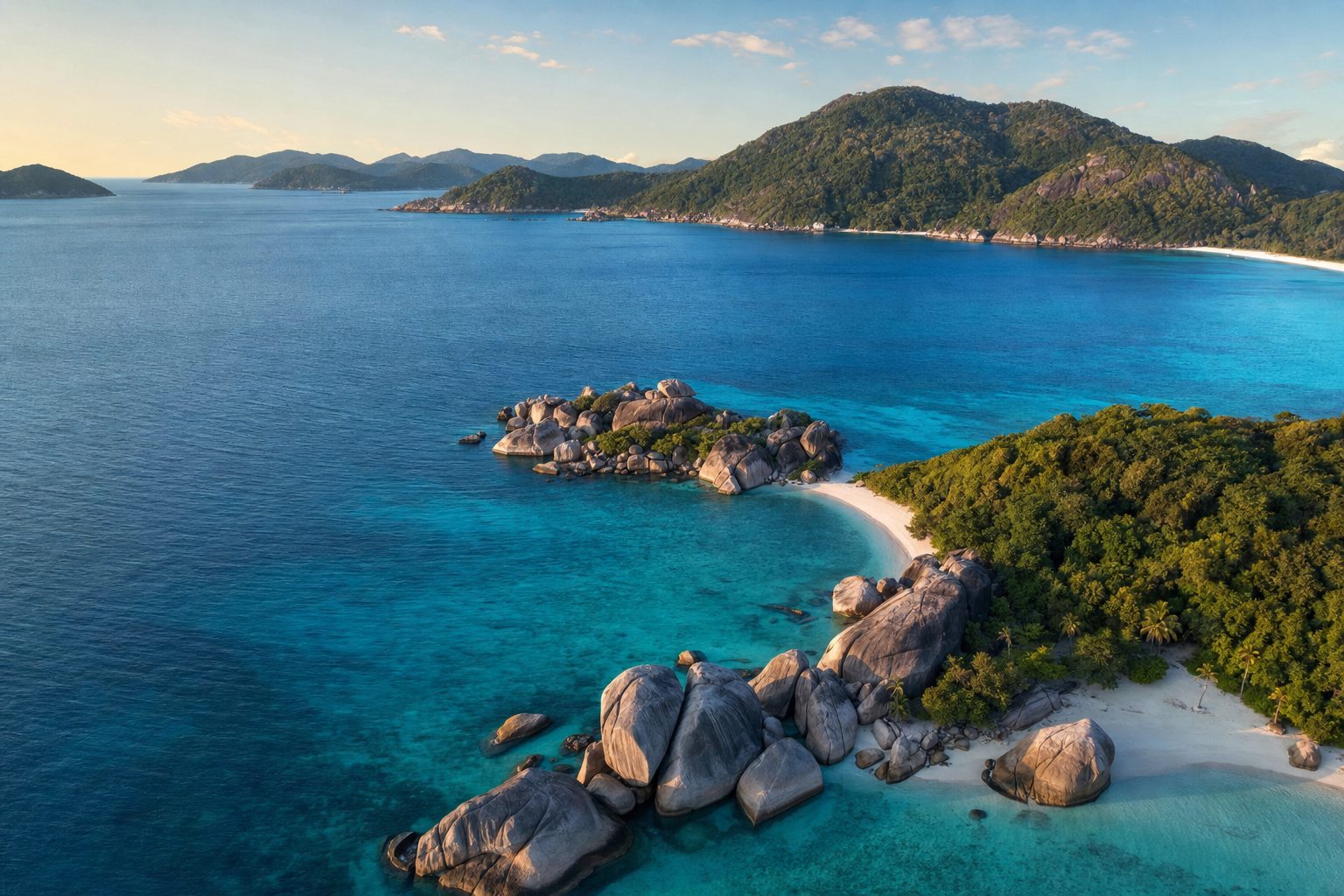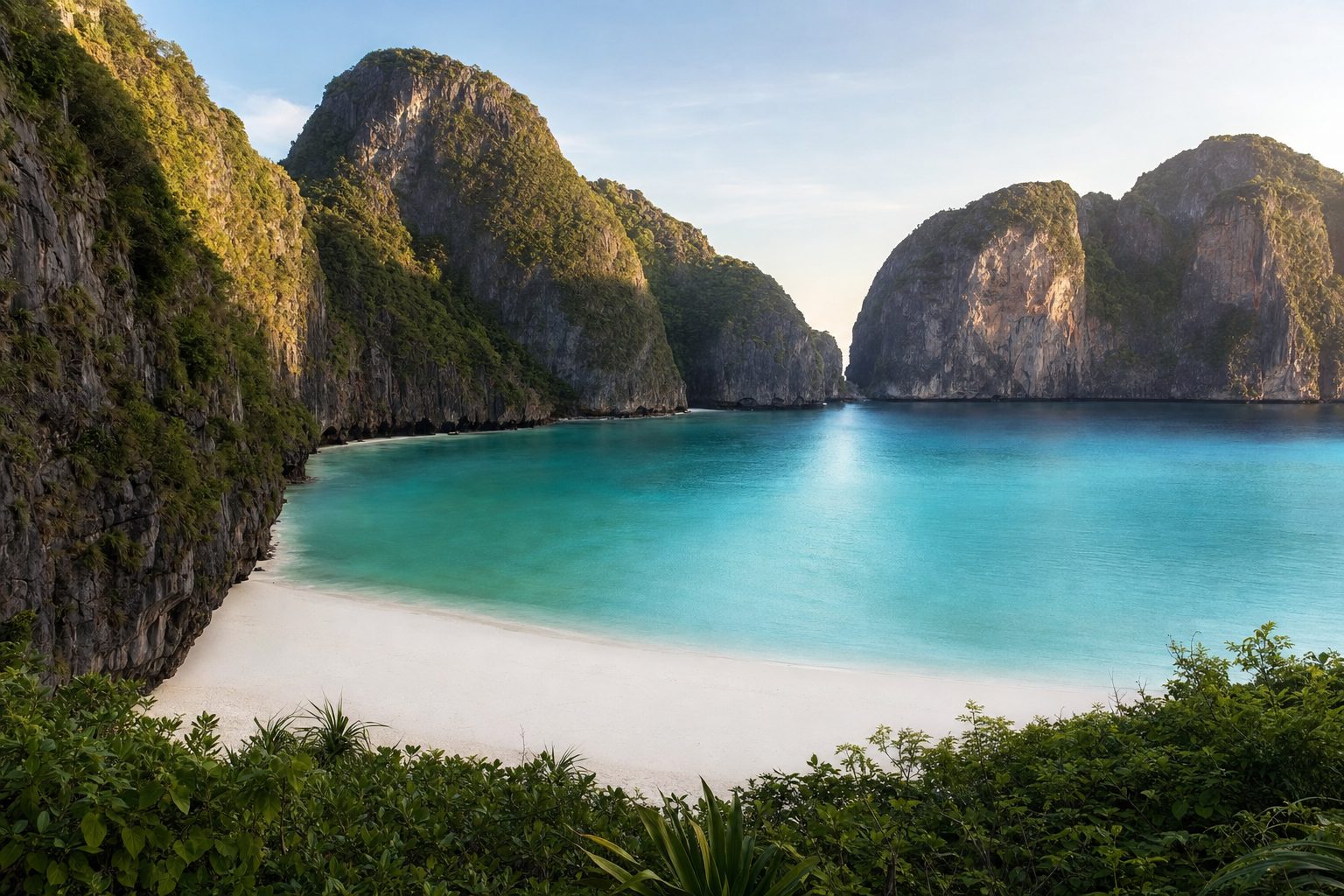

Raja Ampat is the place divers name when asked where the reefs are still whole. Off the north-western tip of New Guinea, in Indonesia's Southwest Papua province, more than 1,500 islands, cays and shoals scatter across the Dampier Strait and the open water beyond it, at the heart of the Coral Triangle. The karst towers of Piaynemo supply the photographs; the reefs of the Dampier Strait supply the reason people spend two days getting here.
The trip turns on a few decisions made before you leave home: when to travel, whether to sleep in a homestay, a dive resort or a liveaboard, how to pay two separate official fees, and how much cash to carry into an archipelago with almost no banking. The hook from the reel is true: one permit really does last a year. The details around it are less tidy.
Where you will actually spend your time
The name means Four Kings, after the main islands of Waigeo, Batanta, Salawati and Misool, but a first visit happens in a small corner of the map. Waisai, the regency capital on Waigeo, is where the public ferry from Sorong lands and where both official fees are paid. From there, homestay boats fan out across the Dampier Strait to Kri, Mansuar, Gam and Arborek, the cluster where most homestays, dive centres and the best-known sites lie within a short ride of one another. Piaynemo, in the Fam Islands, is a long day trip west; Misool, in the far south, is a separate journey by liveaboard or resort boat; Wayag, the lagoon on every poster, is the far north and currently off limits.
The seascape carries two UNESCO labels, a Global Geopark since 2023 and a biosphere reserve since 2025. Neither changes how you visit, but both explain the fees: the marine protected areas here exceed two million hectares, and patrolling them costs money visitors are asked to help provide.
UNESCO designated the Raja Ampat Global Geopark in 2023. It covers 3,666,000 hectares around the four main islands of Waigeo, Batanta, Salawati and Misool, contains Indonesia's oldest rock formation (Silurian–Devonian, roughly 444 to 359 million years old) and, by UNESCO's account, waters that are home to around 75 per cent of the world's reef fish species. [8]
When to go: the northwest monsoon window
Raja Ampat sits almost on the equator, with daytime highs near 31°C and sea temperatures around 29°C all year. What changes is the wind. The northwest monsoon, roughly October to April, brings the fewest rainy days and the calmest seas for small boats; the southeast monsoon, May to September, brings most of the year's rain and, from mid-June to mid-September, a windy season that can keep homestay longboats tied up for a day at a time. December and January are a wetter interlude inside the good season, though rain tends to come in short bursts.
For the best odds of settled weather, the homestay association's long-standing advice is mid-October to mid-December. That window also opens the manta season: reef mantas are present all year at the Dampier Strait cleaning stations, but numbers peak from about mid-October to mid-May, when plankton draws them in and, on the same days, cuts visibility. July and August work from a homestay on a sheltered northern shore, but expect days when the sea sets the schedule.
The Raja Ampat Homestay Association's weather guide recommends October to April, with the best chance of perfect conditions from mid-October to mid-December, and gives the Dampier Strait manta season as usually mid-October to mid-May. It identifies mid-June to mid-September as the windy season, when choppy seas can occasionally limit small-boat travel between islands. [6]
Getting there: Sorong, then the Waisai ferry
There are no international flights into Sorong. You fly to Domine Eduard Osok Airport from Jakarta or Makassar, and most arrivals land too late for a same-day crossing, so budget a night in town and withdraw cash while you are there. The public fast ferry, run by PT Belibis, takes about two hours to Waisai and cannot be booked online: buy at the harbour counter an hour or two before departure, because seats sell out on busy days.
Never trust the timetable from memory. For most of 2026 the pattern from Sorong was a daily 14:00 sailing with an extra 09:00 boat on Wednesdays, Fridays and Sundays. As checked in September 2026, a new tariff and timetable took effect on 1 September, agreed between the provincial and regency governments and the operator: the stated schedule is a 09:00 departure from Sorong and a 14:00 return from Waisai, and foreign visitors now pay IDR 200,000 for an economy seat, against IDR 175,000 for Indonesians from outside the regency and IDR 125,000 for residents. Have your homestay confirm the sailings the evening before, and leave a spare day before any onward flight. Transfers from Waisai to the islands are arranged with your accommodation and priced per boat.
Permits and fees: one lasts a year, one does not
Two official fees apply to every foreign visitor, collected by different bodies for different purposes. The first is the Marine Park Entry Permit, formally the Environmental Service Fee, charged by the Raja Ampat Marine Protected Areas Management Authority (BLUD UPTD KKP Raja Ampat) to fund patrols and monitoring of its protected-area network. As checked in September 2026, a new rate has applied since 3 August 2026: IDR 1,000,000 for international passport holders, valid for 12 months from the date of purchase, with children under 12 exempt. This is the permit behind the reel: return within the year and it is still good. Buy it on the authority's official fee portal, which takes a passport scan and your travel dates, or in person at the Waisai office or the booth in Sorong harbour.
The Raja Ampat Homestay Association's permit page states that new Marine Park Entry Permit rates took effect on 3 August 2026: IDR 1,000,000 per person per year for international passport holders, valid for 12 months from the date of purchase, and IDR 25,000 per day for Indonesian citizens, with children under 12 exempt. Permit cards carry the holder's name and passport number. [2]
The second is the Raja Ampat Visitor Entry Ticket, introduced by the regency government in December 2019 to pay for jetties, viewpoints and other tourism infrastructure. It is charged per visit, not per year: leave the regency and return and you pay again. As checked in September 2026, the regency's SIPARI registration portal gives the levy for international tourists as IDR 1,000,000 under Regent's Regulations 33 and 34 of 2025; domestic visitors pay IDR 300,000. Register and pay online through SIPARI, or at the Regency Tourism Office counter in the Waisai port building, which takes cards. Budget IDR 2,000,000 per person in official fees, and expect to show both receipts at ranger checks at sea.
Two warnings. Both figures have changed more than once since 2019 and many well-ranked pages still quote the old IDR 700,000 permit; treat the two official portals as the reference. And permits are personal and recorded: buy only from the authority, the tourism office or an operator you trust, and insist on the card or an official receipt. Neither fee is included in accommodation prices unless stated in writing.
Homestay, resort or liveaboard
Where you sleep decides the trip, because there are no restaurants, shops or public boats to fall back on. Homestays are the Papuan model: a few stilted or beachfront bungalows owned by a local family, with three meals a day, drinking water and a generator that usually runs from sunset until around midnight. Bathrooms are often a bucket-and-ladle mandi, hot water is rare, and the reef starts at the jetty. As checked in September 2026, most charge roughly IDR 350,000 to 500,000 per person per night with meals; the Homestay Association's explainer is required reading. Kri and Arborek have the best dive access; Gam is greener and quieter.
Dive resorts on Kri, Gam, Mansuar and Batanta add air conditioning, constant power and house dive centres at roughly €200 to €400 a night. Liveaboards run from around US$150 a day on simple wooden boats to well over US$1,000 on phinisi yachts, and are the only practical way to combine the Dampier Strait with Misool; most operate October to April and sell out Christmas departures six months to a year ahead. For Thailand's national-park island model, see our Similan Islands guide.
In the water: Dampier Strait, Arborek and Piaynemo
The Dampier Strait is why the fees are worth paying. Cape Kri, on the tip of Kri Island, holds the often-quoted single-dive record of 374 fish species, counted in 2012, and on a running current it behaves like it: walls of fusiliers, sweetlips, reef sharks and enormous groupers. Blue Magic, a pinnacle mid-strait, draws oceanic mantas on strong-current days; Manta Sandy and Manta Ridge, near Arborek, are shallow cleaning stations where reef mantas queue over the rubble, behind a rangered rope line that everyone must respect. Snorkellers are not second-class here: Yenbuba jetty, Arborek's village jetty and the Kri house reefs are among the best shallow reefs anywhere.
Piaynemo is the accessible version of the poster: a wooden stairway of about 300 steps climbs to a platform above forest-topped limestone knobs in a swimming-pool lagoon, with the Telaga Bintang star lagoon a short scramble nearby. It lies about 60 kilometres west of Waisai, so the boat is the real cost. The Fam Islands villages levy a local landing fee at the jetty, charged per boat rather than per person, on top of the two official fees; the association's entry-fees page last recorded it at IDR 300,000 per boat. Arrive early, before the liveaboard tenders.
- Bring more cash than seems reasonable: the only ATMs are in Sorong and Waisai, cards rarely work beyond the Waisai counters, and boat fuel is paid in rupiah on the day.
- Buy a Telkomsel SIM in Sorong; it is the only network with meaningful island coverage, and even then expect signal at the jetty rather than in your room.
- Share boats. Piaynemo, manta and Kabui Bay trips are priced per boat, and two people versus six is the difference between a splurge and a routine day out.
- Keep your permit card and Visitor Entry Ticket receipt with your passport; rangers check them at sea, and without them you may be asked to pay again.
Wayag is closed, and how to behave in what is open
The most photographed place in Raja Ampat is not open. In June 2025, after the national government revoked four nickel-mining licences in the archipelago, customary landowners in the Kawe area blockaded Wayag and the regency ordered it temporarily closed while a settlement was sought. As checked in September 2026, the Homestay Association's Wayag page carries a dated notice that Wayag remains closed to all activities under customary law, that travelling there is not recommended and potentially unsafe, and that no reopening date is known. Some commercial pages claim otherwise; ask any operator offering Wayag exactly what has changed. Even when open it is a 300-kilometre round trip across open water with its own landing fee. Piaynemo gives you the same geology in a day; Misool's lagoons give it in the south. Build the trip around what is open.
As of its September 2026 update, the Raja Ampat Homestay Association states that Wayag remains closed to all activities by customary-law declaration, that travelling there is not recommended and potentially unsafe, and that it does not know when or if visitor access will be restored. Its Wayag guide also notes that a Waisai–Wayag round trip is over 300 kilometres, that there is no homestay accommodation there, and that at last report boats visiting Wayag were charged IDR 1,000,000 plus IDR 400,000 for a mandatory guide. [7]
The reefs are in this condition because communities closed them to outsiders long before the government did, through the customary sasi system of seasonal harvest bans. Visitors are guests inside that system. The Marine Park Authority publishes a visitor etiquette guide and the rules are enforced more firmly than in most of Indonesia: do not touch, stand on or kick coral; do not chase, ride or block mantas and turtles; no fishing, shell collecting or drones over villages without permission; and as little single-use plastic as possible, because there is no waste collection beyond Waisai. Ask before photographing people, dress modestly in villages, and remember that Sunday is a church day.
The management authority describes Raja Ampat tourism as built on preserving nature, respecting local culture, empowering communities and promoting sustainable prosperity, guided by the Papuan indigenous philosophy that the forest is our mother and the sea is our father, both of which feed, raise and protect us.
— Paraphrased from the Raja Ampat MPAs Management Authority's visitor guide
Raja Ampat rewards the traveller who arrives with fees paid, cash counted, expectations set for bucket showers and generator hours, and a plan built around the Dampier Strait. Go between mid-October and April if you can, stay long enough for the sea to have its bad day, and let the reef do the rest. For other marine destinations where access is rationed to protect what people come to see, read our guides to the Galápagos Islands and Socotra; for a gentler Indonesian island week, start with Bali beyond the beaches.
Sources & further reading
- 1. Raja Ampat MPAs Management Authority (BLUD UPTD KKP Raja Ampat) — official Marine Park Fee purchase portal
- 2. Stay Raja Ampat (Raja Ampat Homestay Association) — Marine Park Entry Permit, new rates effective 3 August 2026
- 3. SIPARI Raja Ampat (Raja Ampat Regency Government) — International Online Registration and Rp 1,000,000 entry levy
- 4. RRI (Radio Republik Indonesia) — Sorong–Waisai ferry fares in three categories from 1 September 2026
- 5. Let's Go Beyond — Raja Ampat travel guide 2026 (ferry pattern, cash and costs)
- 6. Stay Raja Ampat — Raja Ampat weather, seasons and manta season
- 7. Stay Raja Ampat — How to get to Wayag (September 2026 closure notice)
- 8. UNESCO — Raja Ampat UNESCO Global Geopark (designated 2023)