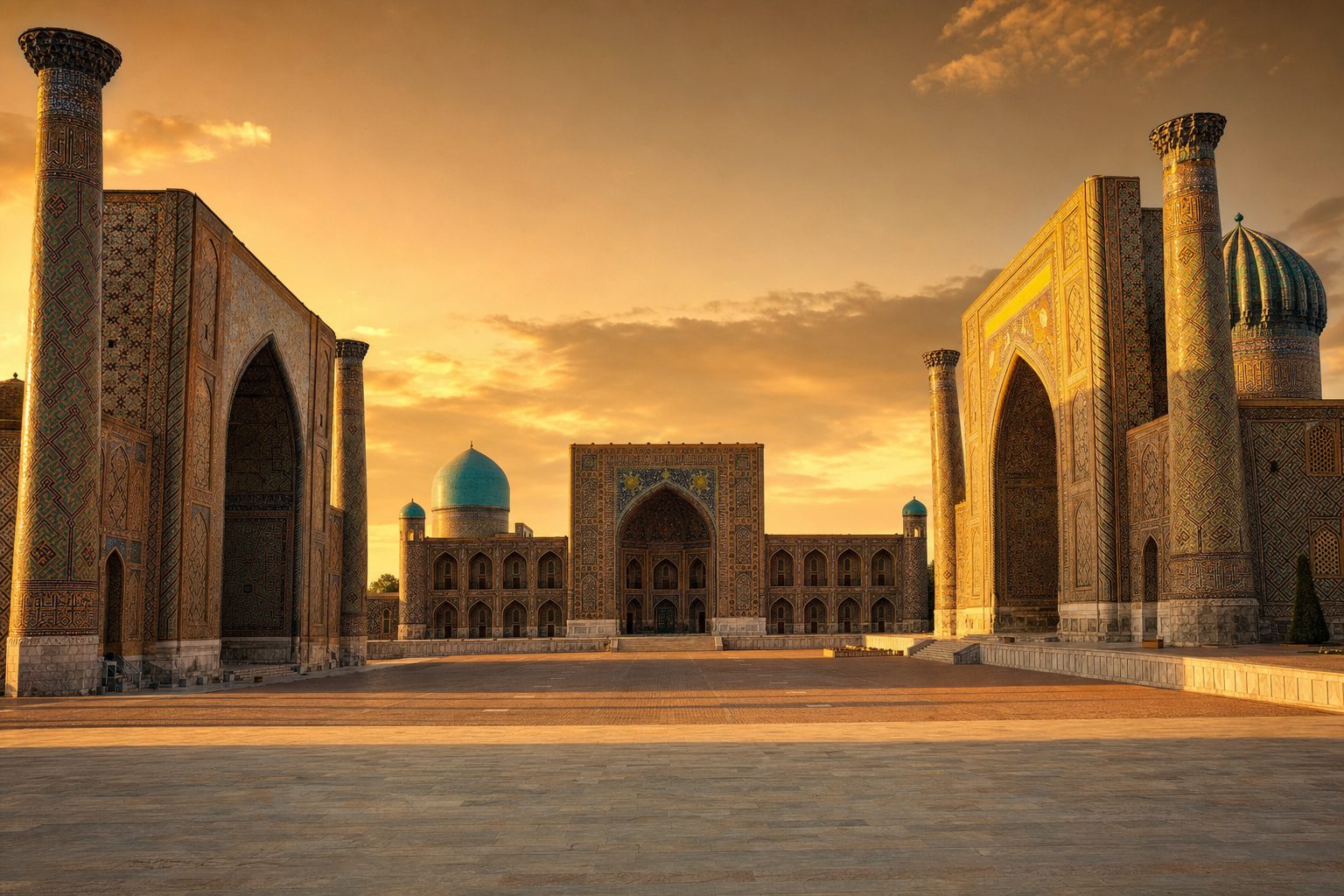
Three schools, six hundred years, one square. The line that brings most people to Samarkand is essentially accurate: the Registan is a single public plaza framed on three sides by monumental madrasas — Islamic colleges — begun in 1417 and finished in 1660, their portals tall as apartment blocks and tiled in turquoise, cobalt and gold. It is the set-piece image of the Silk Road, and it sits not in some remote valley but in the middle of a working Uzbek city of half a million people, two hours from Tashkent by high-speed train.
The decisions that shape a first visit are refreshingly few. When do you travel — spring and autumn are ideal, high summer is punishing. How do you get there — almost certainly the Afrosiyob fast train, which sells out and needs booking ahead. And how do you time the big three sights — the Registan, the Shah-i-Zinda necropolis and Gur-e-Amir, Tamerlane's mausoleum — so that you see each in its best light and ahead of the tour groups. This guide works through those choices in order, with fees and timings as checked in September 2026.
Three schools, six hundred years: what the Registan is
Registan means, roughly, 'sandy place': this was medieval Samarkand's main square, where roads converged for trade, proclamations and celebrations. The three madrasas were built as residential colleges of Islamic learning, and their construction spans nearly two and a half centuries. On the left as you face the square stands the Ulugh Beg madrasa, built 1417–1420 by Timur's grandson — an astronomer-king who taught mathematics and astronomy here himself. Opposite it is Sher-Dor (1619–1636), famous for the heraldic tiger-and-sun mosaics across its portal, a startling break with the convention against depicting living creatures. Between them sits Tilya-Kori (1646–1660), whose name means 'gilded': its mosque interior is sheathed in gold leaf beneath a ceiling that appears domed but is in fact flat.
The Registan's three madrasas were built across three dynastic eras: Ulugh Beg in 1417–1420, Sher-Dor in 1619–1636 and Tilya-Kori in 1646–1660 — one ticket now covers all three, including Tilya-Kori's gold-leafed mosque. [5]
The colleges long ago stopped teaching; their student cells now hold craft shops, small museums and workshops, which sounds dispiriting but in practice keeps the courtyards alive. In the Ulugh Beg madrasa you can climb one of the minarets for a small extra fee — around 20,000 som, paid at the stair — up a spiral staircase so narrow that only two people are meant to be inside at once. The little viewing platform gives the best elevated angle on the square that you can reach legitimately.
Booking the Afrosiyob: the fast train from Tashkent
Nearly everyone arrives by rail. The Spanish-built Afrosiyob high-speed train covers Tashkent to Samarkand in about 2 hours 10 minutes at up to 250 km/h, with several departures daily from around 6am. As checked in September 2026, economy fares run to roughly 311,000 som (about US$25), with business and VIP classes above that; seats have airline-style comfort, tea service and big windows onto cotton fields and bare hills. Book on the official Uzbekistan Railways e-ticket site or the railways app — sales open 60 days ahead, and in the April–May and September–October peaks the trains genuinely sell out days or even weeks in advance. Book the moment your dates firm up.
If the Afrosiyob is full, the slower Sharq day train does the run in about 3.5 hours for less money, and the same line continues to Bukhara, roughly 1.5 hours beyond Samarkand — worth knowing if you are building a longer Silk Road itinerary. A day trip from Tashkent is technically possible on the first train out and the last one back, but it wastes the city's best hours: the monuments are lit every evening, and staying at least one night is the single best planning decision you can make. The station sits about 6 km from the Registan; a taxi in is 30,000–50,000 som, and the Yandex Go app keeps rides haggle-free at US$1–2 across town.
Registan tickets, hours and beating the groups
As checked in July 2026, Registan entry for foreign visitors was 100,000 som (about US$8), covering all three madrasas, with opening hours of roughly 8am to 8pm and later closing in summer. [4]
Fees across Samarkand's monuments rose sharply through 2025–26 and continue to shift, so treat every figure here as close rather than exact and carry som in cash — the Registan ticket office takes cards, but smaller booths often do not. The square itself is open around the clock and costs nothing to admire from the viewing terrace; the ticket buys you into the courtyards and interiors. Allow a good two hours.
Timing matters more than anything else here. Photographers also rate the last two hours before sunset, when the sun drops behind the Ulugh Beg madrasa and the tilework goes molten; if that is your plan, buy your ticket around 5pm and stay through golden hour into the illumination. Either way, avoid the dead middle of the day, when the light is flat and the coaches are in.
The illumination and the sound-and-light show
Two different things happen at the Registan after dark, and it pays to know which is which. The first is the nightly facade illumination — free, reliable, and reason enough to linger. The second is a projected sound-and-light show, a 25-minute narrated spectacle that maps Samarkand's history onto the madrasa facades, from Alexander the Great at Marakanda through Genghis Khan's destruction and Timur's rebuilding. As checked in September 2026, the show runs nightly from April to October, starting around 8.30pm in spring, 9.30pm in high summer and 8pm in September–October, with seated tickets sold on the square from 6pm (around 150,000 som for adults) and free sightlines from the lawns and terraces outside the ticketed area. Schedules are not always formally published and shows occasionally skip a night, so ask your hotel to confirm that day's timing rather than planning your only evening around it.
Shah-i-Zinda and Gur-e-Amir: timing the other two
Shah-i-Zinda — 'the Living King' — is an avenue of mausoleums climbing a hillside north-east of the bazaar, built mainly between the 11th and 15th centuries for Timur's relatives and nobles around the shrine of Qusam ibn Abbas, a cousin of the Prophet Muhammad said to be buried here. The tilework is the finest in the city, a corridor of every blue the Timurid palette could produce. Entry was around 80,000 som as checked in mid-2026, with hours of roughly 9am to 7pm and later closing in summer. Come at opening or in the last hour of the day: by 10am the narrow lane fills shoulder-to-shoulder with groups, and the late-afternoon light on the tiles is the best in Samarkand. This is an active pilgrimage site, so cover shoulders and knees and keep your voice low.
Gur-e-Amir, a ten-minute walk south-west of the Registan, is the tomb of Timur — Tamerlane — beneath a fluted turquoise dome, with his sons and his grandson Ulugh Beg buried alongside and a slab of dark jade marking the conqueror's grave. The interior ceiling, a dense lattice of gold and lapis, is the most opulent surface in the city. Entry was around 65,000–75,000 som as checked in mid-2026, and summer evening opening makes a late visit worthwhile: the exterior lighting after dark is superb. Architecturally this building is an ancestor: its dome and chamber directly influenced the mausoleums Timur's descendants, the Mughals, later raised in India — a lineage that runs straight to the Taj Mahal.
Ensembles such as the Bibi-Khanym Mosque and Registan Square played a seminal role in the development of Islamic architecture across the whole region, from the Mediterranean to the Indian subcontinent.
— Paraphrased from the UNESCO World Heritage listing for Samarkand – Crossroad of Cultures
Round out the circuit with Bibi-Khanym Mosque, Timur's over-ambitious congregational mosque with its 35-metre entrance portal — largely a Soviet-era reconstruction after centuries of partial collapse, and honestly best appreciated from the street if your budget is tight — and Siyob Bazaar next door, the city's biggest market. The bazaar is the place for dried apricots, walnuts, halva and Samarkand non, the dense round bread stamped with patterns; taste what you are offered, bargain gently and without theatre, and assemble a picnic for the train.
When to go, and what Samarkand costs
April–May and September–October are the sweet spots: warm days, cool nights, poplars green or golden. High summer is the trade-off season — July and August regularly push past 38°C, which means sightseeing early and late with a long rest at midday, though the show runs latest and Shah-i-Zinda stays open into the evening. Winter is cold but crowd-free, and the blue tilework is remarkable against snow. Note that the peak seasons are exactly when the trains sell out, so transport booking discipline matters most when the weather is best.
Budgeting is simple. The five headline sights — Registan, Shah-i-Zinda, Gur-e-Amir, Bibi-Khanym and the Ulugh Beg Observatory — totalled roughly 350,000–400,000 som (US$28–32) per person as checked in July 2026. Meals run about US$3–10 a head, taxis US$1–2, and a good half-day local guide US$25–40, though the sights are easy to manage independently. ATMs are common in the centre and cards work in larger restaurants and hotels, but keep cash for ticket booths, the bazaar and taxis. Two full days is the sweet spot: the big three plus bazaar on day one, Shah-i-Zinda early on day two followed by the Ulugh Beg Observatory and the Afrosiyob Museum.
Visas, registration and manners
Uzbekistan's Ministry of Foreign Affairs lists visa-free entry of up to 30 days for citizens of more than 75 countries — including the UK, the EU states, Japan, Canada and Australia — while US citizens generally need an e-visa unless aged 55 or over. [2]
Entry, for most readers, is the easiest part: check your nationality against the official MFA visa page before booking, and make sure your passport carries comfortable validity. Hotels register foreign guests automatically; if you stay in a private apartment, confirm your host lodges the registration, since proof can be requested on departure. Uzbekistan is relaxed by regional standards and notably safe for visitors, including solo travellers — normal bazaar-and-station precautions apply. At religious sites, particularly Shah-i-Zinda and Bibi-Khanym, cover shoulders and knees; scarves are sold at entrances if you are caught short. Ask before photographing people.
- Book the Afrosiyob on eticket.railway.uz as soon as dates are fixed — sales open 60 days out and peak-season trains sell out.
- Reserve a hotel within walking distance of the Registan and stay at least one night for the illumination.
- Plan the Registan for 8am opening, Shah-i-Zinda for late afternoon and Gur-e-Amir towards evening.
- Carry som in cash for tickets, taxis and the bazaar; cards are patchy outside larger venues.
- Confirm that evening's sound-and-light show timing with your hotel — schedules shift and nights are skipped.
Samarkand rewards the planner lightly: one train booking, one well-timed morning, and the rest falls into place. If the Registan starts a taste for monumental places reached by early starts, the carved facades of Petra scratch the same itch further west along the old trade routes, and the cave churches and dawn balloon fields of Cappadocia make a natural next chapter for anyone routing home through Türkiye.
Sources & further reading
- 1. UNESCO World Heritage Centre — Samarkand – Crossroad of Cultures
- 2. Ministry of Foreign Affairs of Uzbekistan — Visa to the Republic of Uzbekistan
- 3. Uzbekistan Railways — official e-ticket portal
- 4. Uzbekistan Wanderer — Samarkand Travel Guide
- 5. Anastasi Fink — Registan Square, Samarkand: A Complete Visitor's Guide
- 6. Safar — Registan Sound & Light Show 2026 Guide
- 7. Hit the Road Ket — How to Visit Registan