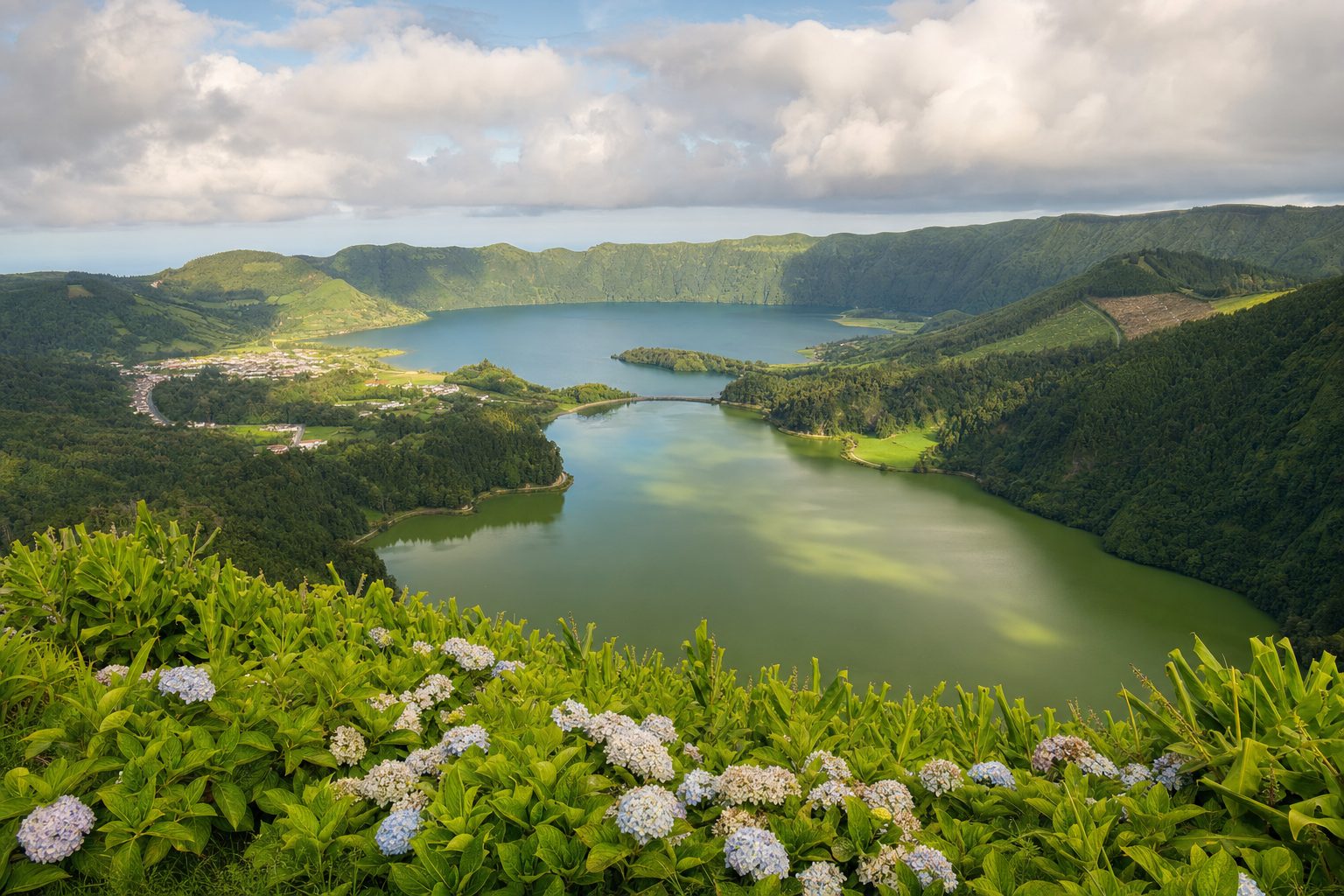
São Miguel is the largest of the nine Azorean islands and the one most travellers land on first, drawn by a single image circulating on Instagram: two lakes, one green and one blue, filling a volcanic crater at Sete Cidades. That view is real, but it is also weather-dependent, ticket-gated in places, and increasingly rule-bound in ways that were looser even three or four years ago. The decisions that shape a trip here are less about which sights to see, since the island is compact enough to cover most of them, and more about when to go, how to book, and how to behave around landscapes the regional government now actively manages rather than simply leaves open.
This guide works through those decisions in order: hiring a car, timing Sete Cidades against the fog, booking the Furnas hot springs correctly, understanding the new access rules at Lagoa do Fogo, budgeting for the municipal tourist tax, and choosing a season for whale watching. Treat the specifics as current as of the source dates below and re-check anything time-sensitive, since ticketing systems and access rules on the island have changed more than once in the past two years.
Deciding whether to hire a car, and when to book it
São Miguel has no rail network and limited bus coverage to the crater lakes and eastern viewpoints, so a hire car is the practical default for anyone wanting to reach Sete Cidades, Furnas, Lagoa do Fogo and the Nordeste coast on their own schedule rather than a tour operator's. The complication is supply rather than roads: the island's rental fleet is small relative to summer demand, and prices climb sharply as availability tightens, particularly for automatics, which make up a small share of the fleet. Travellers planning a June-to-September visit are consistently advised to book a car as soon as flights are confirmed, sometimes months out, rather than after arranging accommodation. Outside peak season, from October to May, rates drop and cars are easier to find, though weather and rain are more of a factor on driving days.
Sete Cidades: reading the fog before you drive up
The twin-coloured lake at the heart of Sete Cidades sits inside a volcanic caldera on the island's western end, and the classic photograph is taken from Miradouro da Vista do Rei, named for the 1901 visit of King Dom Carlos and Queen Dona Amélia. Officially the lake is one connected body of water, though it is generally described as two lakes, Lagoa Azul and Lagoa Verde, coloured differently by depth and algae rather than by the star-crossed shepherd-and-princess legend locals tell visitors. The area is protected as the Sete Cidades Lake landscape, recognised among the Seven Natural Wonders of Portugal.
As checked in July 2026, the Sete Cidades lake and crater are officially designated the Protected Landscape of the Sete Cidades Lake Basin, one of the Seven Natural Wonders of Portugal, with the Vista do Rei viewpoint named for a 1901 royal visit. [3]
The real planning problem is not the legend but the microclimate: this caldera sits at altitude on an Atlantic island, and cloud can roll in and erase the view within the hour, regardless of the forecast checked the night before. Travel writers who cover the island repeatedly point to the same workaround, which is checking a live webcam rather than a weather app before making the drive up. Building a flexible morning, with Vista do Rei as a first or last stop rather than a fixed midday slot, is the most reliable way to avoid arriving at a wall of white.
Furnas hot springs: booking Poça da Dona Beija correctly
Furnas, on the island's east side, is the geothermal valley where São Miguel's volcanic activity is most visible above ground, and its best-known bathing spot is Poça da Dona Beija, a set of iron-rich thermal pools kept around 39°C. Tickets are sold only through the venue's own booking system, and pricing is split by time of day: €12 per person for entry until 5:30pm, rising to €16 from 6pm onward, with reduced child rates and free entry under age two. Minors may only enter accompanied by an adult.
As checked in July 2026, Poça da Dona Beija charges €12 per person for entry until 5:30pm and €16 from 6:00pm onward, with tickets sold exclusively through the venue's own online booking system and no cancellations or refunds once purchased. [1]
The water's high iron content is the reason the pools have their distinctive orange-brown tint, and it will discolour light-coloured swimwear, jewellery and dyed or bleached hair, sometimes irreversibly, a point the venue's own guidance flags directly. Bringing older, darker swimwear rather than a new white or pastel suit avoids an unwelcome souvenir. Sessions run to a fixed duration once booked, and because tickets cannot be exchanged for a different date or time, the venue's guidance is blunt about not purchasing until a visitor is certain of the slot.
The operator advises that dyed or bleached hair, and coloured nail varnish, may change colour on contact with the iron-rich water, and states plainly that anyone unsure of their booking date or time should not proceed with the purchase, since tickets cannot be exchanged or refunded.
— Paraphrased from the official Poça da Dona Beija FAQ
Furnas is also where São Miguel's geothermal heat becomes dinner: at the northeastern edge of Furnas lake, restaurants bury sealed pots of cozido, a mixed meat and vegetable stew, in volcanic ground that holds a steady, high temperature, retrieving them some six to seven hours later fully cooked with no flame or electricity involved. The cooking ground is publicly viewable, and pots are typically lifted out around midday, making a late-morning stop at the lakeshore a reasonable add-on to a hot springs booking rather than a separate excursion. Travellers combining thermal towns across Portuguese islands sometimes pair this stop with the walking trails of Madeira for a wider look at Portugal's volcanic Atlantic outposts.
Lagoa do Fogo: what the new shuttle rule actually means
Lagoa do Fogo, the island's highest lake, sits inside the collapsed caldera of the Água de Pau volcano and has been protected as a nature reserve since 1974, later gaining Ramsar wetland status and inclusion in the EU's Natura 2000 network. Where Sete Cidades can be driven right up to, Lagoa do Fogo has tightened its rules: during the peak season roughly mid-June to the end of September, the connecting road between Caldeira Velha and Casa da Água is closed to private rental vehicles between 9am and 7pm, and visitors instead leave the car at one of the two bookend car parks and use a dedicated shuttle bus that links the viewpoints along the route.
As checked in July 2026, Lagoa do Fogo has been protected as a nature reserve since 1974 and is now managed alongside the wider São Miguel Nature Park, with the reserve covering roughly 507 hectares of the Água de Pau volcano's collapse caldera. [4]
The shuttle runs daily and charges a modest fee for non-residents, with Azorean residents and young children riding free; a single ticket typically allows hopping on and off at the route's viewpoints for the rest of that day. Outside the restricted hours, or outside the mid-June to September window, driving straight up in a rental car remains possible. Swimming in the lake itself is not permitted, since it remains a protected water body, and the steep informal path down to the pumice beach at the shoreline is not an official trail, though it is well used; travellers who prefer a signed route can instead take the longer Praia–Lagoa do Fogo trail to reach the shore legitimately. As with Sete Cidades, exact shuttle hours and fees should be confirmed close to a travel date, since the system was only introduced in 2023 and has been adjusted since.
- Confirm the current Lagoa do Fogo shuttle schedule and fee before driving up during the June-to-September window, since private rental cars are barred from the connecting road between roughly 9am and 7pm in that period.
- Pack proper walking shoes if descending to the lake's pumice beach; the direct route from the main viewpoint is a steep, unofficial path rather than a maintained trail.
- Do not plan to swim at Lagoa do Fogo; it is a protected reserve and bathing in the lake is not allowed.
- Bring cash in small euro denominations for shuttle tickets, parking machines, and small entry fees at sites like the Furnas cooking ground.
- Treat any listed price or schedule for shuttles and springs as provisional and check the operator's own site within a week of travel.
Budgeting for the municipal tourist tax
All six municipalities on São Miguel, Ponta Delgada, Lagoa, Ribeira Grande, Vila Franca do Campo, Povoação, and Nordeste, apply a municipal tourist tax on paid overnight stays in hotels and short-term rentals, in force since January 2025. The rate is €2 per guest aged 13 or over, per night, capped at three consecutive nights per stay, meaning the maximum any guest pays per booking is €6 regardless of how much longer the stay runs. Azorean residents are exempt, as are guests displaced for health reasons, and the tax is generally collected by the accommodation at check-in rather than folded into headline room rates shown online.
As checked in July 2026, all six São Miguel municipalities charge a municipal tourist tax of €2 per guest aged 13 or older per night, capped at three consecutive nights per stay, for a maximum of €6 per guest. [5]
This is a modest sum next to flights and car hire, but it is worth factoring into a multi-stop itinerary that overnights in more than one of the six municipalities, since the three-night cap resets per establishment rather than covering an entire trip. Anyone piecing together a longer Portuguese island-hopping route, weighing São Miguel against a stay on the mainland, might compare notes with a broader guide to Lisbon and the Algarve, where municipal tourist taxes follow similar per-night structures but different caps.
Choosing a season: whale watching, weather, and crowds
São Miguel's waters sit on a migratory corridor used by baleen whales moving between equatorial breeding grounds and summer feeding areas off Greenland, Iceland and Norway, which makes spring the standout season for the largest species. Sperm whales, by contrast, are resident year-round and can reasonably be expected on any given outing, with slightly better odds in summer. Regional tourism guidance frames sightings as occurring on the large majority of trips across the calendar, weather permitting, rather than being confined to one narrow window.
As checked in July 2026, the Azores' official tourism guidance states that blue whales are most easily spotted at the end of winter into spring, sperm whales are present year-round, and spotted dolphins are more common in summer, with whale and dolphin sightings occurring on the large majority of boat trips regardless of season. [2]
Whale watching here is tightly regulated: licensed operators must keep at least 50 metres from any animal, 100 metres if calves are present, cap the number of boats near a single sighting at three, and limit swimming with cetaceans to dolphins under strict conditions, with swimming alongside whales prohibited outright. Choosing a licensed operator that follows this code, rather than the cheapest available trip, is the more meaningful decision for most visitors than picking an exact month, since sightings are reported on the vast majority of outings across the year. Broader seasonal planning for São Miguel otherwise mirrors much of coastal Atlantic Europe, and travellers building a longer trip around it might find useful parallels in a guide to lesser-known finds across Europe for pacing a multi-stop itinerary.
None of these systems, the springs' timed tickets, the lake reserve's shuttle hours, the tourist tax, are especially burdensome on their own, but together they mean a São Miguel trip rewards a small amount of upfront booking far more than it used to. Reserve the car early, book Poça da Dona Beija once the itinerary is fixed, and hold the Sete Cidades drive loosely enough to chase clear weather rather than a fixed time slot; travellers extending the trip to a second Portuguese island often continue on to the levada network of Madeira, which runs on a comparably rule-bound but rewarding system of its own.
Sources & further reading
- 1. Poça da Dona Beija official FAQ
- 2. Visit Azores: Whale Watching
- 3. Visit Azores: Protected Landscape of the Sete Cidades Lake
- 4. Parques Naturais dos Açores: Lagoa do Fogo Nature Reserve
- 5. Hostwise: 2026 Portuguese Municipal Tourist Tax Guide (Azores table)
- 6. Visit Azores: Fogo Lake
- 7. Azores Regional Government: Lagoa do Fogo Shuttle Announcement
- 8. My Azores Home: Renting a Car in São Miguel (2026 Guide)