A first safari is less about ticking off animals than about making a handful of good decisions early: when to travel, which parks to combine, how much to budget, and how to behave once the engine is off. Get those right and the Serengeti rewards patience with some of the most concentrated wildlife on Earth. This guide is built around those choices, not a rigid day-by-day script — because the thing most first-timers come to see, the great migration, keeps its own calendar.
What a Serengeti safari actually involves
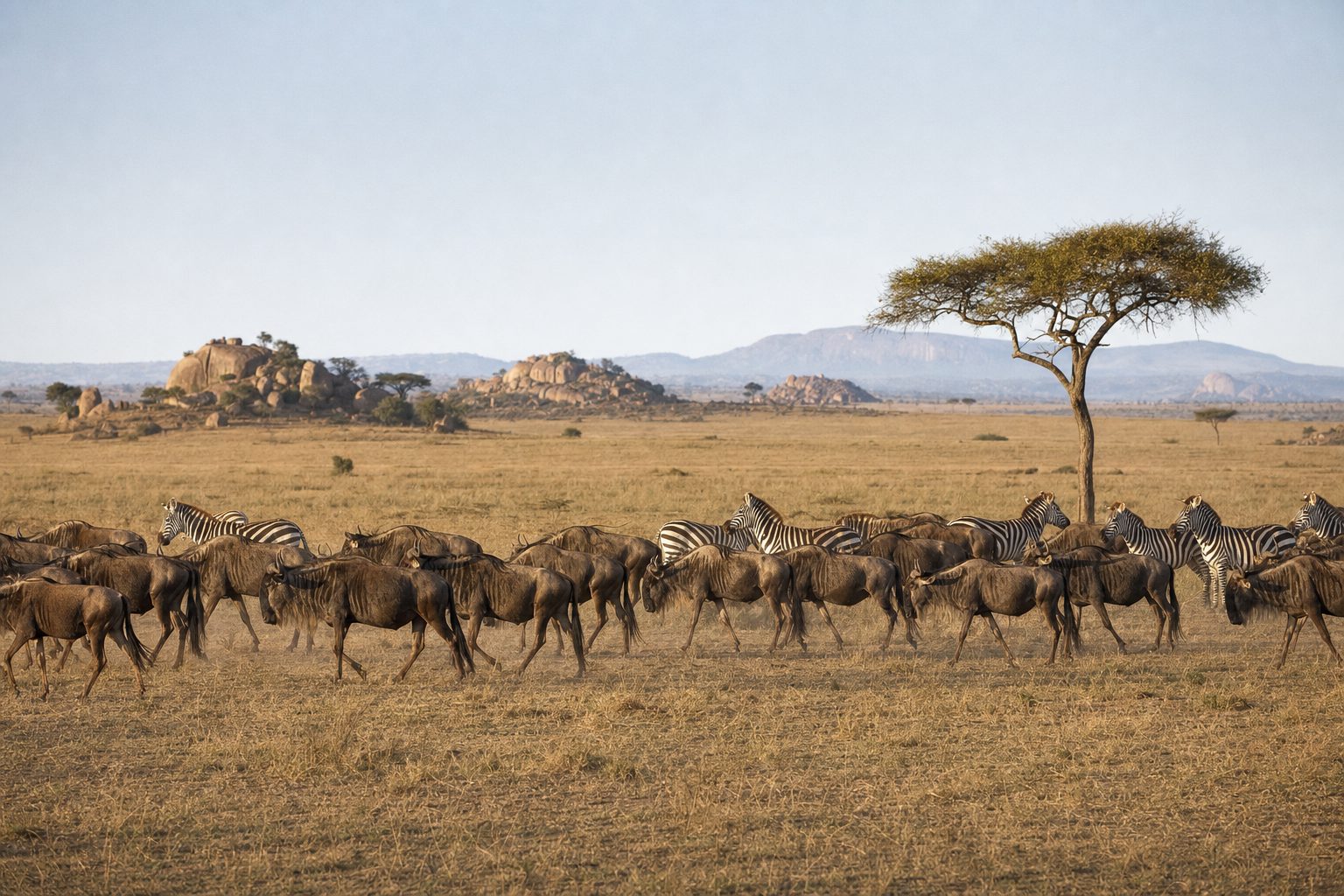
The Serengeti sits in northern Tanzania, a vast sweep of savannah that the UNESCO World Heritage listing puts at roughly 1.5 million hectares of short-grass plains, granite kopjes, rivers and woodland. Most visitors experience it from a guided vehicle on game drives at dawn and late afternoon, when animals are most active and the light is kindest. Days are unhurried by design: long, slow loops punctuated by waiting, rather than a race between sightings.

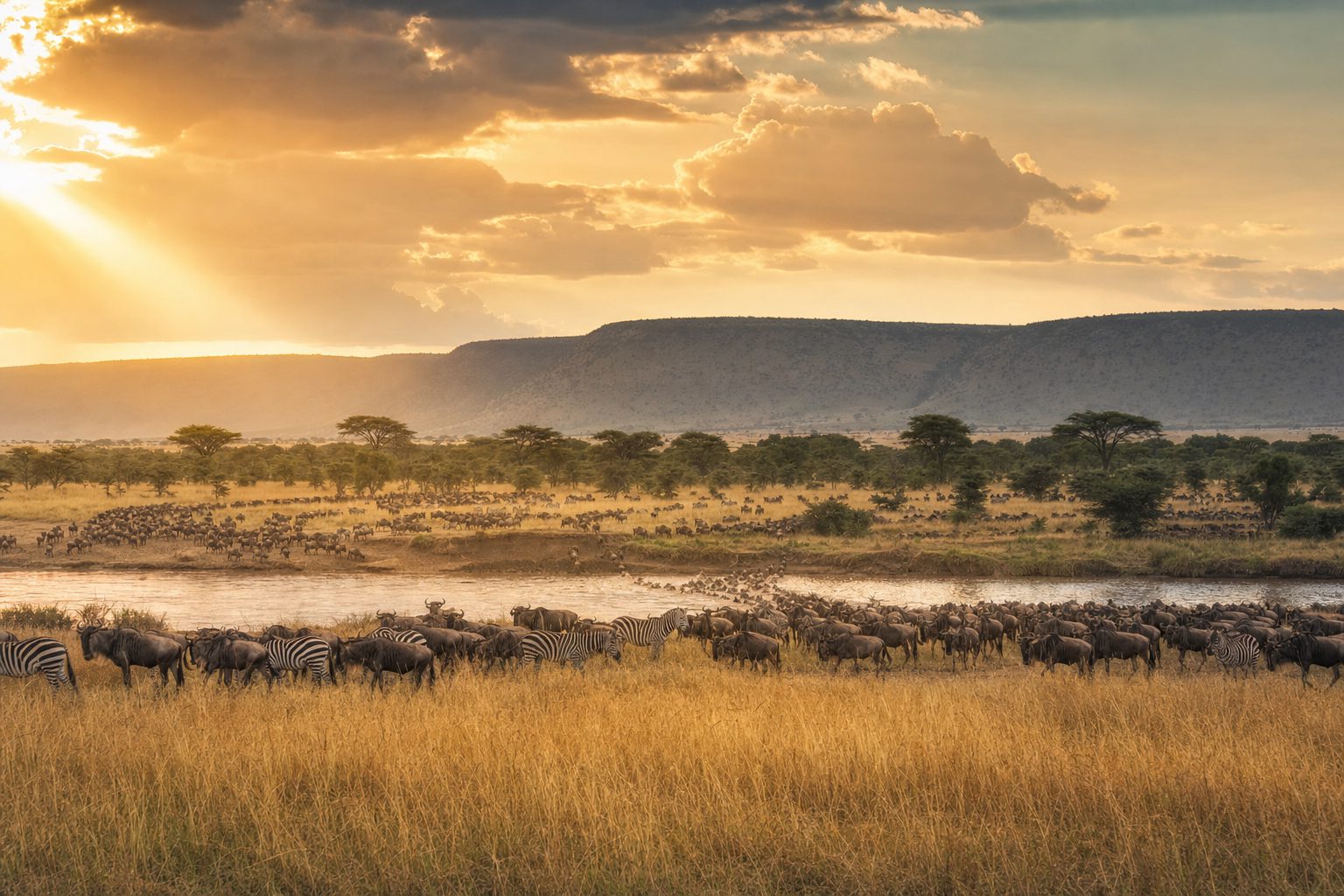
The wider Serengeti ecosystem covers about 25,000 square kilometres and supports an annual movement of some two million wildebeest alongside hundreds of thousands of zebras and gazelles. [3]
That scale is worth holding in mind. The famous herds are not staged in one spot; they are part of a living system that ranges across national parks, conservation areas and community land. Understanding where the animals are likely to be at a given time of year is the single most useful thing a first-time visitor can learn.
When to go, and why no one can promise a crossing
The migration is a loop, not an event. Over the course of a year the herds trace a roughly circular route across the Tanzania–Kenya ecosystem, following rainfall and the fresh grazing it brings. The Tanzania Tourism Board describes the animals moving north from the southern breeding plains, with many funnelling through the western corridor and across the Grumeti River while others push toward the Lobo hills.
Because that movement is driven by rain and pasture rather than a fixed date, timing shifts from year to year. A river crossing is a matter of luck as much as planning: herds can mass at a bank for hours and then turn away, and no itinerary — however expensive — can guarantee one. The honest way to plan is to choose the region where the herds are statistically most likely to be for your travel window, then treat any dramatic crossing as a bonus rather than a promise.
Choosing your parks: the Northern Circuit
Tanzania's Northern Circuit strings several protected areas together, and a strong first trip usually combines two or three rather than sprinting through all of them. The Serengeti is the anchor; its neighbour, the Ngorongoro Conservation Area, adds something completely different.
Ngorongoro covers 809,440 hectares and contains the world's largest unbroken volcanic caldera; it forms part of the Serengeti–Mara ecosystem, and calving takes place on the short-grass plains along its boundary. [4]
Ngorongoro is also a multiple-use landscape shared with semi-nomadic Maasai pastoralists, a reminder that this is lived-in country rather than a fenced zoo. Pairing the open Serengeti plains with the enclosed drama of the crater gives a first visit both breadth and contrast. Travellers extending further across the continent often bookend a safari with a city stay — our guide to the Marrakech medina is a useful companion for the North African leg of a longer Africa trip.
What it costs: fees you can check today
Park fees are a real line in any safari budget, and they change, so it pays to read them at the source. As checked in July 2026, the TANAPA tariff page lists a non-resident Serengeti conservation fee of US$70.80, valid for 24 hours, with under-fives free and reduced rates for children aged five to fifteen; the figure includes 18% VAT where applicable and is paid through the government's GePG system.
As checked in July 2026, the non-resident Serengeti conservation fee was listed at US$70.80, valid for 24 hours, inclusive of 18% VAT where applicable. [2]
Ngorongoro is priced separately, and here the official picture is less transparent: the NCAA tariff page does not currently publish a complete, up-to-date schedule of non-resident visitor, crater-service and vehicle fees. Rather than rely on second-hand figures, confirm the current rates directly with the authority — or have your operator itemise every park fee in writing — before you commit to a route.
- Ask operators to separate park and concession fees from their own service charge, so you can compare like with like.
- Remember conservation fees are time-limited (the Serengeti fee runs 24 hours), which affects how nights map to days.
- Budget for the parks you will actually enter; combining fewer areas well is usually better value than a rushed circuit.
Health and preparation
General official guidance is straightforward and worth acting on early. The US CDC's Tanzania travel health page recommends seeing a clinician at least a month before departure to be up to date on routine vaccinations and to discuss prescription malaria prevention, since malaria risk is present below about 1,800 metres.
The same official guidance stresses practical habits over anxiety: consistent insect-bite precautions, reviewing travel insurance and considering medical-evacuation cover, avoiding contact with animals, and basic road safety — using a licensed, trained driver, wearing seat belts and avoiding driving at night. None of this is medical advice for any individual; it is a prompt to have the right conversation with a qualified clinician in good time.
Watching wildlife responsibly
How visitors behave shapes whether these landscapes survive the attention. TANAPA's Mara River crossing guideline sets out clear rules at the water: vehicles stay stationary at designated crossing points, keep to maximum-vehicle and distance limits, and never approach, block or crowd the animals; occupants stay inside the vehicle and do not picnic at the riverbank.

Park management may temporarily close crossing areas for breeding or calving, where vegetation has been degraded, or in wet conditions. [6]
Restraint pays off elsewhere too. The Serengeti's Moru Kopjes shelter black rhino, and the wider ecosystem depends on the connectivity UNESCO flags as central to its value; keeping distance and staying on established tracks protects both. Ngorongoro's managers name vehicle pressure and the need for genuine community participation among their live concerns, so choosing operators who respect quiet hours and local partnerships is part of travelling well. Readers drawn to lighter-footprint travel may recognise the ethos from our quieter-corners guide to Bali.
Shaping a first itinerary
A sensible first safari is a matter of principles rather than a fixed grid. Arrive through Arusha, ease in with a smaller park, give the Serengeti the most time, and let Ngorongoro provide the contrast — leaving slack for the days when the plains go quiet. The aim is depth in a few places, not a tally of parks.
The Serengeti is described by UNESCO as a vast short-grass plain scattered with kopjes, rivers and woodland — a single connected ecosystem rather than a set of separate attractions.
— Paraphrased from the UNESCO World Heritage listing
That mindset — fewer stops, more presence — travels well beyond Africa. It is the same unhurried approach we take to the high country in our Sacred Valley walking guide, where the quiet days away from the headline site often turn out to be the ones that stay with you. Plan the Serengeti the same way, verify the practical details at their official source, and a first migration trip becomes something you can actually settle into.
Where to Eat
Dining on safari means lodge and camp restaurants rather than a la carte options — here are three that go well beyond expectations for food in the bush.

Four Seasons Safari Lodge SerengetiPan-African & international — Central Serengeti
Multiple dining venues let guests eat somewhere different each day: Nuru serves continental and Mediterranean dishes, Boma is an open-air, fire-centred venue with Maasai storytelling, and the Maji Bar and Terrace does relaxed poolside dining.
Why it’s so good: A rare full-service culinary destination in the bush, with torchlit bush barbecues, pool-island dinners and a multi-course wine-cellar tasting menu.
Top picks: Octopus ceviche and prawn linguini at Maji · Open-fire Maasai and Swahili grills at Boma

Singita Sasakwa LodgePan-African & international — Singita Grumeti Reserve
An Edwardian manor house on a hilltop in the private Grumeti Reserve, serving al fresco dinners in the courtyard under the stars with the plains stretching out below.
Why it’s so good: Genuinely exceptional food for a remote wilderness lodge, drawing on Singita's South African roots, paired from one of East Africa's finest wine cellars.
Top picks: Al fresco courtyard dinner · Bush breakfast

Sanctuary Kichakani Serengeti CampInternational safari fine dining — mobile migration camp
A luxury movable tented camp that relocates through the Serengeti to follow the Great Migration, with meals served in a dining tent lit by chandeliers made from old aluminium torches.
Why it’s so good: Celebrated for food that is sophisticated despite its remoteness, delivering refined dining deep in the migration zone.
Top picks: Chilled avocado soup · Barbecued Tanzanian beef
Sources & further reading
- 1. Tanzania Tourism Board — Serengeti
- 2. Tanzania National Parks Authority (TANAPA) — Tariffs
- 3. UNESCO World Heritage Centre — Serengeti National Park
- 4. UNESCO World Heritage Centre — Ngorongoro Conservation Area
- 5. US CDC Travelers' Health — Tanzania
- 6. TANAPA — Mara River Crossing Guideline (PDF)
- 7. Ngorongoro Conservation Area Authority (NCAA) — Tariffs
- 8. Four Seasons — Dining
- 9. Singita — Sasakwa Lodge
- 10. Evening Standard — Sanctuary Kichakani Review