The claim that pulls travellers off the Takayama–Kanazawa bus route is a structural one: the great triangular farmhouses of Shirakawa-go were raised without a single nail in their roof frames. Beams are lashed and slotted, thatch is layered a metre thick against some of Japan's heaviest snowfall, and several of the houses have stood for more than 250 years. The village in question is Ogimachi, the largest settlement in the Shirakawa-go district of Gifu Prefecture and, together with two smaller villages in neighbouring Gokayama, a UNESCO World Heritage Site since 1995.
Visiting well comes down to four decisions: which gateway city to approach from, whether to day-trip or sleep in a farmhouse, how to time the famous viewpoint, and — if you are aiming for the reservation-only winter light-up — whether you can commit months in advance. This guide works through each in turn, using fares, timetables and booking rules published by the Shirakawa-go Tourist Association and the bus operators.
What gassho-zukuri actually means
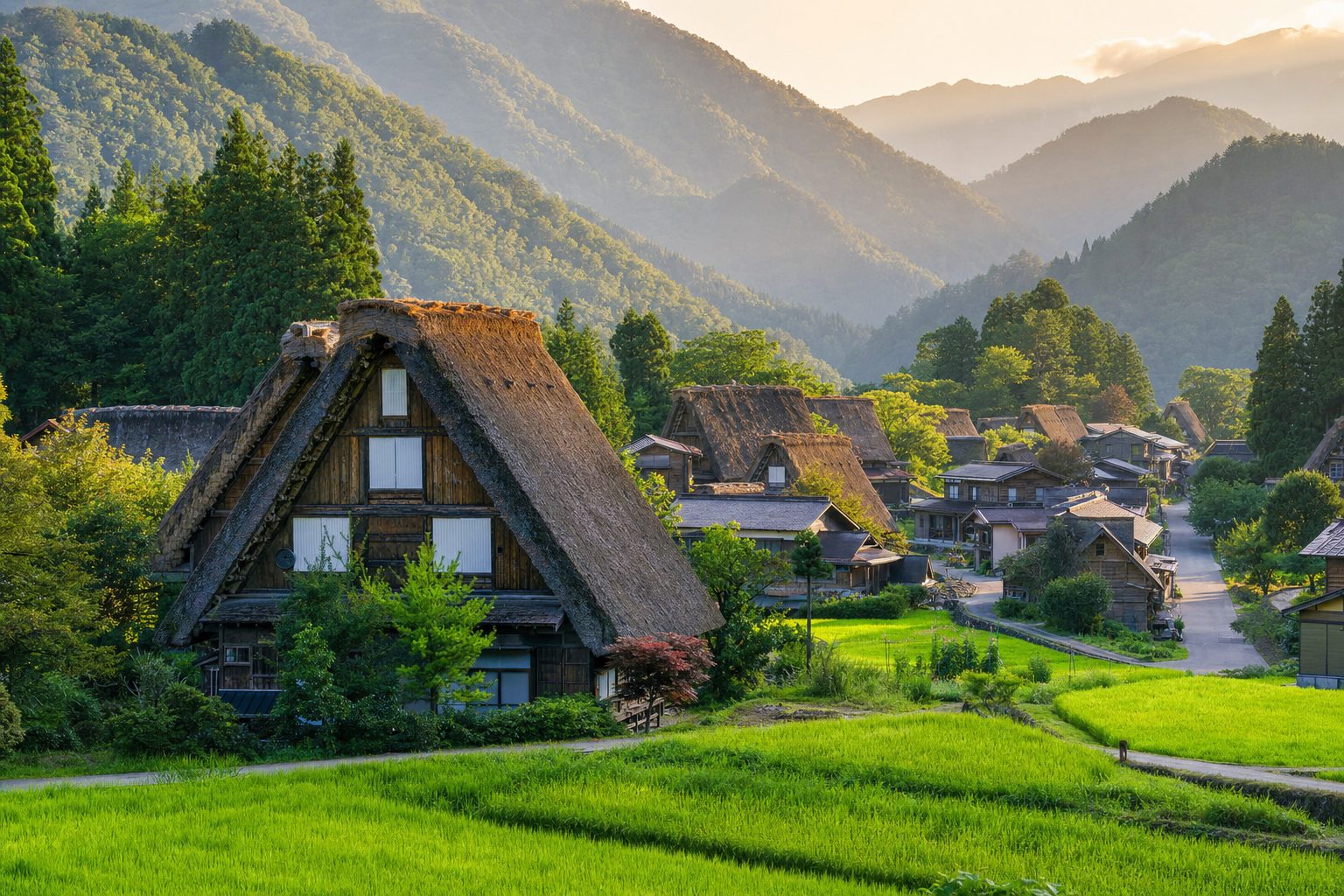
Gassho-zukuri translates roughly as “built like hands in prayer”, after the steep pitch of the thatched roofs, which sheds the heavy wet snow of the Shogawa valley. The Japan National Tourism Organization describes each house as a masterpiece of carpentry: the roof structures were assembled without nails, with every beam slotted or lashed into the next, and the vast attics were given over to silkworm cultivation, the industry that sustained these once-isolated villages. Ogimachi alone has more than a hundred gassho buildings of various sizes, and — crucially for how you should behave here — most are still private homes rather than museum pieces.
The UNESCO property Historic Villages of Shirakawa-go and Gokayama comprises three villages — Ogimachi in Shirakawa-go plus Ainokura and Suganuma in Gokayama — along the Sho River in Gifu and Toyama Prefectures; settlements have existed here since the 11th century. [5]
A handful of houses open their doors for a small fee. Wada House, a minute's walk from the bus terminal, is one of the largest gassho houses in the village and a designated national Important Cultural Property; its owners once served as village headmen and traded in gunpowder during the Edo period, and the first and second floors are open to visitors while the family still lives there. The Kanda and Nagase houses and the Myozenji temple museum fill out a comfortable half-day of interiors, sooty roof beams and silk-farming displays.
The villages are outstanding examples of traditional settlements whose large houses, with their steeply pitched thatched roofs, embody a highly rational structural system adapted to mountain isolation, mulberry cultivation and silkworm rearing.
— Paraphrased from the UNESCO World Heritage listing
Getting there: buses, not trains
No railway reaches Shirakawa-go. The village sits on the highway-bus corridor between Takayama and Kanazawa, which makes it either a return day trip from one city or — more efficiently — a stopover while travelling between the two. Because these are private highway buses run by Nohi Bus and Hokuriku Railroad rather than JR services, national rail passes do not apply; budget the fares separately and plan the rail legs to Takayama or Kanazawa with our Japan train travel guide.
Nohi Bus runs 16 round trips a day between Takayama and Shirakawa-go, taking about 50 minutes for a one-way fare of ¥2,800; roughly half the departures are reservation-required, with the rest sold unreserved on the day. [4]
From Kanazawa the express bus takes about 80 minutes, roughly 90 minutes station to station, again ¥2,800 one way — but note the stricter booking culture on this side: Hokuriku Railroad states that all of its highway buses require seat reservations, so book both directions rather than assuming you can wave down a return. As checked in September 2026, reservations for either route can be made through Japan Bus Online or the operators' telephone reservation centres; confirm current timetables on the Nohi Bus English page before you travel. Drivers should know that all private vehicles use the Seseragi Park car park across the river — ¥2,000 per car, open 8:00 to 17:00 with last entry at 16:30 — from which a suspension bridge delivers you into the village in about two minutes.
The postcard view and how to time it
The photograph everyone arrives with — the whole triangular village laid out against forested slopes — is taken from the Ogimachi Castle Ruins observation deck (Shiroyama viewpoint) on the hillside north of the village. You can walk up in about fifteen minutes on a gentle track, or take the paid shuttle bus that leaves from in front of Wada House. Light matters here: the valley runs so that the roofs are best lit before midday, and by early afternoon tour-bus crowds share the railing with you. Go up first, then descend for the house interiors.
Day trip or farmhouse night
Three to four hours is genuinely enough to climb to the viewpoint, tour two or three houses and walk the rice-field lanes — which is why the village heaves between roughly 10:00 and 15:00, when day-trip arrivals from Takayama, Kanazawa and the tour-bus circuit overlap. If that is your window, lean into the stopover model: morning bus from Takayama, luggage in a terminal coin locker, afternoon bus onward to Kanazawa. Budget modestly for interiors — the open houses each charge an entry fee of a few hundred yen, payable in cash — and leave time for an unhurried loop of the southern rice fields, where the classic three-house cluster beside the ponds is photographed at ground level rather than from above.
The alternative changes the experience entirely. A dozen or so gassho farmhouses operate as minshuku — family-run inns where you sleep on futons under those hand-lashed beams and eat dinner around the irori hearth, typically for ¥8,000 to ¥20,000 per person including dinner and breakfast, according to japan-guide.com. Rooms are few, so book months ahead through the tourist association's reservation pages. The reward is the village after 16:00, when the car park closes, the crowds drain away and Ogimachi reverts to a working farming settlement of woodsmoke and frog song. Overnight guests also hold a decisive advantage for the winter light-up, covered next.
- Book highway buses early in both directions — Kanazawa services are all reserved-seating, and popular morning departures from Takayama sell out.
- Carry cash: the viewpoint shuttle, house entry fees of a few hundred yen and some minshuku are cash-only.
- Do not enter private homes, gardens or rice fields — residents live here year-round.
- Take your rubbish with you; there are no public bins in the village, and smoking outside designated spots is prohibited.
- Driving in winter? Snow tyres are mandatory, and light-up nights require pre-reserved parking.
The winter light-up: four nights, no walk-ins
The event behind most of Shirakawa-go's viral photographs — snow-laden roofs glowing gold in the blue hour — happens on only a handful of January and February evenings each year, and access is now tightly rationed. The 40th light-up ran on four nights in early 2026, and the village has already confirmed the 41st for 11, 17, 24 and 31 January 2027. Entry to the village on event evenings is impossible without a prior reservation of some kind — an accommodation booking won by lottery, a reserved parking slot or a licensed bus-tour package — and the observation deck is further restricted to overnight guests and specific tour bookings.
The 40th Shirakawa-go Light-Up ran on exactly four nights — 12, 18 and 25 January and 1 February 2026, from 17:30 to 19:30 — and was fully reservation-only: visitors without a booking were turned away even on the day, and drone photography was strictly prohibited. [1]
As checked in September 2026, the booking machinery for each light-up opens in stages from September of the preceding year: the accommodation lottery ran through October with results in November for the 2026 event, parking reservations opened in first-come rounds from December, and bus-tour packages sold out early. Assume the same rhythm for 2027 and watch the Shirakawa-go Tourist Association's event page from early September, when reservation details are published. Note the association's own caveat that a severe cold-wave forecast can cancel an evening outright.
Etiquette in a village people live in
The single most important thing to understand about Ogimachi is that it is not an open-air museum. Families farm, commute and raise children behind those famous facades, and the village's rules exist to keep that life viable under mass tourism. Stay on public lanes, photograph houses from the road rather than the garden, and keep voices down in the early morning and evening — particularly if you are one of the overnight guests who has the lanes to yourself. Fire is the historic terror of thatched villages, and Shirakawa-go takes it seriously: the three World Heritage hamlets are laced with elaborate fire-extinguishing systems and defended by resident fire squads, which is one reason smoking is confined to designated areas and open flames of any kind are banned.
All private vehicles must use the village-managed Seseragi Park car park — ¥2,000 per car and ¥500 per motorcycle, open 8:00 to 17:00 with last admission at 16:30 — from which a suspension bridge leads into the World Heritage village in about two minutes on foot. [2]
Part of that parking fee is channelled directly into preservation work on the World Heritage site, so drivers are contributing to the roofs they came to see. Re-thatching a single gassho roof is a communal undertaking — traditionally the whole village turns out under the mutual-aid system known as yui, one of the intangible practices the World Heritage listing was written to protect — and the thatch on a given face of a roof lasts decades before its turn comes around again. If you see scaffolding and bare rafters on a house during your visit, you are watching the living system that keeps the village authentic rather than a restoration anomaly.
When to go the rest of the year
Outside the light-up circus, seasonality is straightforward. Deep winter (January–February) delivers the snow-globe scenery with no reservation gate on ordinary days, though buses fill quickly, the walking paths are icy and daylight is short — aim to arrive by mid-morning. April brings cherry blossom against the thatch; summer is intensely green, with rice fields flooded and mirror-still in June; late October into early November wraps the valley in autumn colour, and mid-October adds the Doburoku Festival, when unfiltered sake brewed under a rare legal exemption is shared at the village shrine to lion-dance performances. Whatever the season, the village rewards the first and last hours of the day — which is, again, the quiet argument for a farmhouse night.
Quieter still is Gokayama, twenty minutes further down the valley in Toyama Prefecture, where the World Heritage hamlets of Ainokura and Suganuma see a fraction of Ogimachi's traffic; reaching them requires a change of bus at Shirakawa-go, which filters out most of the crowd.
Shirakawa-go slots naturally into a first Japan itinerary as the rural counterweight to the cities: a night under thatch between Takayama's old town and Kanazawa's gardens, before the shinkansen returns you to the main line. If you are assembling that wider route, our guides to Kyoto's temples and food culture and climbing Mount Fuji cover the two other set-pieces most first-timers pair it with.
Sources & further reading
- 1. Shirakawa-go Tourist Association — 40th Light-Up announcement
- 2. Shirakawa-go Tourist Association — Access and parking
- 3. Shirakawa-go Tourist Association — Shuttle bus FAQ
- 4. Nohi Bus — Takayama–Shirakawago–Kanazawa line
- 5. UNESCO World Heritage Centre — Historic Villages of Shirakawa-go and Gokayama
- 6. Japan National Tourism Organization — Shirakawa-go
- 7. Visit Gifu — 2026 Shirakawa-go Light-Up reservations
- 8. japan-guide.com — Shirakawa-go and Gokayama