The Instagram hook is accurate: the Similan Islands really are off limits for five months of every year. Mu Ko Similan National Park, a chain of eleven granite islands roughly 70 kilometres off Thailand's Phang Nga coast, closes by order of the Department of National Parks each 15 May and does not reopen until 15 October, when the southwest monsoon has passed and the reefs have had a season to recover. There is no shoulder-season workaround, no private charter exception and no liveaboard loophole; during the closed months, nobody lands and nobody dives. The 2026–27 season opens on 15 October 2026 and runs to the middle of May 2027.
That seven-month window is only the first constraint. Daily visitor numbers are capped, entry now runs through an advance e-ticket system tied to your passport number, sleeping on the islands has been banned since 2018, and several islands — including the celebrated Koh Tachai — are closed outright for conservation. None of this should put you off; the controls are precisely why the water here is still some of the clearest in Thailand. But it does mean the trip rewards planning. The decisions that matter are when to go within the season, whether to base yourself in Khao Lak or Phuket, and whether a day trip or a liveaboard fits the kind of visit you want.
When the islands actually open
The season runs from 15 October to 15 May, a rhythm that barely changes from year to year, although the Department of National Parks confirms the exact reopening date shortly before mid-October and can close the park early if the weather turns. The closure exists for two reasons: the monsoon makes the long open-water crossing genuinely hazardous for day boats, and the reefs benefit from five months without anchors, fins and sunscreen. Rangers use the empty months to repair moorings and station buildings. If a tour operator offers you a Similan trip in July, it is not a quiet-season bargain; it is illegal.
The Similan and Surin Islands reopen on 15 October 2026 after the annual monsoon closure that began on 15 May, and the 2026–27 season runs until around 15 May 2027. [3]
Within the window, conditions are not uniform. November to April brings the calmest seas and the best underwater visibility, which regularly stretches beyond 20 metres. The weeks immediately after the October reopening are a considered choice: the reef has just had five undisturbed months, visibility is good and the peak-season crowds have not yet arrived. December to February is the busiest stretch, and the daily cap genuinely fills around Christmas, New Year and Chinese New Year, so those dates need booking well ahead. Late April tails off as the monsoon gathers.
Caps, e-tickets and how booking works
The Similans were nearly loved to death in the 2010s, when the busiest days saw around 7,000 visitors. The response, introduced in 2018, was a hard daily cap alongside a ban on overnight stays. As checked in September 2026, the widely applied limit is 3,850 visitors a day, with tighter controls at sensitive sites, and Thai media have reported the cap trimmed further in some seasons — one more reason to treat the official park information as the final word before you book.
From 15 October 2025, entry to six southern Thai marine national parks — including Mu Ko Similan, Mu Ko Surin and the park covering Maya Bay — requires a pre-booked e-ticket, with visitors providing a passport number at the time of booking. [6]
In practice, most visitors never touch the booking system directly: licensed day-trip and liveaboard operators handle e-tickets for their passengers, which is one good argument for booking with an established company rather than a beach-desk reseller. If you are travelling independently, tickets are booked in advance through the Department of National Parks' official platforms. Either way, carry the passport used at booking. As checked in September 2026, the park entrance fee is 500 THB for foreign adults and 250 THB for children aged 3–14, with divers paying an additional 200 THB per diving day; fees are usually excluded from quoted tour prices, so budget for them separately.
Since 2018 the park has operated with a daily visitor cap of 3,850 people and a complete ban on overnight stays on the islands — the bungalows, tents and camping grounds that once existed are gone. [1]
Day trip or liveaboard
Because you cannot sleep on the islands, there are exactly two ways to visit. The first is a day trip by speedboat, and here geography matters: the closest mainland departure point is Thap Lamu pier near Khao Lak, from which the crossing takes roughly 60 to 90 minutes each way. Trips sold from Phuket use the same pier but add around 90 minutes of van transfer in each direction, turning a full day into a very long one. If the Similans are the reason you are on this coast, base yourself in Khao Lak for a night or two; the shorter, safer crossing and earlier arrival are worth it. Park hours are 08:00 to 16:00, and the first boats of the day reach Donald Duck Bay well before the main fleet.
The second option is a liveaboard — a dive boat you sleep aboard, typically for four to seven nights, mooring inside the park while the day boats go home. The overnight ban applies to the islands themselves, not to licensed vessels, so a liveaboard is the only way to be in the water at first light. Itineraries usually run north through the Similans to Koh Bon and the Surin Islands, finishing at Richelieu Rock, the horseshoe seamount that is widely rated Thailand's single best dive site. It is a different trip in kind, not just in length, and comparable in spirit to how Maya Bay's conservation-era rules reshaped visits on the other side of the Andaman: the regulations decide the format, and you choose within it.
Richelieu Rock, a horseshoe-shaped seamount near the Surin Islands reached almost exclusively by liveaboard, records Thailand's most frequent whale shark encounters, with sightings almost daily from February through May. [8]
Which islands you can visit — and which are closed
The park's eleven islands are numbered south to north, and not all of them are open. Islands 1 to 3 — Koh Huyong, Koh Payang and Koh Payan — are off limits under a turtle conservation programme; Koh Huyong's long beach is a nesting ground for green and leatherback turtles and is patrolled by rangers rather than visited by boats. Koh Tachai, the northernmost island, was closed indefinitely in 2016 after its small beach was overwhelmed by visitor numbers, and it remains closed to landings, although divers can still visit some surrounding sites. Treat any 2026–27 tour advertising a Koh Tachai beach stop with suspicion.
Koh Tachai has been closed to tourists since 2016 because of damage from overcrowding; the island remains off limits, though some dive sites in its surrounding waters are still open to divers. [2]
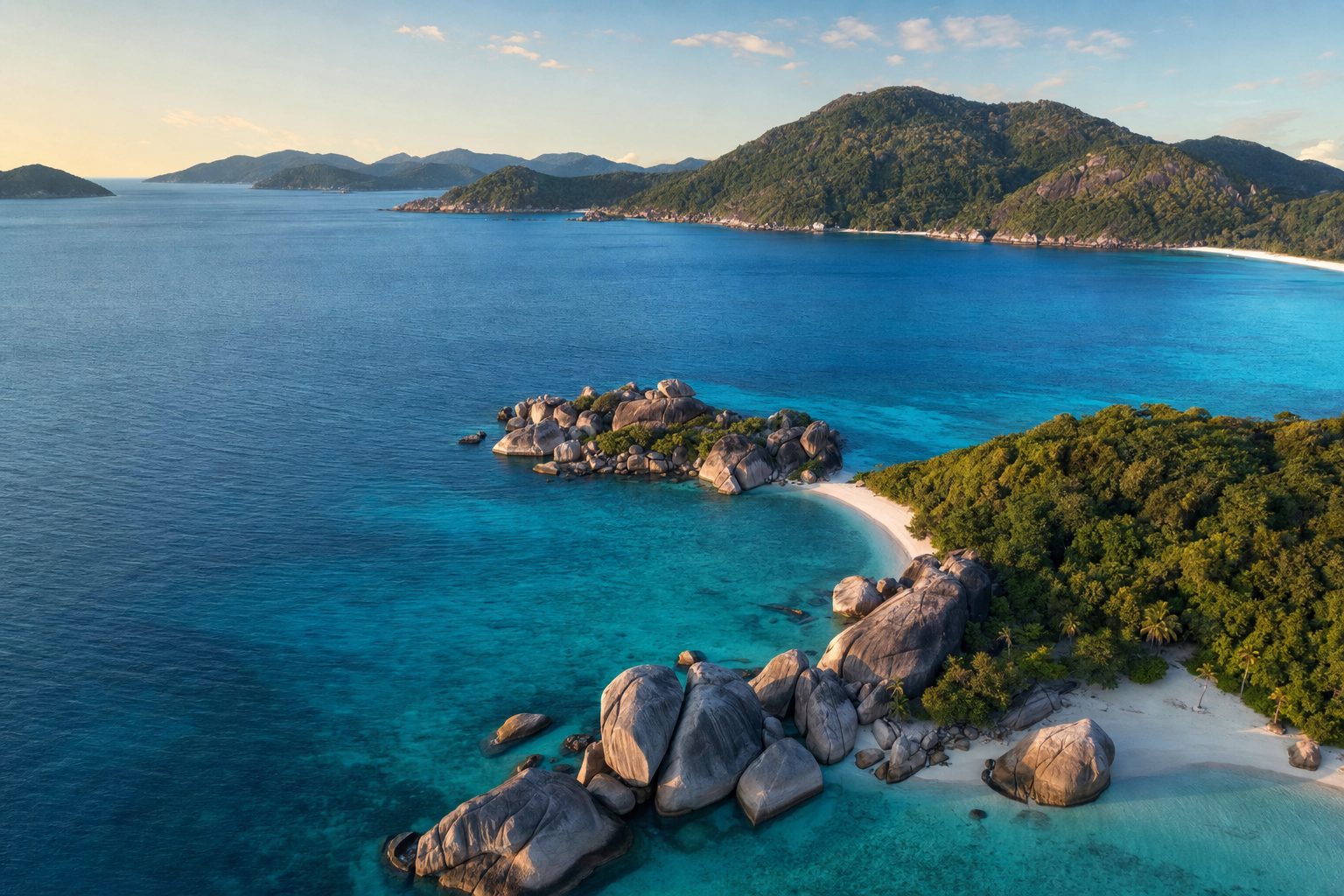
What remains is plenty. Day trips concentrate on Koh Miang (Island 4), which has the park's ranger station and two quiet beaches, and Koh Similan (Island 8), the largest island. Island 8's Donald Duck Bay — named for a boulder said to resemble the cartoon duck — is the classic lunch-and-swim stop, and the short, steep trail to the Sail Rock viewpoint above it produces the postcard image of the archipelago: a colossal balanced granite boulder over white sand and layered blues. The scramble involves uneven steps and bare granite, takes ten to twenty minutes, and queues form at the top in peak season; go early or accept the wait.
The annual closure gives the reefs a season without anchor chains, fins or sunscreen, and the crossing is too dangerous in monsoon swell for small passenger boats in any case.
— Paraphrased from the Similan National Park Guide's explanation of the closed season
Snorkelling, diving and what the fuss is about
The Similans are granite islands, not limestone karst, and that geology is the point. Enormous rounded boulders continue underwater, stacking into swim-throughs, canyons and arches that make dive sites such as Elephant Head Rock feel architectural rather than merely pretty. Visibility of 20 to 30 metres is routine in season, and the fish life runs from dense reef schools to passing mantas at Koh Bon and whale sharks later in the season. Snorkellers are well served too: the shallow fringing reefs at Islands 4, 7 and 8 hold most of the colour within a few metres of the surface, and day-trip operators supply masks and fins.
The park's conduct rules are enforced and worth internalising before you get in the water: do not touch or stand on coral, do not feed fish, and leave nothing behind. Currents at the more exposed sites can be strong, so follow the guides' briefings rather than swimming at the first thing you see. If you have snorkelled the roped-off crowds of more accessible Thai bays, the difference here — fewer boats, clearer water, intact coral — is the direct dividend of the caps and closures, the same trade-off that governs timed entry at El Nido's lagoons.
Costs and practical planning
- Park entrance fee: 500 THB for foreign adults, 250 THB for children aged 3–14, paid on top of tour prices; divers add 200 THB per diving day (as checked in September 2026).
- Day trips from Khao Lak typically include hotel pickup, the speedboat crossing, lunch, snorkelling gear and two or three island stops; Phuket departures add about 90 minutes of road transfer each way.
- Liveaboards run four to seven nights, sold months ahead for the October opening and the Christmas–New Year peak.
- Bring reef-safe sunscreen, a dry bag and cash for park fees; there are no shops on the islands.
- The season runs 15 October to 15 May only — verify exact dates with the Department of National Parks before booking flights.
How the Similans fit a southern Thailand trip
The practical geography is simple: fly to Phuket, then decide how much the Similans matter to you. If they are one stop among many, a Phuket-based day trip works, long as the day is. If they are the headline, move up the coast — Khao Lak is 90 minutes north and exists largely in service of this park and Mu Ko Surin. Divers should think in terms of a liveaboard booked around the February-to-May whale shark window at Richelieu Rock, then beach time afterwards. And if your itinerary leans towards islands with rules — capacity caps, entry fees, closed seasons — you are travelling in the right era for them: Boracay's post-rehabilitation system tells the same story further east, of places that closed, recovered and reopened on stricter terms. The Similans simply do it every single year.
Sources & further reading
- 1. Similan National Park Guide — season dates, park fees and day trips
- 2. Thai National Parks — Mu Ko Similan National Park
- 3. Siam Tour and Realty — Similan and Surin Islands reopen 15 October 2026
- 4. Simba Sea Trips — Similan Islands opening and closing dates
- 5. Phuket 101 — Similan Islands travel guide
- 6. Phuket Tropic Tours — marine park e-tickets in Thailand from October 2025
- 7. Visit Similan Islands — exploring the 11 islands of the marine park
- 8. Diving Thailand — Richelieu Rock dive site guide