The Taj Mahal is not difficult to understand; it is difficult to time well. The familiar white-marble silhouette is the payoff, but a first visit is shaped by small decisions made earlier: whether the date is a Friday, which entry gate makes sense, whether the main-mausoleum add-on matters and whether a Delhi–Agra journey leaves enough room for security and the return. Treat the monument as a controlled heritage site rather than a quick photo stop and the day becomes considerably calmer.
This is a guide to those choices rather than a promise of an empty dawn. It uses the official Taj Mahal and Archaeological Survey of India (ASI) guidance checked in August 2026; ticket prices, access rules and rail timings can change, so recheck the linked official pages immediately before paying. The key Instagram image is still worth seeking, but the practical hook is more useful: a sunrise plan, a small bag and a ticket bought before the queue is the version of the Taj that gives the rest of Agra room to breathe.
Understand what the Taj Mahal is before you plan the photograph
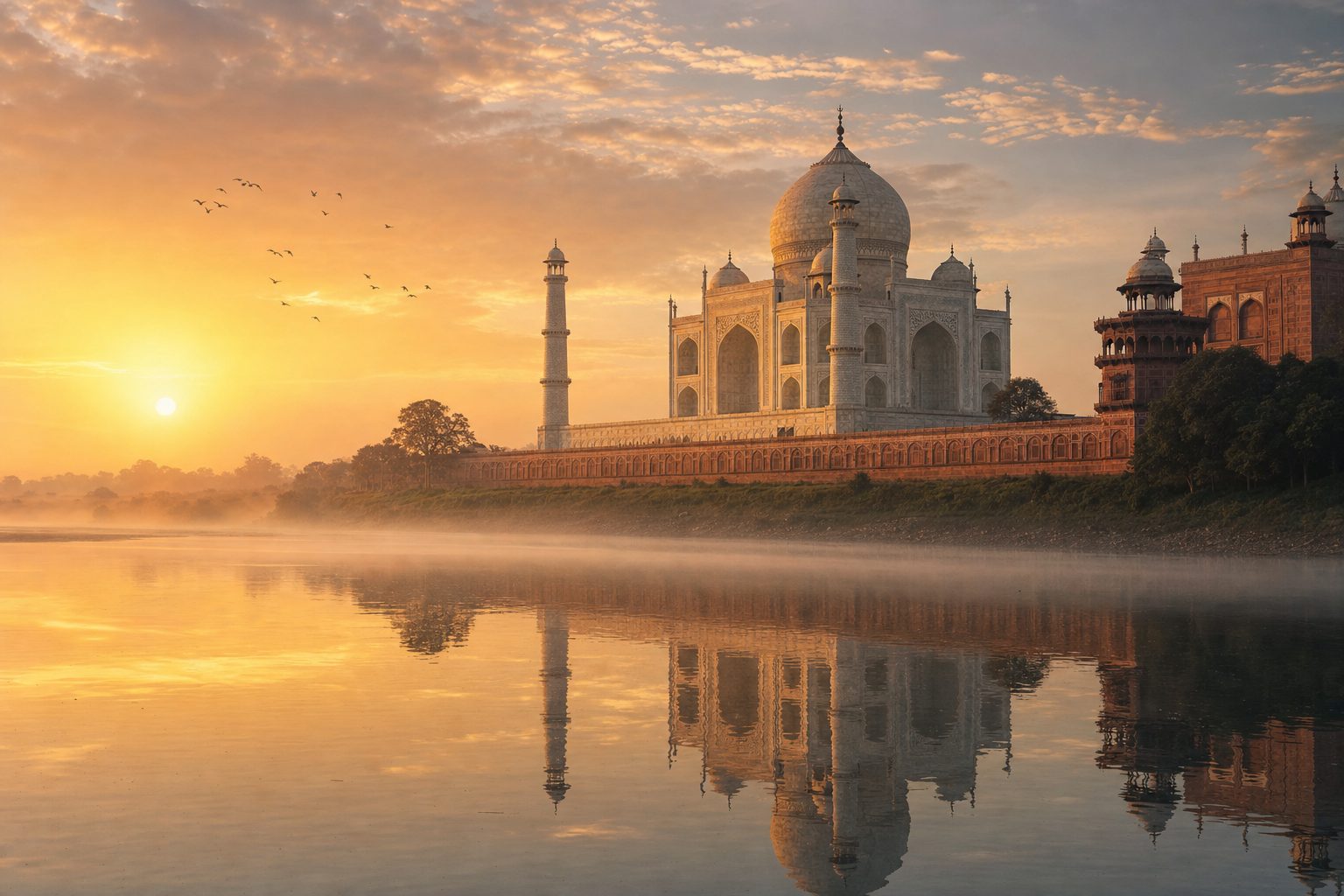
The Taj Mahal is a mausoleum within a larger riverside complex, not a palace. UNESCO describes it as the immense white-marble tomb built in Agra between 1631 and 1648 by order of the Mughal emperor Shah Jahan in memory of his wife. That framing helps set the pace: the central tomb is the focus, but the formal garden, gateway, mosque and matching guest house are part of the designed sequence, not background scenery to rush past.
UNESCO lists the Taj Mahal as World Heritage and dates its construction to 1631–1648. Its listing calls the Agra mausoleum a masterpiece of world heritage built by Shah Jahan in memory of his wife. [1]
At the marble platform, look sideways as well as forward. The ASI identifies the red-sandstone mosque on the west and the Mehman-Khana, or guest house, on the east. Their balance explains why the central tomb reads as a composed whole from the garden axis. Give the pair a few minutes before joining the flow towards the mausoleum: they are the architectural counterweight that makes the familiar frontal view more legible.
Buy the ticket that matches the visit you actually want
As checked in August 2026, the standard daytime ticket is Rs 1,100 for a foreign visitor, Rs 540 for citizens of SAARC or BIMSTEC countries, and Rs 50 for Indian citizens and OCI cardholders. The Rs 200 main-mausoleum ticket is additional and optional in every category. It is not simply a premium queue: it is the extra ticket that allows access to the principal tomb, so decide before arrival whether seeing that interior is part of the visit. Children under 15 are admitted free, whether domestic or foreign.
As checked in August 2026, official Taj Mahal guidance lists daytime admission at Rs 1,100 for foreign visitors, Rs 540 for SAARC/BIMSTEC visitors and Rs 50 for Indian/OCI visitors; the optional main-mausoleum add-on is Rs 200 and children below 15 enter free. [2]
Use the official Taj Mahal visiting-hours page to start the purchase process, then follow its links to ASI ticketing at asi.payumoney.com or ASI Agra Circle. The official page says online purchase is available to domestic and foreign visitors and notes a small online discount: Rs 5 on an Indian ticket and Rs 50 on a foreign ticket. Save the ticket and the identity document used for the purchase offline as well as in email; mobile reception, battery and a rushed security line are a poor place to discover a missing confirmation.
Do not select a Friday by mistake. The Taj Mahal is closed every Friday for general viewing. The ASI’s heritage page notes that the mosque is used for Friday prayers from noon to 2pm, but that does not create normal tourist access to the complex. If Friday is the only day in Agra, shift the full Taj visit to another day and use the time for Agra Fort, food or a viewpoint instead of trying to negotiate an exception. For another South Asian monument visit where access rules need to shape the trip before arrival, see our Bhutan and Tiger’s Nest guide.
Use sunrise and the correct gate to protect the day
On ordinary operating days, the official timetable puts the monument opening 30 minutes before sunrise and closing 30 minutes after sunset; last entry is 30 minutes before closing. That makes first light the most useful strategy, not because it guarantees solitude but because it keeps the first priority ahead of the heat, coach traffic and any later disruption. Check that day’s sunrise in Agra, arrive with ticket and ID already organised, and leave a buffer for security rather than interpreting the advertised opening minute as the moment to reach the perimeter.
For ticket-counter users, both the Western Gate near Saheli Burj and the Eastern Gate sell tickets from one hour before sunrise until 45 minutes before sunset. The Southern Gate is currently exit-only. The official site also notes separate domestic and foreign queues. In practice, select the gate around the location of your hotel or driver drop-off, but do not rely on a last-minute switch: the right gate on a map is less valuable than being at one gate early with a valid ticket.
Official Taj Mahal guidance says daytime ticket windows at the Eastern and Western gates open one hour before sunrise and close 45 minutes before sunset. The Southern Gate currently permits exit only; the monument itself is closed on Fridays for general viewing. [2]
Night viewing is a different product, not an evening extension of a day ticket. It is available only on the full-moon night and the two nights on either side: five nights in a lunar month. The official schedule is 20:00–23:59 in eight batches of no more than 50 people, with 30 minutes for each batch. Book only after confirming the exact eligible date and ticket procedure with ASI; the Agra Circle page lists a foreign adult night ticket at Rs 750 and advises visitors to confirm dates with its office.
If you do secure a night ticket, report at Shilpgram near the Eastern Gate 30 minutes before the time printed on it for security checks, carrying the required ID. Night viewing does not run on Fridays or during Ramzan. The short, batch-controlled visit suits travellers who deliberately want the moonlit setting; it is not a practical substitute for a daylight visit, where the garden, mosque, guest house and marble detail can be read properly.
Pack for security, not for a long day of sightseeing
Go light. ASI Agra Circle’s published prohibited-items list covers food products, smoking items and matches, gutkha, flowers and garlands, religious items, drones, big bags and briefcases. Do not bring those items hoping they will be waved through. Put only essentials in a compact bag, finish food before the security area and leave a drone at the hotel; the safest plan is to remove the decision from the checkpoint entirely.
A water bottle is allowed under the official Taj guidance. That page also says foreign and SAARC/BIMSTEC tickets include shoe covers, a half-litre bottle of water, a tourist map and battery-bus/golf-cart service, while wheelchairs are available from the ASI office. These are useful facilities, but do not treat them as a reason to carry bulky extras. Security instructions can be tightened without notice, so check the current ASI page and follow officers on the day.
- Bring ticket confirmation, the matching identity document, phone, payment method, sunscreen and a modest amount of water.
- Wear footwear that is comfortable for paved paths and accepts shoe covers or removal where required at the marble platform.
- Leave food, smoking materials, flowers, religious offerings, drones, large bags and briefcases at the hotel.
- For night viewing, carry the ID required on the ticket and no video camera; ASI says video cameras are not allowed during the night visit.
- Keep a little time after the Taj for an unhurried exit rather than scheduling a train or driver at the nominal closing time.
Use Mehtab Bagh as a second view, not a workaround
Mehtab Bagh is the useful counterpoint to the formal garden inside the monument: an alternate, across-the-river view to add later in the day. The official Taj Mahal page specifically says the Taj can be seen from this viewpoint on Fridays and on full-moon nights. That makes it a sensible Friday fallback or a quiet visual complement after a daytime entry, not a loophole that replaces the controlled experience of the monument itself.
Do not use old web listings for Mehtab Bagh hours or prices: the official Taj page still contains Covid-curfew wording, so those operational details should be confirmed locally before making a special trip. The decision is simpler than the logistics: use the garden if you want a second angle and a pause from the central complex; skip it if a short Agra stay would mean sacrificing the mosque, guest house or a properly paced Taj entry.
Read the Taj Mahal as a complete, balanced ensemble: the central marble mausoleum is framed by a mosque to the west and a guest house to the east, with the garden forming the approach rather than a decorative afterthought.
— Paraphrased from Archaeological Survey of India, Agra Circle heritage guidance
Choose a practical Agra base and a realistic arrival
For one sunrise at the Taj, stay in or near Taj Ganj rather than choosing a distant hotel for a marginal saving. The useful test is not the property’s claimed view but whether it can arrange an early departure, a legal local drop-off and a prompt return after the visit. A more central Agra hotel can suit a longer stay that includes Agra Fort and other Mughal sites, but it should not turn the first-morning journey into the most uncertain part of the day.
From Delhi, rail is often the cleanest public-transport approach: book a Delhi–Agra Cantt itinerary, because the Taj Mahal’s own travel information identifies Agra Cantt as the main station and describes rail links with Delhi and the rest of India. Use the government Indian Railways schedule and IRCTC booking search to verify the live train, departure station, frequency, seat availability and arrival time; do not build a sunrise plan around an old timetable or a named service copied from a blog.
A private road transfer is the flexible alternative when luggage, children or an early arrival complicate the rail plan, but it should still end with local transport rather than an assumed kerbside Taj entrance. The official Taj guidance says petrol and diesel vehicles are not permitted in the immediate Taj area and points visitors towards battery-operated buses, tongas and rickshaws. Agree the final drop-off and return point with the driver before leaving Delhi or Agra Cantt.
Build the first Agra day around one unhurried priority
A workable first-visit pattern is simple. Stay the night before in Agra; enter the Taj at the opening window; give the complex two to three measured hours including the mosque and guest house; then return for breakfast before choosing one further monument or a rest. Later, add Mehtab Bagh for the alternate view if timings are confirmed. This sequence leaves room for a late security line, a slower traveller or the decision to linger over the building rather than calculating every photograph against a train departure.
For a Delhi-based trip with no Agra overnight, reverse the ambition rather than the clock. Take a confirmed train to Agra Cantt, visit the Taj with a ticket already purchased, and regard the afternoon as a choice between Agra Fort, a meal and the return journey. Trying to add the night view, several monuments and a same-day rail return turns a landmark visit into a sequence of timed hand-offs. An overnight is the stronger choice if sunrise is important.
The Taj Mahal becomes easier once the immovable rules are accepted: no general viewing on Friday, a separate Rs 200 decision for the mausoleum, early security, small bags and a tightly limited lunar night visit. Use those constraints to make the Agra stop deliberate, then continue west with our Rajasthan road trip guide for a broader India journey shaped around forts, cities and road days rather than a single rushed icon.
Sources & further reading
- 1. UNESCO World Heritage Centre — Taj Mahal
- 2. Official Taj Mahal site — visiting hours and ticket prices
- 3. Official Taj Mahal site — night viewing rules
- 4. ASI Agra Circle — visitor information and night-viewing tickets
- 5. Official Taj Mahal site — visitor dos and don’ts
- 6. ASI Agra Circle — Taj Mahal heritage information
- 7. Official Taj Mahal site — Mehtab Bagh viewpoint
- 8. Indian Railways — official train schedule enquiry