For most of living memory, Theth was a place you earned. The village sits in a glacial bowl at the head of the Shala valley in Albania's Accursed Mountains, ringed by limestone walls that climb past 2,000 metres, and until 2021 the only road in was a broken track over a high pass that demanded a four-wheel drive and a strong stomach. That is the hook that brings most people here from a thirty-second reel: the valley a proper road only just reached. The asphalt changed Theth's calendar and its crowds, but not the mountains, and a first-time visitor's decisions are still shaped by snow, cash and daylight.
Those decisions come down to four questions: when you can actually get in, given that the pass is snowbound for roughly half the year; how to travel the 70 kilometres from Shkodër now that a normal car can manage it in summer; whether you are coming for the village and its day walks or for the Valbona Pass crossing and Komani Lake ferry loop; and how to behave in a working community of a few hundred people where your bed, dinner and onward lift are arranged by the same family. This guide takes each in turn, in the same spirit as our Dolomites hiking guide.
What Theth actually is
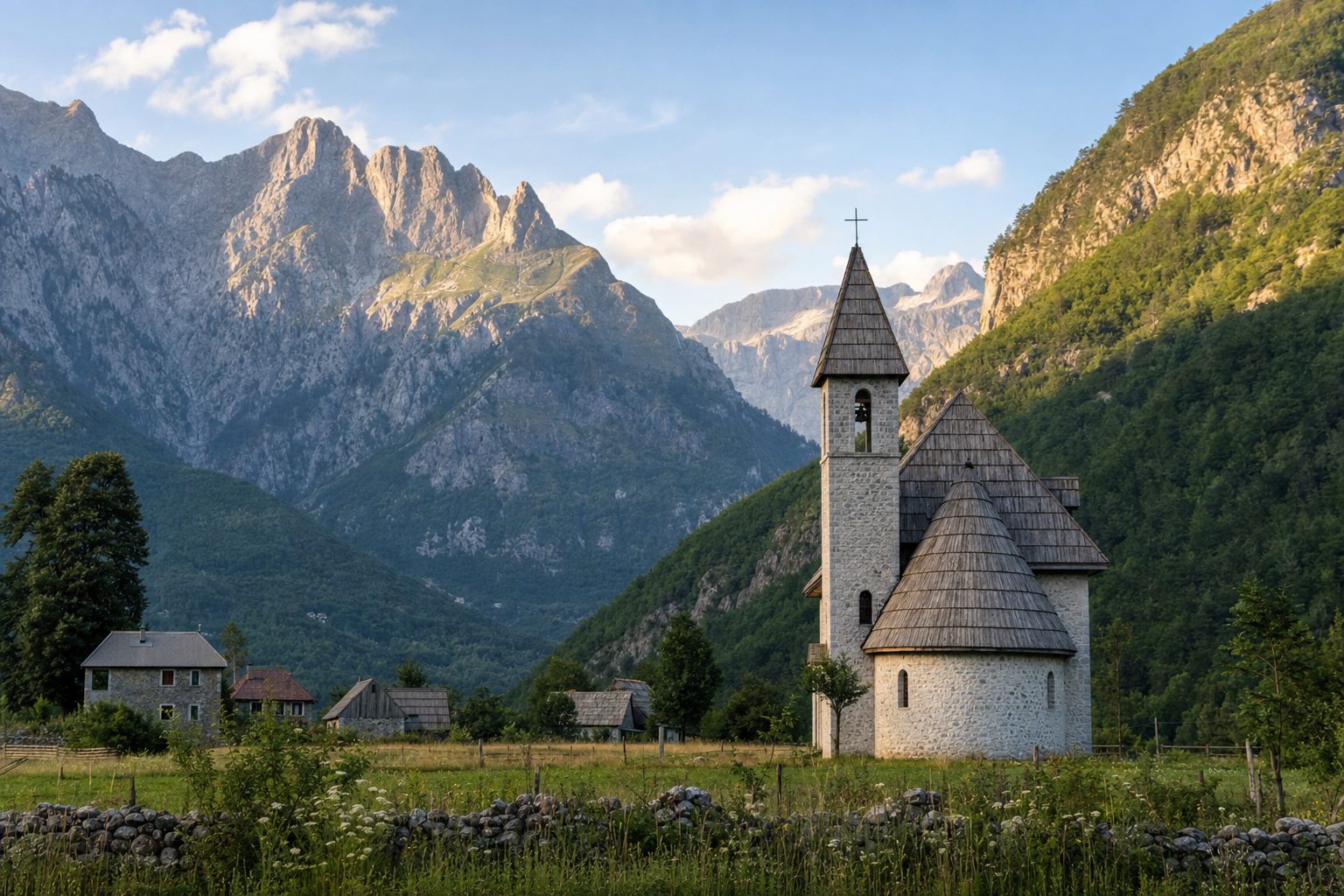
Theth is a scattered settlement: stone farmhouses and guesthouses spread along a flat valley floor at roughly 750 to 900 metres, with the peaks of Radohima, Arapi and Jezerca closing the horizon on three sides. The landmark in every photograph is the small Catholic church, a stone-and-timber building from 1892 standing alone in a meadow. Nearby is the kulla e ngujimit, the squat 'lock-in tower' where men caught up in blood feuds under the highland code of the Kanun once confined themselves; the national tourism agency lists it as the valley's principal historical monument.
The valley has been protected since 1966, when Theth National Park was declared over 2,630 hectares; in January 2022 it was folded, with the Valbona valley and the Gashi river reserve, into the much larger Alps of Albania National Park. The village core is separately designated a protected historic centre, which is why new guesthouses follow the stone-and-slate pattern and the church meadow has stayed open. The tourism agency's page on the park is the closest thing to an official visitor briefing; there is no park gate or ticket office.
Albania's National Tourism Agency records Theth National Park at 2,630 hectares, some 70 kilometres from Shkodër, and states that heavy snowfall normally lasts around 150 days a year, with the area blocked by snow for roughly six months over the pass that links Boga to the Theth basin. [2]
The road that changed everything: the SH21 and the pass
The reel is accurate. The SH21 climbs out of the Shkodër plain past Koplik and Boga, crosses the Qafa e Thorës pass and drops into Theth on a final descent of roughly 12 kilometres with around 27 hairpins and gradients of 15 to 18 per cent. Until 2021 the section over the pass was unsurfaced, which is why every older account of Theth involves a Land Rover. Since the asphalt arrived, the drive from Shkodër takes two and a half to three and a half hours in a normal car in dry summer conditions. It remains a genuine mountain road, narrow and largely without barriers, and furgon drivers do not expect to give way on the hairpins.
Published altitudes for the pass disagree: the tourism agency rounds Qafa e Thorës to 'about 2,000 metres', while road guides put it at around 1,690 to 1,700 metres. Either way it is where the snow decides the season. From roughly November until April or May the pass is usually snowbound and often closed outright for days at a time. Even when open in the shoulder months, ice on the hairpins is a serious hazard, many rental agreements forbid the SH21 outside summer, and the descent should never be attempted in rain, fog or after dark. The SH21 driving guide at Theth.net is a sober briefing if you plan to self-drive; once in Theth the car mostly stays parked.
The SH21 from Shkodër was fully paved in 2021; the final descent from Qafa e Thorës into Theth runs about 12 kilometres with roughly 27 hairpins and gradients of 15 to 18 per cent, and a normal car is sufficient in dry summer conditions. [6]
When to go: a season set by snow, not by you
The practical window is June to September, with shoulder weeks either side depending on the year's snowpack. Guesthouses follow the road: most open as the pass clears in late spring and close again in October or early November, and many owners move down to Shkodër for the winter. The Valbona Pass trail holds snow into June in a heavy year, so early-season visitors should treat the crossing as conditional and ask their host about the pass before committing to a one-way plan.
July and August bring the most reliable weather and, since the road opened, the biggest numbers: furgon seats fill days ahead and the better-known guesthouses are booked out at weekends. Late June and September are the sweet spot for walkers, with settled mornings and quieter trails. As checked in September 2026, the Shkodër to Theth minibus line and the Komani Lake ferry both run on seasonal timetables from mid-April to early November; confirm current dates with the operators before travelling outside high summer.
Getting there: furgon, ferry loop or your own car
Shkodër is the gateway. The standard approach is a shared minibus, the furgon, which leaves from outside Hotel Rozafa in the city centre at around 07:00 and 14:00 in season. The published fare is €12 a seat, paid to the driver. Booking platforms sell the same seat with a mark-up, so ask your guesthouse to hold a place; hosts in Theth also arrange the return, which leaves mid-morning or late afternoon. A private car from Shkodër is quoted from around €90 and makes sense for a group or anyone wanting to walk on the day of arrival.
The classic alternative is the loop: take the early shuttle from Shkodër to Koman, ride the Berisha car ferry two and a half hours along the fjord-like Komani Lake reservoir to Fierza, transfer to Valbona, walk over the Valbona Pass into Theth the next day, and take the furgon down to Shkodër. The circuit shows both faces of the Accursed Mountains without retracing a kilometre. The operator's timetable page publishes ferry and shuttle times together, the easiest way to check the connections still line up.
As checked in September 2026, the Berisha ferry on Komani Lake runs daily from 15 April to 5 November, leaving Koman at 09:00 and Fierza at 13:00; the standard fare is €10 or 1,000 lek per person in cash (€8.80 online), and the operator's Shkodër to Theth shuttle departs at 07:00 and 14:00 for €12. [4]
What to do in the valley: the day walks
Give Theth at least two nights. The first day is for the valley itself: a half-day walk strings together the church, the lock-in tower and the Grunas waterfall, which drops 25 to 30 metres into a pool about an hour's walk south of the village, with a longer variant continuing to the Grunas canyon. None of it is technical, but paths are stony and the valley sun is fierce by late morning.
The other essential is the Blue Eye of Theth, known locally as the Blue Eye of Kaprre to distinguish it from its namesake near Sarandë in the south. It is a karst spring pool fed by snowmelt, startlingly blue and bitterly cold. It lies down-valley: about seven kilometres by rough track to the hamlet of Nderlysa, then roughly two kilometres on foot up a river gorge with wooden bridges and some easy scrambling. Walking all the way from Theth and back is an 18-kilometre day; most visitors take the shared minibus guesthouses arrange to Nderlysa for around €5 each way and make it a relaxed half-day. Swimming is brief and bracing.
The Blue Eye of Theth is a karst spring pool about 100 square metres in area and four to five metres deep, with water at roughly 5 to 8 °C year-round; it is reached from Nderlysa, about seven kilometres down-valley, by a walk of roughly two kilometres taking 40 to 50 minutes. [7]
The Valbona Pass crossing and the Peaks of the Balkans
The walk that made Theth a destination is the crossing to Valbona: a point-to-point mountain day of around 17 kilometres, climbing roughly 900 metres through beech forest and steep meadows to the Valbona Pass at about 1,795 metres before descending some 700 metres into the Valbona valley. Fit walkers move for six to eight hours; with breaks most people are out for seven to nine. The route is waymarked in red and white as part of the Peaks of the Balkans system and there is no technical ground, but the descent into Valbona is long and ends on a stony riverbed road. Theth to Valbona puts the hard climbing first; the reverse suits those arriving on the ferry and rewards you with Theth's bowl opening beneath you.
Start early. Guides consistently advise leaving Theth by 07:00 and being over the pass by early afternoon, because summer storms build after lunch and the pass is fully exposed. Carry at least two litres of water and wear boots with ankle support. Guesthouses will send your main bag round by road for a fee. No permit is needed for the Valbona crossing itself, which stays inside Albania. The Albania Spirit route guide breaks the day into timed sections.
If you intend to continue on the multi-day Peaks of the Balkans trail through Albania, Montenegro and Kosovo over unmanned mountain borders, the rules change. As checked in September 2026, the Albanian State Police require a border-crossing application naming every group member with passport numbers and the planned points, dates and times of leaving and re-entering Albania, emailed to the regional border police directorate or to Tirana. The official application form lists the addresses; allow at least a week, and note that Montenegro and Kosovo run separate procedures.
None of the three countries has a mountain rescue service of the kind found in the western Alps; in an emergency, hikers should call 112, which coordinates police, ambulance and fire response across the region, and foreign visitors receive first aid and emergency medical care free of charge.
— Paraphrased from the Peaks of the Balkans official mountain safety guidance
Where to stay, what it costs and how to behave
Accommodation in Theth means family guesthouses, and there is no other kind. Most offer half board: a room in a stone house, dinner built around what the valley produces, such as lamb, river trout, home-made cheese and byrek, and breakfast before you walk. Prices are modest, typically €25 to €40 per person half board in high season. The permanent population is a few hundred at most, so hosts are also the transport fixers, the weather forecasters and the people who will notice if you do not come back from the pass. Book ahead for July, August and any weekend.
Etiquette is mostly common sense in a place with a strong tradition of hospitality. Tell your host your walking plan and when you expect to be back, and settle up in cash on the last evening. Paths cross working pasture and hay meadows, so stay on the track and leave gates as you find them. Carry out everything you carry in; there is no waste collection above the village. The official Peaks of the Balkans safety page lists emergency numbers for all three countries.
- Withdraw all the lek you need in Shkodër, including a buffer for a weather day; there are no ATMs in the valley.
- Book your furgon seat and first night through a guesthouse, and confirm departure times the evening before; mountain schedules shift with demand.
- Pack for two climates: shorts weather on the valley floor, a warm layer and a waterproof shell for the pass, plus boots with ankle support.
- Download offline maps and a copy of your booking details; signal drops out on the SH21 hairpins and on the Valbona trail.
- If your trip involves the Peaks of the Balkans, apply for your border permits at least a week ahead and carry printed copies.
Is Theth still worth it now the road is in? Yes, with a caveat: the asphalt has ended the sense of arriving at the end of the world, and in August the church meadow can have a coach party in it. But the valley remains one of the most dramatic in the Balkans, the walking is real, and the welcome is what guesthouse travel used to be everywhere. Theth rewards travellers who respect its short season and arrive prepared: cash in hand, a booked bed, an early start and a spare day for the weather. If the Accursed Mountains leave you wanting more of Europe's steep places, Norway's Trolltunga offers a very different kind of exposure, while the drive from Dubrovnik to Kotor makes a natural sea-level coda to a week in the Albanian Alps.
Sources & further reading
- 1. Albanian National Tourism Agency (AKT) — Theth National Park (official)
- 2. Albanian National Tourism Agency (AKT) — 'Thethi, paradise among the Alps' (official)
- 3. Albanian State Police / Ministry for Europe and Foreign Affairs — Peaks of the Balkans border-crossing application form (official PDF)
- 4. Koman Lake Ferry Berisha — timetables and prices (operator)
- 5. Peaks of the Balkans — mountain safety (official trail site)
- 6. Theth.net — Driving the SH21 to Theth
- 7. Theth.net — The Blue Eye of Theth: a complete guide
- 8. Albania Spirit — Theth to Valbona hike guide