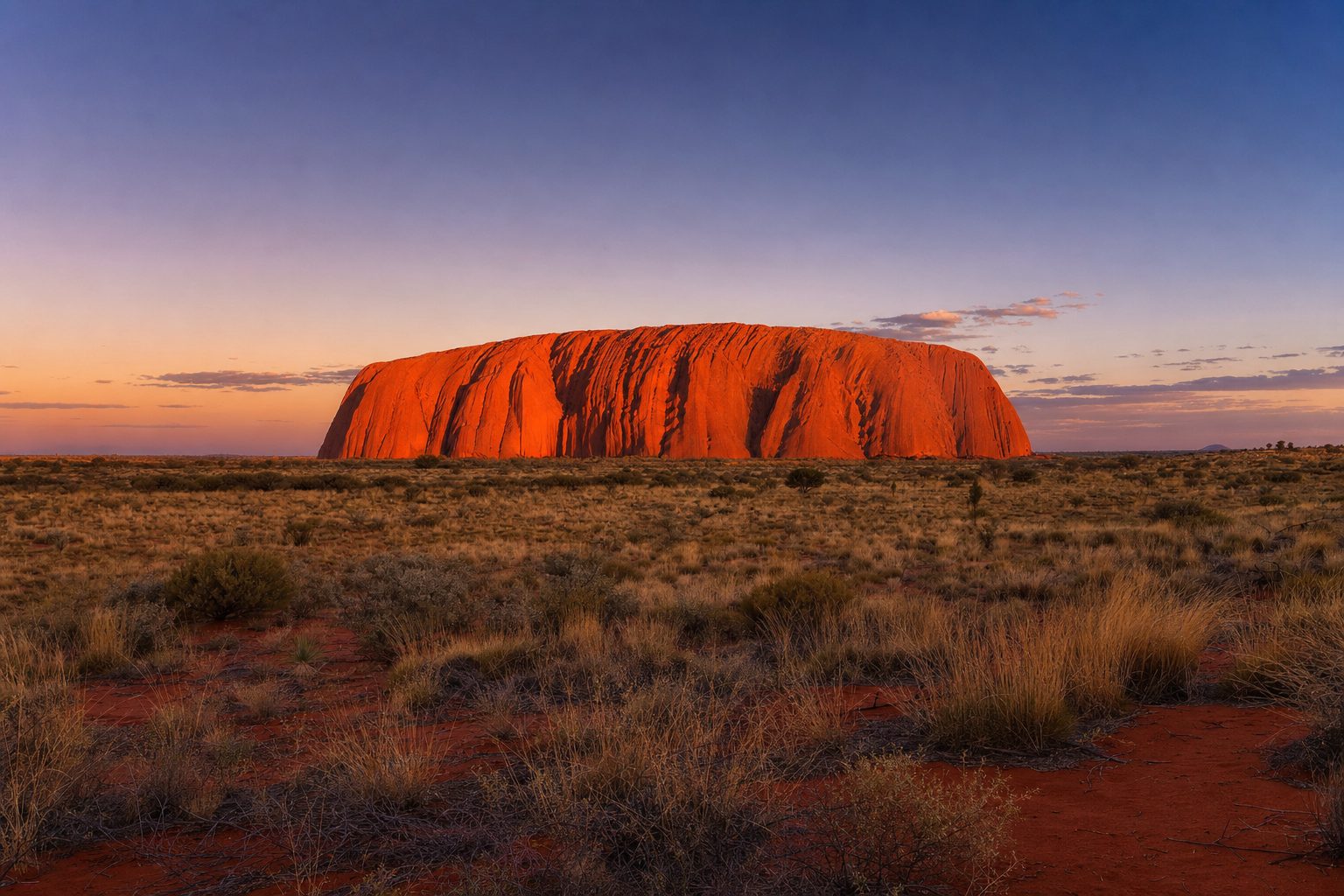
The essential Uluṟu decision has changed. The familiar image may still be a single red rock in a vast central-Australian horizon, but the useful question is no longer whether to climb it. It is how to give a sacred, jointly managed landscape enough time and attention: whether three days is worth using, whether to walk the full base, where to watch first light, and how to make the visit work without a car if necessary. The answers shape the trip far more than a checklist of photographs.
Start with the scale of the place, not the old climb. Uluṟu and Kata Tjuṯa began forming about 550 million years ago, but this is also Aṉangu Country, governed by Tjukurpa and cared for through joint management. A well-planned first visit treats the rock as part of a wider national park: make room for the Cultural Centre, one considered walk and both the Uluṟu and Kata Tjuṯa sides of the landscape. The practical details below are checked against Parks Australia information in August 2026; check the linked official pages again before travelling.
Uluṟu and Kata Tjuṯa started to form about 550 million years ago. [1]
Begin with the climb closure, then choose what the visit is for
The Uluṟu climb closed permanently on 26 October 2019. This was not a change in outdoor recreation policy to be worked around: Parks Australia explains that climbing was not generally permitted under Tjukurpa, and that the closure upholds Aṉangu law and Culture within joint management. Do not frame a visit as an attempt to reach a summit. The park’s climb-closure guidance is unambiguous: do not climb, and an attempt breaches the EPBC Act.
That leaves a better set of choices. A visitor who wants a cultural grounding should begin at the Cultural Centre, then take a guided or self-guided walk that makes the rock feel less abstract. A visitor led by light and landscape should protect a dawn or dusk window rather than trying to squeeze every viewpoint into one rushed day. Anyone who has come principally for a strenuous activity should put the 10.6-kilometre base circuit or a Kata Tjuṯa walk at the centre, with heat and closing time setting the limit. These are not substitute attractions; they are the contemporary visit.
Approach Uluṟu as Aṉangu Country: the permanent end of the climb gives visitors the chance to understand a place whose cultural obligations matter as much as its extraordinary form.
— Paraphrased from Parks Australia’s Uluṟu climb-closure guidance
There is a useful comparison with other places where access rules improve the trip rather than diminish it. Our Mount Fuji guide explains how a famous ascent now depends on booking and preparation. At Uluṟu, the lesson is different but equally clear: take the instruction seriously, and let the park’s walking, viewing and cultural opportunities define the day.
Buy the pass that matches your time on the ground
For most first-time visitors, the adult three-day pass is the sensible baseline. It buys room for a sunrise, a proper base-walk morning and Kata Tjuṯa without turning every stop into a race against a short visit. As checked in August 2026, it costs A$38 and covers three consecutive days; under-18s enter free. The A$50 adult annual pass only becomes the better value if you genuinely expect to return within the year. Fees can change, so confirm the current rate before travel through the official park-pass page.
As checked in August 2026, an adult park pass is A$38 for three consecutive days; under-18s are free, and an adult annual pass is A$50. [4]
Buy online if you can, save the QR code to the phone as well as an offline copy, and treat the pass as park entry rather than a reservation for a particular activity. It does not solve transport, breakfast before dawn or a late return from Kata Tjuṯa. Passes can also be bought at the entry station, but having one ready removes an avoidable stop when the morning light is the point. Keep the official guide on the phone too: it is a compact map, safety reminder and a useful check on seasonal operating hours.
The calendar matters as much as the ticket. Park hours vary by month; in August the park is open 6:00 am–7:30 pm, and all visitors must be out by closing time. As checked in August 2026, the park is also scheduled to close on Friday 28 August from 6:00 am to 11:00 am ACST for the funeral of a senior Aṉangu woman, reopening at 11:00 am. If that is your date, do not plan a sunrise or an early walk inside the park. Build the day around the reopening and verify the notice and hours at Parks Australia’s opening-hours page immediately before setting out.
Choose sunrise for its light, not simply its reputation
There are five purpose-built sunrise and sunset viewing areas in the national park. The obvious impulse is to join the largest cluster at first light, but the park’s own advice offers a calmer photographic and visual alternative: go to a sunset viewing area at dawn to see the sun rise beside the rock formations, rather than watching direct light strike them. Reverse the logic at the end of the day by considering a sunrise area for sunset. This is a strategy, not a secret spot, and it can turn a crowded ritual into a more deliberate choice.
The park has five dedicated sunrise and sunset viewing areas, and Parks Australia advises using a sunset viewing area at dawn to see the sunrise beside the rock formations. [5]
Talinguṟu Nyakunytjaku is the main Uluṟu sunrise setting and has accessible viewing infrastructure, shelters and tracks; it is a sound first choice when ease matters. For a broad Uluṟu-and-Kata Tjuṯa horizon, the dune viewing area offers a different balance, while the dedicated Kata Tjuṯa locations make more sense when the domes, not the rock, are the subject. Choose one intention before leaving Yulara: classic colour change, silhouette, a wide paired landscape, or quiet. Trying to change car parks during the short light window rarely improves the experience.
Arrive early enough to park safely, then stay put. Bring a warm layer for the pre-dawn wait, water and a torch only for the walk between vehicle and marked viewing area. Keep headlights, doors and voices low once you are there. The official visitor guide also makes a non-negotiable point for anyone making images: drones are not permitted, and there are culturally sensitive areas where photography, filming and painting of rock formations are prohibited. Follow signs and keep the camera pointed away from restricted rock formations, rather than assuming every angle is available.
Treat the base walk as a heat and attention decision
The Uluṟu Base Walk is the right choice for visitors who want proximity, changing surfaces and time to notice detail. It is a full circuit rather than a summit alternative, moving through woodland and beside sites whose stories and restrictions deserve attention. This is not a casual stroll around a roadside landmark: Grade 3, distance and exposure ask for an honest assessment of fitness, temperature and how early you can start. If the full loop feels too ambitious, choose a shorter named walk rather than starting late and hoping the heat will be manageable.
The Uluṟu Base Walk is a Grade 3, 10.6-kilometre full circuit, with an official guide time of about three and a half hours. [4]
In cooler conditions, begin from Mala carpark in the early morning and travel clockwise, as the park advises. In hot weather, the instruction is firmer: walk only in the cooler morning hours and aim to finish before 11:00 am. Carry water, use a broad-brimmed hat and sturdy shoes, stay on marked tracks, and accept a ranger closure or warning without negotiation. The guide’s safety advice is not theoretical: the desert can exceed 40°C in summer, and heat-related incidents rise later in the day. Check the forecast at the Cultural Centre or accommodation before committing.
The most meaningful pace is not necessarily the quickest. Allow pauses at interpretive material, respect signs marking sensitive places and do not photograph restricted rock formations. The walk gains value when it is experienced as a sequence of Country, not a distance to log on a watch. Visitors who prefer a structured introduction can consider the free ranger-guided Mala walk in the official guide, then continue only if weather, water and energy make the full circuit sensible.
- Buy the pass online, save its QR code offline and reconfirm current fees and opening hours before travel.
- Choose one dedicated viewing area for dawn or dusk; for sunrise beside the formations, use a sunset area at dawn.
- Start the Base Walk early, carry sufficient water and finish before 11:00 am in hot weather rather than forcing the circuit.
- Visit the Cultural Centre before treating Uluṟu as a photo stop, and obey all photography restrictions and no-drone rules.
- Keep a second plan for wind, heat, road timing or a temporary closure: a short walk, the Cultural Centre or a slower park day are all valid choices.
Put the Cultural Centre before the postcard view
The Cultural Centre is the best correction to a visit built only around sunrise times. It sits on the main road to Uluṟu, roughly 10–15 minutes’ drive from the entry station, and its displays, ranger information and Aṉangu-led cultural context give the landscape a vocabulary before you encounter its restrictions on a track. Entry is free. As checked in August 2026, the official visitor guide suggests allowing at least two hours, which is a useful standard rather than an indulgence.
Go here early in the stay, even if the first booked activity is a dawn viewing. Learn what Tjukurpa means in this setting, ask about current walk conditions and pick up a paper guide if screen glare has made the phone map impractical. Community-owned shops, galleries and the café are part of the visit, but the greater value is orientation: which stories are shared, which images should not be made, and why respectful travel can be more observant rather than less curious. The Cultural Centre’s official page carries current opening details and visitor information.
This is also the place to reset expectations about ownership and access. Uluṟu-Kata Tjuṯa National Park is not an empty backdrop where visitors can invent their own rules. Keep to marked tracks; do not fly drones; take rubbish out; and respond to temporary restrictions as part of caring for Country. The same discipline is helpful on other highly managed landscapes: our Lord Howe Island guide is another reminder that a finite, protected destination works best when travellers plan around its protections rather than treating them as obstacles.
Decide how to move between Yulara, Uluṟu and Kata Tjuṯa
A car offers the most control over the pre-dawn start, the Base Walk and a separate Kata Tjuṯa outing, but it is not the only option. Rental vehicles at Yulara are limited, so Parks Australia advises booking a few weeks ahead. If you will not drive, make transport the first booking after flights and accommodation: organised tours are available, and their fixed timing should be checked against the light window or walk you most want. This is a place where transport is part of the plan, rather than a detail to leave until arrival.
Do not underestimate time simply because the roads are straightforward. The decisions around dawn, heat and closing time mean that arriving at a car park is not the same as being ready to experience it. Build enough margin to be at a viewing area before light, to leave Kata Tjuṯa before the park’s closing requirement, and to return to Yulara without pressing the last minute. A central-Australia itinerary feels better with one unprogrammed buffer than with an ambitious sequence of timed stops.
Uluṟu is most rewarding when the plan makes space for revision: cloud can change the best light, temperature can change the right walk, and Aṉangu cultural obligations can require a temporary closure. That flexibility is not a compromise. It is how a 550-million-year-old landscape, visited after the climb closure, is met on its own terms. If desert light and access logistics are the reason you travel, continue with our Sossusvlei planning guide for another landscape where the hour of entry can decide the whole day.
Sources & further reading
- 1. Parks Australia — Uluṟu-Kata Tjuṯa geology
- 2. Parks Australia — Uluṟu climb closure
- 3. Parks Australia — buy your park pass
- 4. Parks Australia — Uluṟu-Kata Tjuṯa visitor guide
- 5. Parks Australia — sunrise and sunset
- 6. Parks Australia — park opening hours
- 7. Parks Australia — Cultural Centre
- 8. Parks Australia — getting here