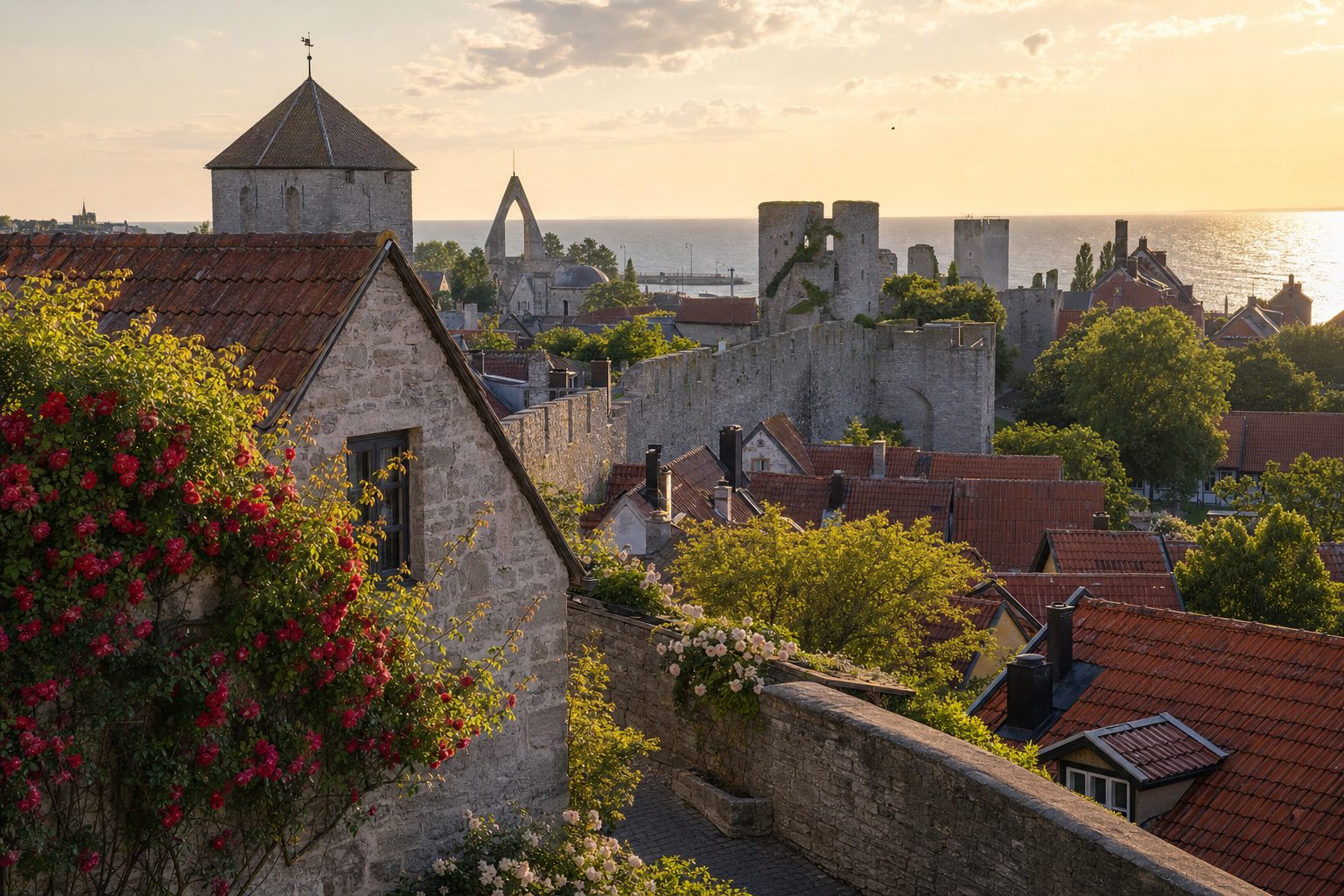
The Visby that travels well is not the one seen through a windscreen. It is a compact walled town of steep lanes, church ruins and merchant buildings on Gotland’s Baltic coast, where the practical choices arrive before the photographs: which ferry to take, whether to bring a car, and how much summer crowding is acceptable. The reel-ready view is real—the ring wall rolls above grass and limestone, with towers punctuating the route—but its value lies in walking a small place slowly rather than trying to cover every corner between arrivals and departures.
For a first stay, make the historic centre your base and give it at least two nights. That creates one complete day for the wall, ruins and lanes, plus time to use the harbour and museum without carrying luggage through the busiest streets. It also avoids an expensive mistake: in summer, ordinary motor traffic is restricted within the inner town. Visitors who book a room inside the wall or travel by ferry with a vehicle need to know the rule before assuming that a hotel address equals easy driving.
Start with the wall, then let the town set the pace
Visby’s scale is its great advantage. The wall gives the old town a legible edge, while the harbour and Almedalen sit below its western side. Begin near Kruttornet by the harbour, then use the slopes and lanes to move inland towards Stora Torget and the northern or eastern gates. There is no need to turn the perimeter into a timed circuit. The rewarding pattern is to alternate the outside perspective—grass, moat, stonework and towers—with the inward one: doorways, rooflines and small squares that reveal why the enclosure still feels like a town rather than a monument.
About 3.44 kilometres of Visby’s original roughly 3.6-kilometre ring wall remain. Built in the 13th and 14th centuries, it retains 27 large towers and nine smaller towers and is described as the best-preserved medieval city wall in Scandinavia. [1]
Kruttornet deserves a deliberate stop rather than a passing photograph. The harbour-side tower predates the main wall: it is a 12th-century structure and the oldest surviving non-religious building in the Nordic countries. Seen first, it explains the order of the landscape—the port mattered before the defensive circuit became Visby’s defining silhouette. From there, walk the harbour edge and choose an uphill street rather than following the loudest crowd. The town’s medieval fabric is unusually dense: Britannica notes roughly 200 surviving warehouses and merchants’ houses from the 13th and 14th centuries, many now private homes.
That last detail sets the etiquette. This is a lived-in centre, not an open-air reconstruction. Keep voices low in residential lanes, do not enter courtyards or block doorways for photographs, and treat the stone steps as uneven working surfaces rather than viewing platforms. At Stora Torget, the large ruin of St. Karin is an obvious marker; elsewhere, leave room for unplanned turns. The official Gotland visitor guide points to the wall, moats and preserved church ruins as the features that define the cityscape, which is a good argument for letting a map support the walk rather than dictate it.
Visby’s power comes from the relationship between its encircling wall, the church ruins and the lanes inside it: a historic urban landscape best understood on foot, not as isolated sights to tick off.
— Paraphrased from Gotland.com: Past and present
Make the first wall walk an orientation rather than an endurance exercise. From the harbour, take in Kruttornet and the sea-facing stretch, then climb towards the centre; later, return to an outer path or a gate when the light changes. A morning route gives the best chance of finding the lanes before day visitors concentrate around the central squares, while an early evening circuit lets the wall read as a line around the roofs rather than a sequence of tower photographs. Wear shoes that can manage cobbles and slopes, carry water in warm weather, and keep the plan intentionally short enough to stop for a church ruin, a café or a museum. The purpose is to understand how the town is assembled, not to complete a prescribed circuit.
Treat the summer vehicle ban as part of the itinerary
A car can be useful elsewhere on Gotland, but it is usually a burden in central Visby in high summer. Region Gotland applies a recurring motor-vehicle ban inside the inner town from the Saturday of week 24 through week 35. Authorised traffic includes residents, guests travelling to temporary accommodation inside the zone, taxis, scheduled buses, deliveries and necessary service traffic; that does not make the medieval lanes a convenient place for a visitor to circulate. If a hotel gives arrival directions, follow them closely and ask in advance about permitted access and luggage unloading.
Every summer, Region Gotland restricts motor vehicles in Visby’s inner town from Saturday in week 24 through week 35; hotel or other temporary accommodation is treated as a residence for the authorised-traffic rule. [3]
The simple plan is to park outside the gates and arrive on foot, using a taxi only when it genuinely reduces a luggage problem. As checked in August 2026, Region Gotland’s summer guidance identifies Östercentrum and Östra Byrummet by Kajsarporten as recommended parking options when a car is necessary, while warning of highly limited harbour-area access and parking during major early-summer events. Its temporary traffic arrangements can change, so check the 2026 traffic and parking notice again before driving into town.
Choose ferry and flight plans before choosing an island road trip
For many international visitors, Stockholm is the natural gateway, but Gotland is still an island logistics decision. The ferry from Nynäshamn to Visby is the classic route: allow for the transfer to the port, check sailing times against a flight or train arrival, and avoid treating the crossing as a minor add-on. The Destination Gotland route guide lists the Nynäshamn–Visby crossing at about three hours 15 minutes, with summer sailings also connecting Visby to Oskarshamn and Västervik. Timetables and frequencies are operational, so book against the carrier’s current schedule rather than a general planning page.
The Nynäshamn–Visby ferry crossing is listed at about 3 hours 15 minutes; the same route guide lists summer services from the mainland ports of Nynäshamn, Oskarshamn and Västervik to Visby. [5]
Bring a car only if the rest of Gotland is a central purpose of the trip—beaches, farm cafés, southern limestone landscapes or remote accommodation—and reserve vehicle-deck space early for peak dates. For a Visby-focused weekend, walking, airport transfers and local taxis normally reduce both cost and friction. This is the same useful distinction that shapes other European island trips: build the arrival around the destination’s constraints, not around an assumption that a hire car must be used every day. The broader guide to travelling around Europe is a helpful next read when ferries, trains and flights need to work as one journey.
An arrival-night strategy is often the calmest one. Take an afternoon or evening ferry, walk from the harbour to a centrally placed hotel, eat nearby and leave the wall for the following morning. A morning arrival can work just as well, but do not schedule a full old-town walk, museum visit and island drive on the same day unless the ferry and luggage arrangements are unusually simple. If the weather is poor, use Fornsalen first and move the outdoor route to the clearer half of the day; if the weather is fine, start outside and save the museum for the afternoon. Those small reversals are easier when the accommodation is in or near the walled centre and the vehicle, if there is one, is no longer part of every decision.
- For a Visby-only stay, book pedestrian ferry tickets or flights and reserve accommodation within a comfortable walk of the harbour or a gate.
- For a wider Gotland trip, secure car-deck space before committing to an island itinerary, then plan to leave the vehicle outside the inner town.
- Allow a buffer between a Stockholm arrival and a ferry departure; the port transfer is part of the journey, not a formality.
- Keep the ferry confirmation, hotel access instructions and an offline town map together, especially for a summer arrival with luggage.
Use ruins and museums to add context, not another checklist
The right cultural counterweight to the wall is an indoor stop early in the visit. Gotlands Museum’s Fornsalen on Strandgatan gives the island’s long history a framework before the town’s street-level details blur together. As checked in August 2026, the museum lists daily 09.00–17.00 opening from May to September and daily 11.00–16.00 from October to April; it advises checking its calendar for exceptions. The same official page lists summer access for several Visby ruins, but closures for pre-booked events are possible. Build a museum or ruin visit into the flexible part of the day, rather than promising it to a tight ferry schedule.
The best choice is usually one substantial ruin, one museum visit and a long unscripted walk. St. Karin at Stora Torget is the straightforward first pick; quieter lanes to the north or east offer the chance to see how medieval-scale buildings coexist with homes, cafés and ordinary errands. Seek information from museum staff rather than inventing a story for a façade. That restraint is particularly valuable in a town whose recognisable medieval look encourages visitors to treat every wall as scenery. Visby became a UNESCO World Heritage site in 1995, but heritage status is not a reason to hurry—it is a reason to look more carefully.
Decide whether Medieval Week is the point or the complication
Medieval Week changes the town’s texture and its availability. If historical performance, markets and costume are the reason for the trip, plan around it rather than merely landing during it. The festival runs for eight days from Sunday in week 31 to Sunday in week 32; in 2026 it ran 2–9 August. Its organisers describe it as Sweden’s largest historical festival, with more than twenty medieval venues, and advise pre-booking tickets for popular programme items. Accommodation and transport should be treated the same way: choose a place to sleep and a ferry or flight before fine-tuning the programme.
Medieval Week runs for eight days, Sunday in week 31 to Sunday in week 32; the 2026 edition ran 2–9 August, and the organisers advise booking popular programme tickets in advance. [6]
For travellers who want Visby’s architecture with more room to think, choose a date outside the festival and outside the busiest summer weeks. Spring and early autumn can make the walking more comfortable, though opening hours and ferry frequency require closer checking. In any season, the core decision is unchanged: use the walls as the boundary of a walkable place, stay long enough to step beyond the headline sights, and leave space for weather, ferry timetables and the daily life behind the façades. If a car-free historic town is the draw, compare the different rules and rhythms of Venice before building a wider European itinerary.
Sources & further reading
- 1. Wikipedia: Visby City Wall
- 2. Encyclopaedia Britannica: Visby
- 3. Region Gotland: Summer motor-vehicle ban in Visby inner city
- 4. Region Gotland: Traffic and parking in Visby during summer 2026
- 5. Ferry Guide: Destination Gotland routes and timetable
- 6. Medieval Week on Gotland: About Medieval Week
- 7. Gotland.com: Past and present
- 8. Gotlands Museum: Entry and opening hours