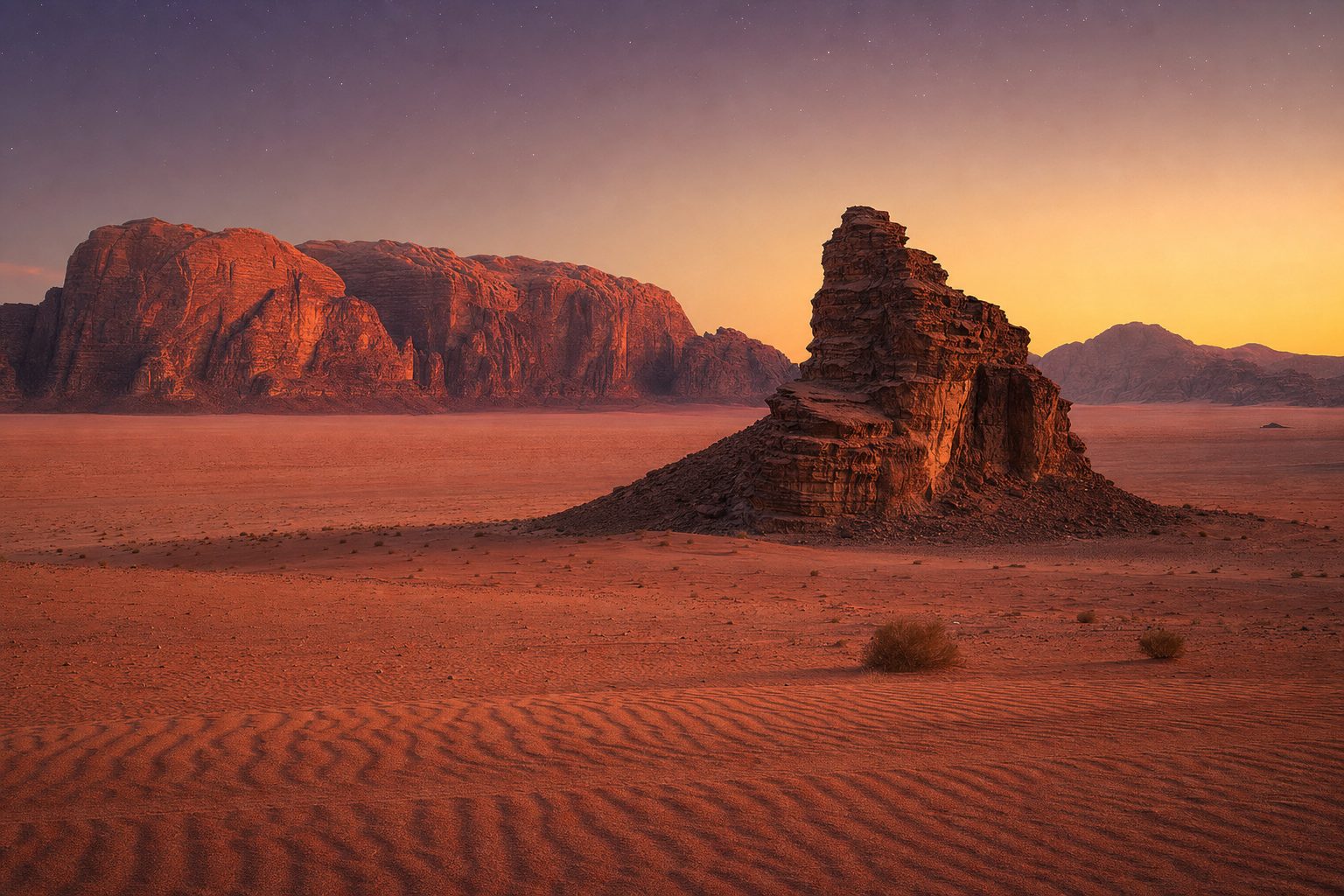
Wadi Rum looks, in the reels that send people searching for it, like a place you could simply drive into and wander. It is not. The 74,000-hectare protected area in southern Jordan is managed as a single access point, and the decisions a first-time visitor actually makes are narrower and more practical than they first appear: which Bedouin camp to book, how long a jeep tour to pay for, whether to add the Jordan Pass, and which season to travel in given how sharply desert temperatures swing between day and night.
This guide sets out those decisions in order, using the protected area's own fee structure, the Jordan Pass programme, and the tourism board's guidance, rather than the improvised routes that circulate on social media.
Why you cannot simply drive yourself in
Wadi Rum is inscribed on the UNESCO World Heritage list as a mixed natural and cultural site, valued both for its sandstone landforms and for 12,000 years of human occupation recorded in petroglyphs and inscriptions across the valley. That protected status is enforced at a single Visitor Centre on the approach road, where every arrival, whether by rental car, taxi, or tour bus, stops to buy an entry ticket or present a Jordan Pass before continuing toward Rum village. From that point on, ordinary two-wheel-drive cars are not permitted into the open desert; movement inside the reserve is by licensed Bedouin 4x4 pick-up truck, camel, or on foot, which is why almost every visit is built around a jeep tour booked through a camp or cooperative rather than a self-guided drive.
As checked in July 2026, Wadi Rum Protected Area is a 74,000-hectare UNESCO World Heritage site inscribed in 2011 for both its desert landforms and 12,000 years of documented human occupation, including roughly 25,000 rock carvings and 20,000 inscriptions. [1]
The property is described as combining a varied desert landscape of narrow gorges, natural arches, towering cliffs and caverns with petroglyphs and inscriptions that trace the evolution of human thought and the early development of the alphabet.
— Paraphrased from the UNESCO World Heritage listing for Wadi Rum Protected Area
The practical upshot is that a trip here is planned backwards from the camp, not the car. Booking a Bedouin-run camp inside or at the edge of the protected area secures the jeep transfer, the guide, and usually the tour itself as one package, which is the pattern nearly every visitor ends up using regardless of how independently they started planning.
What entry actually costs, and where the Jordan Pass fits
The standard Wadi Rum Protected Area entrance fee is 5 Jordanian dinars (JOD) per international visitor, paid at the Visitor Centre, with children under 12 admitted free. That fee covers entry to the reserve only; it does not include a jeep tour, a camel ride, or a camp stay, all of which are booked and paid separately, typically in cash. If a personal or rental 4x4 is driven in under special arrangement, the reserve charges an additional vehicle fee on top of the per-person entrance charge.
As checked in July 2026, the official Jordan tourism board lists the Wadi Rum entrance fee at 5 JOD for foreign visitors and 1 JOD for Jordanian citizens, separate from Petra's foreign visitor fee, which runs from 50 JOD for a single day up to 60 JOD for three days. [2]
For anyone also visiting multiple heritage sites in one trip, the Jordan Pass is worth weighing early. It bundles entry to more than 40 attractions, including Wadi Rum and Petra, into one of three tiers priced by how many days of Petra access are included, and it waives the standard tourist entry visa fee for anyone who buys it before arrival and stays a minimum of two whole nights, or three days, in the country. Wadi Rum's own 5 JOD fee is covered by any tier of the pass, so the calculation mostly comes down to how many days you plan at Petra and whether your total stay clears the visa-waiver threshold.
Choosing a camp and a jeep tour
Because independent driving inside the reserve is not practical, the camp booking is the real itinerary decision. Camps range from simple shared tents with a communal fire to private cabins with attached bathrooms, and most quote per-person rates that include a jeep transfer from the Visitor Centre, dinner, breakfast, and often a short sunset drive. The most common pattern for a first visit is a half-day or full-day jeep tour through the classic landmarks, followed by dinner and an overnight stay under the stars, before returning to the Visitor Centre the next morning. Tour lengths on offer typically run from a two-hour taster to a full day of six to eight hours, with longer tours covering more distant formations such as rock bridges and higher dunes.
- Decide on tour length first: a 3-4 hour jeep tour covers the classic sites near Rum village, while a full day adds remote formations like Burdah Rock Bridge.
- Book the camp directly or through a reputable platform rather than negotiating at the Visitor Centre gate, since prices there are largely fixed by the local cooperative.
- Confirm whether dinner, breakfast, and the jeep transfer are included in the quoted per-person rate before you arrive.
- Carry Jordanian dinars in cash for any add-ons such as a camel ride, sandboarding, or extra jeep time, since card acceptance is inconsistent away from the Visitor Centre.
- If mobility or heat tolerance is a concern, ask about a private rather than shared jeep, since shared tours run to a fixed group schedule.
When to go: heat, cold nights, and stargazing conditions
Wadi Rum has a desert climate with wide swings between day and night. Spring, from March to May, and autumn, from September to November, bring daytime highs in the low-to-mid 20s Celsius and are widely treated as the most comfortable stretch for jeep touring and hiking. Summer, June through August, regularly pushes daytime temperatures above 40°C, which makes midday activity genuinely uncomfortable and pushes most tours toward early morning or late afternoon departures. Winter days are mild, but winter nights can drop below freezing, and a desert camp without proper bedding and layers is a poor place to discover that.
Wadi Rum's dry desert air means clear skies dominate most of the year, and stargazing is possible year-round from camp; the trade-off is a large day-to-night temperature swing, with summer nights cooling to roughly 20°C after 40°C-plus days, and winter nights falling near or below freezing. [4]
This swing is precisely what makes an overnight stay worthwhile rather than a liability: the same dry air that makes summer days brutal is what keeps the night sky largely free of haze, and most camps schedule their fire and tea around sunset for exactly that reason. Pack a proper layer for any season; even a summer visit calls for a jumper after dark, and a winter one calls for a genuine jacket, hat, and gloves.
Pairing Wadi Rum with Petra and Aqaba
Wadi Rum sits almost exactly between Jordan's two other major southern draws. Petra lies roughly 110-120 kilometres to the north, a drive of about one and a half to two hours on reasonable roads, which makes a Petra-to-Wadi-Rum transfer, or the reverse, an easy single morning rather than a full travel day. Aqaba and its Red Sea coastline sit closer still, around 60-70 kilometres south, roughly an hour's drive along the Desert Highway, making it a realistic base for a shorter day trip into the desert for anyone not planning to camp overnight.
The common itinerary pattern runs Amman or the Dead Sea, then Petra for one to three days depending on which Jordan Pass tier is chosen, then a transfer south to Wadi Rum for one overnight, before finishing on the coast at Aqaba. Shared and private taxi transfers run this corridor regularly, and travellers who prefer not to self-drive the desert highway can arrange transfers directly through their Wadi Rum camp or Petra hotel, since both ends of the route are used to coordinating same-day handoffs. Anyone building a wider regional trip around desert and coastal contrasts might also look at a guide to budget travel in Dubai for comparison on how far a similar spend goes elsewhere in the region.
Cash, connectivity, and etiquette on the ground
Jordan runs on the Jordanian dinar, and Wadi Rum in particular is a cash-first environment. Card machines exist at the Visitor Centre and some larger camps, but small operators, camel guides, and roadside stalls in Rum village generally expect JOD in hand, and the nearest reliable ATMs are in Aqaba or Wadi Musa (the town beside Petra) rather than in the village itself. Budgeting cash ahead of arrival, covering the entrance fee, a jeep tour, camp costs, and a margin for extras, avoids an awkward negotiation over a card reader that is not working.
Mobile signal inside the protected area is patchy at best and frequently absent at remote camps, which is worth treating as a feature rather than a fault, given how much of the appeal here is the absence of light pollution and background noise. Modest dress is appreciated in a conservative, Bedouin-run desert community, and guides generally welcome questions about the landscape and local history as part of the experience rather than an intrusion on it.
Building the trip around a single overnight
Most first-time visitors do not need more than one night in Wadi Rum itself; a single overnight, bracketed by an afternoon jeep tour on arrival and a sunrise or short morning activity before departure, covers the landmarks that matter and the stargazing that is the main draw, without over-committing days that could go toward Petra or the coast. Travellers with more time, or a specific interest in longer hikes such as the ascent of Jabal Umm ad Dami, Jordan's highest peak, can extend to two nights and add a full-day tour, but this is an addition rather than a requirement for a satisfying visit.
The desert's reputation as a stand-in for Mars, familiar from the films shot among its dunes and cliffs, is really a reputation for scale and silence that photographs poorly convey. Travellers weighing a longer swing through the region's deserts and old cities might pair this stop with the guide to navigating Marrakech's medina for a sense of how differently two historic desert-adjacent destinations handle guides, bargaining, and first-time logistics.
Sources & further reading
- 1. UNESCO World Heritage: Wadi Rum Protected Area
- 2. Jordan Entrance Fees (official tourism board)
- 3. Jordan Pass: Frequently Asked Questions
- 4. Wadi Rum Weather (Mohammed Mutlak Camp desert blog)
- 5. Petra Jordan: How to Get There (Visit Jordan)
- 6. Wadi Rum Fees and Charges (official protected area site)
- 7. Wadi Rum: Things to See and Do (official protected area site)