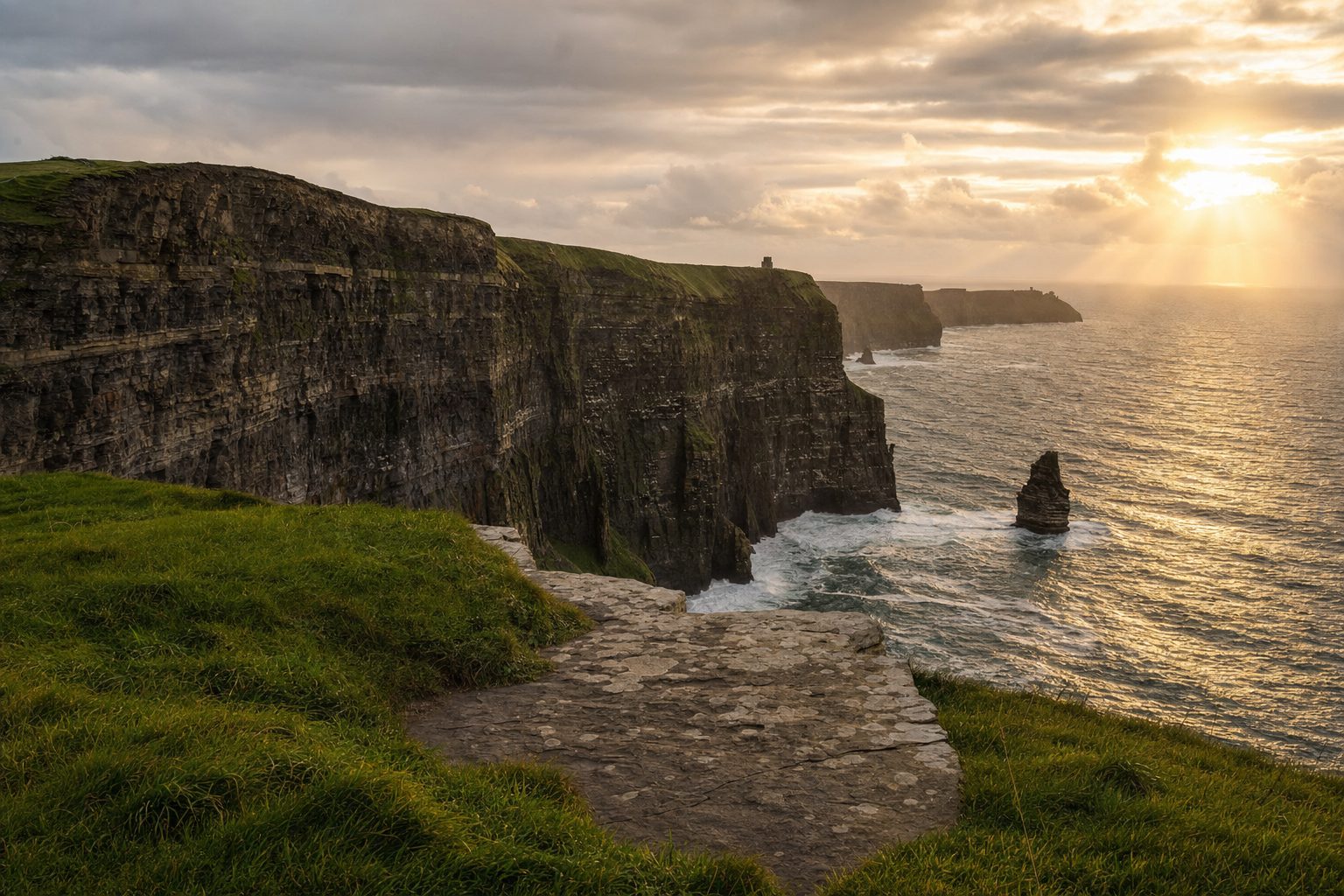
The Cliffs of Moher draw more than a million visitors a year to a stretch of County Clare coastline where the Atlantic has spent 320 million years cutting into shale and sandstone. The decisions that matter here are less about whether to go and more about when, how you arrive, and how far you can actually walk. As checked in July 2026, a large section of the historic coastal trail is closed for safety works, ticket prices depend heavily on the hour you book, and the weather can turn a calm morning into a genuinely hazardous one within an hour.
This guide sets out what is open, what is not, what it costs, and how to time a visit so the crowds, the wind, and the light work in your favour rather than against it, using the operator's own current guidance rather than outdated blog posts.
What is actually open on the coastal walk right now
The old idea of walking the full Cliffs of Moher Coastal Walk from Liscannor to Doolin no longer holds. The southern section, roughly six kilometres between Liscannor and Hag's Head and on to the Visitor Centre, is fully closed due to safety concerns, with no access from either end. On the northern side, walkers can go from Doolin as far as Surfers Path before being asked to turn back; there is no through-route from Doolin to the Visitor Centre along the cliff path. What remains reliably open is the 3.5 km looped stretch around the Visitor Centre itself, including an 800-metre section north of O'Brien's Tower that reopened after resurfacing work in 2025.
As checked in July 2026, the coastal walk's southern section from Liscannor/Hag's Head is fully closed for safety reasons, and the northern Doolin section is open only as far as Surfers Path, with no through-access to the Visitor Centre. [1]
For anyone who arrived expecting the full 14 km ridge walk between the two villages, this is worth absorbing before booking accommodation or transport around a route that no longer connects. If a long coastal walk was the main draw, it is worth treating Doolin and the Visitor Centre as two separate, shorter outings rather than one linear hike, and checking the official page again close to your travel date in case conditions change.
Choosing when to go: hours, seasons, and ticket prices
Tickets are priced by time slot, and the difference between peak and off-peak is substantial. Gate rates, paid on arrival without a booking, run to €15 for an adult, €12 for a student or senior, and €30 for a family. Booking online in advance is consistently cheaper, particularly outside the 11am to 4pm peak window; the official site frames its off-peak morning slot as 8am to 11am and its off-peak afternoon slot as 4pm until close. Children under 12 go free with an accompanying adult, up to four per family ticket.
As checked in July 2026, official gate rates are €15 for an adult, €12 for a student or senior, and €30 for a family, with online booking offering lower rates and a distinct off-peak pricing tier outside 11am-4pm. [4]
Opening hours shift with the season: winter months run roughly 9am to 5pm, spring and autumn extend to 7pm, and from May to August the site stays open until 9pm, giving room for an evening visit after the coach parties have left. The Visitor Experience closes only on 24, 25, and 26 December.
Weather, wind, and why the site sometimes closes outright
This is an exposed Atlantic headland, and the official guidance treats high winds as a real operational risk rather than a minor inconvenience. The site follows Met Éireann's weather warning protocols: under a status orange-equivalent alert, visitors are told to take extra care near cliff-side paths, and under status red the entire visitor centre and site closes and evacuates because conditions are considered too dangerous for staff and visitors alike. Fog and rain can also arrive with little warning, regardless of wind. Checking the forecast on the morning of a visit, rather than the night before, is standard advice from the operator.
As checked in July 2026, the Cliffs of Moher site follows Met Éireann weather warning protocols and will close and evacuate the visitor centre entirely under status red wind conditions. [3]
The site notes that the cliffs can be cloaked in fog one moment and in full sun the next, and recommends checking the national weather service on the day of travel rather than relying on a forecast checked in advance.
— Paraphrased from the official Cliffs of Moher weather and visiting guidance
A waterproof jacket and proper walking shoes are worth packing regardless of season; the operator specifically advises against umbrellas, since the wind at the cliff edge is usually strong enough to turn one inside out. None of the designated viewing platforms require scrambling, but the unfenced edges beyond the official path are a different matter, discussed below.
Safety at the edge: unfenced sections and livestock
The paved paths and viewing platforms close to the Visitor Centre are walled and considered fully safe for all visitors, including families with children. Beyond that perimeter, the coastal walk narrows and in places tracks close to genuinely unprotected drops of well over 100 metres, with gusts that can knock a person off balance without warning. Signage instructs walkers to stay on designated paths and never go beyond walls or barriers, and to avoid the road at Surfers Path, which the operator flags as hazardous in its own right. Farmland along the route is grazed by cattle, and dogs must stay on leads throughout.
- Stay on the paved, walled path near the Visitor Centre if travelling with children or anyone unsteady on uneven ground.
- Do not cross barriers or walk the unofficial cliff-edge track beyond the official route, even where it looks well trodden.
- Treat the road at Surfers Path as a hazard, not a shortcut, and turn back where signage indicates.
- Check for wind warnings at the car park entrance and on the operator's website or social channels before setting out.
- Keep dogs on leads at all times; they are not permitted inside the Visitor Centre building unless registered assistance animals.
O'Brien's Tower, the Burren, and the geology beneath your feet
The cliffs reach their highest point, 214 metres, just north of O'Brien's Tower, a stone lookout built in 1835 by local landowner Cornelius O'Brien, reportedly to give paying visitors an even better view and to draw early tourist income to the area. The tower still stands close to the site's highest viewpoint and is included in general admission, though its own hours can vary with weather. What lies beneath both cliffs and tower is part of a wider story: the Cliffs of Moher sit within the Burren and Cliffs of Moher UNESCO Global Geopark, a 53,000-hectare landscape of glacio-karst limestone first recognised in 2011 and formally designated a UNESCO Global Geopark in 2015, a status that Clare County Council must have revalidated roughly every four years since. The layered shale and sandstone of the cliff face itself records ancient river deltas depositing sediment over hundreds of millions of years, a geological history that connects the sheer drop at Moher to the pale limestone pavements of the Burren just inland.
Travellers building a broader coastal itinerary sometimes pair this stop with the Isle of Skye in an around-the-British-Isles comparison of cliff scenery, though the geology and the visitor infrastructure at each site differ substantially.
Puffins, seabirds, and the best window for wildlife
The cliffs host one of Ireland's most significant seabird colonies, an assemblage of more than 30,000 breeding pairs across roughly 20 species, protected as a Special Protection Area under the EU Birds Directive. Different species favour different ledges: fulmars nest highest, kittiwakes a level down, guillemots and razorbills on the bare stone ledges below that, with puffins burrowing into the grassy slopes rather than the rock face itself. Puffins typically arrive at the end of March and are most visible between May and June, before heading back out to sea for the winter. The operator lends binoculars free of charge at reception and offers a downloadable audio guide, so it is not necessary to pack your own optics for a reasonable view.
As checked in July 2026, the Cliffs of Moher host over 30,000 breeding seabirds across some 20 species in a designated Special Protection Area, with Atlantic puffins typically arriving at the end of March and best viewed in May and June. [6]
Getting there without a car, and where to base yourself
Driving remains the most flexible option, with parking bundled into the admission fee in a single car park opposite the Visitor Centre; the cliffs-side car park is reserved for disabled permit holders and coaches. For those without a car, Bus Éireann's route 350 connects Galway and Ennis via the Cliffs of Moher and Doolin, running up to ten times a day in each direction in summer, and a newer TFI Local Link route 351 links Galway city directly to Doolin Pier and the cliffs with up to five daily trips. Both routes broadly follow the road version of the Wild Atlantic Way, Ireland's signed coastal touring route, making a car-free day trip from Galway or Limerick (via a connection through Ennis or Galway) genuinely workable.
Doolin, roughly seven kilometres north of the Visitor Centre, remains the more atmospheric overnight base, with a working fishing pier, boat tours out to view the cliffs from the water, and a concentration of guesthouses and traditional music pubs that Liscannor and the car park itself cannot match. Anyone building a longer loop through this corner of Ireland might reasonably pair a Cliffs of Moher stop with a fuller multi-day Europe itinerary, using Doolin or Ennis as the overnight anchor rather than the cliffs themselves.
The cliffs are not going anywhere, but the way visitors reach them keeps shifting: trail closures, new bus routes, and time-tiered pricing all change year to year. Travellers weighing up a wider loop of Atlantic-facing cliff scenery might also look at the Isle of Skye road trip guide for a Scottish counterpart with its own single-track roads and seasonal pressures, but for County Clare the short version holds: check the official closure notices before you plan a long walk, book online ahead of the 11am rush, and treat the weather forecast as something to check on the morning itself, not the night before.
Sources & further reading
- 1. Cliffs of Moher Coastal Walk (official closure notice)
- 2. Cliffs of Moher FAQ
- 3. Cliffs of Moher: Weather and When to Visit
- 4. Cliffs of Moher Admission Rates
- 5. Cliffs of Moher: Your Visit (opening hours)
- 6. Cliffs of Moher Birdwatching and Puffins
- 7. Cliffs of Moher: Directions on Getting Here
- 8. UNESCO: Burren and Cliffs of Moher UNESCO Global Geopark