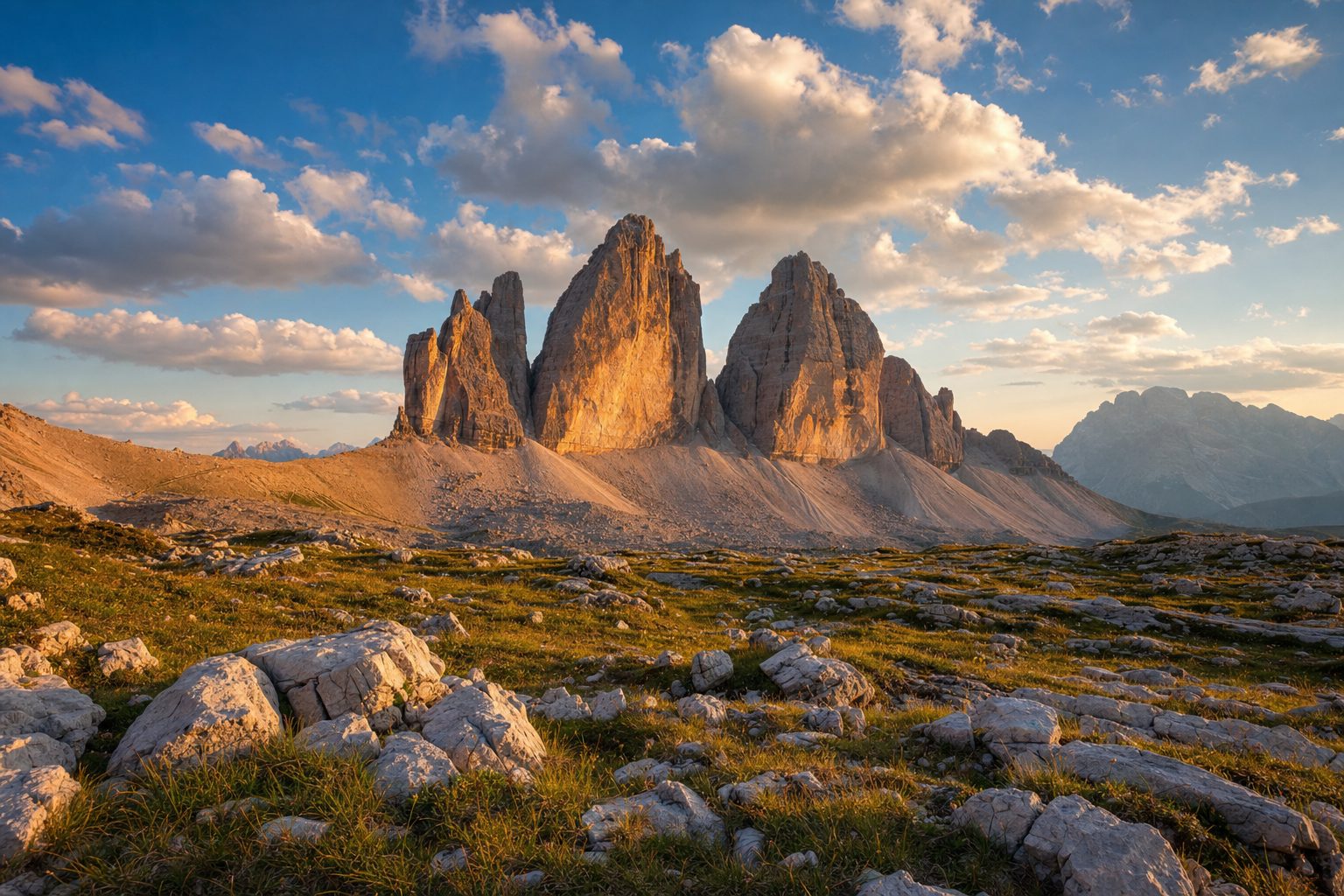
The Dolomites reward hikers with pale limestone towers that turn pink at sunset and trails that connect one mountain refuge to the next, but the logistics have become the real trip-planning challenge. As checked in July 2026, three of the range's most photographed spots, the Tre Cime di Lavaredo loop, the Alpe di Siusi plateau, and Lago di Braies, each now run some form of mandatory reservation or timed road closure, and rifugio beds on the popular long-distance routes sell out months before the season opens.
This guide sets out the decisions that shape a Dolomites trip: which valley to base in, when to go, how to book the access points that now require it, and how to work around the region's reliable afternoon thunderstorms, using tourism-board and operator sources rather than outdated blog advice.
Choosing a base: Val Gardena, Alta Badia, or Cortina
The Dolomites are not one place but a serial UNESCO World Heritage property made up of nine separate mountain groups spread across South Tyrol, Trentino, and the province of Belluno, so no single base puts everything within easy reach. Val Gardena, anchored by Ortisei, Santa Cristina, and Selva, sits closest to the Alpe di Siusi and Seceda and connects into the wider Dolomiti Superski lift network that links twelve ski valleys in winter and keeps many of its cable cars running through summer. Alta Badia, centred on Corvara and La Villa, sits a short drive over the Gardena or Campolongo passes and gives faster access to the Fanes-Sennes-Braies nature park and the Sella group. Cortina d'Ampezzo, in Veneto rather than South Tyrol, is the natural base for Tre Cime di Lavaredo, Lago di Braies, and the Cinque Torri, and markets itself as the pearl of the Dolomites given its position inside the range's UNESCO area.
As checked in July 2026, the Dolomites UNESCO World Heritage property comprises nine separate component areas covering 141,903 hectares and includes 18 peaks rising above 3,000 metres. [1]
For a first trip of five to seven days, basing in one valley and taking day trips by car or lift to the others is more realistic than trying to circuit the whole range; the driving distances between Val Gardena, Alta Badia, and Cortina are short in kilometres but slow on mountain-pass roads that switchback constantly. Val Gardena tends to suit hikers prioritising Alpe di Siusi, Seceda, and the Puez-Odle group, since those trailheads are reachable without crossing a pass. Alta Badia works better as a hub for the Fanes-Sennes-Braies plateau and multi-day rifugio routes through the Sella group, while Cortina is the only sensible base if Tre Cime di Lavaredo and Lago di Braies are the main targets, since both sit within a short drive of the town rather than of the South Tyrolean valleys.
Tre Cime di Lavaredo: the road now requires a booking
The classic loop around the three limestone towers of Tre Cime di Lavaredo starts from Rifugio Auronzo, reached by a roughly six-kilometre toll road that climbs from near Lake Antorno to 2,333 metres. As checked in July 2026, access to the car park at the top is granted only to vehicles with a prior online reservation made through the municipality's own Tre Cime di Lavaredo booking portal, with a car plate entered by 11:59pm the night before arrival and availability generally guaranteed only for requests submitted the day before.
As checked in July 2026, the official Auronzo di Cadore booking system charges €40 for a car, €26 for a motorcycle, €60 for a camper or caravan, and €80-160 for a bus, with reservations made through the auronzo.info portal and the road generally open from late May to late October. [2]
The road and its car park close outright in poor weather, and camping in the car park is explicitly banned, with fines of up to €500 for anyone who tries. Walkers without a car can still reach the same trailhead on foot or by local shuttle bus from Misurina, which avoids the booking system entirely, though it adds walking time. Rifugio Lavaredo and Rifugio Locatelli, both used as lunch stops on the loop, have their own separate opening dates that trail the road's reopening by a few weeks.
Alpe di Siusi and Seceda: cable cars, parking windows, and new booking rules
Alpe di Siusi, Europe's largest high-alpine meadow, sits inside the Sciliar-Catinaccio Nature Park, and its access road has long closed to private traffic between 9am and 5pm whenever the Alpe di Siusi cable car is running, forcing day visitors either up before 9am, up after 5pm, or onto the cable car from Siusi or the bus network instead. New for the 2026 summer season, the plateau's two car parks, P1 Spitzbühl and P2 Compatsch, require an online reservation made no more than six days ahead, a change introduced from 29 June.
As checked in July 2026, Seiser Alm Marketing's official guidance confirms that from 29 June 2026 the Alpe di Siusi car parks P1 and P2 require an online reservation bookable up to six days in advance, and that the access road remains closed to private vehicles between 9am and 5pm regardless of a parking booking. [3]
As with car-free Zermatt, the lift network does much of the work here: the Ortisei-Seceda cable car connects to Furnes and on to Seceda's ridge, and the official operator's own 2026 pricing lists a combined Ortisei-Furnes-Seceda return ticket at €74 for an adult, a cost worth weighing against driving up before dawn.
As checked in July 2026, Seceda Cableways' official summer price list shows the Ortisei-Furnes-Seceda combined return ticket at €74 per adult, with both lift sections running from 22 May to 2 November 2026, 8:30am to 6pm. [4]
Lago di Braies: timed road closures in the busiest months
Lago di Braies, the turquoise lake beneath Croda del Becco that has become one of the most photographed spots in the Dolomites, runs its own summer access restriction. Official guidance from the lakeside parking operator states that the road into the Prags valley closes to cars, motorcycles, and buses during the restricted midday-to-afternoon window across roughly two summer months, and that during those hours the only way to reach the P4 car park beside the lake is with a pre-booked online ticket, an overnight stay at a valley hotel, or arrival on foot, by bicycle, or by public shuttle.
The lakeside parking operator states that a day-stay ticket booked online guarantees passage and a parking space at the lake during the summer road closure, and that outside the closure period the parking areas can be reached directly without a reservation.
— Paraphrased from the official Pragser Wildsee parking guidance
Travellers arriving before the closure window begins or after it ends can usually pay on site at automatic machines instead, and the operator's FAQ notes that a booking only guarantees a space in the relevant car park, not a specific numbered spot.
Rifugio bookings: why waiting until summer is too late
Multi-day hikes such as the Alta Via 1, and shorter rifugio-to-rifugio loops around Cortina or the Sella group, depend on booking mountain huts that open only for a short season and fill quickly. Guidance from the Cortina-based Guide Alpine mountain guides' association notes that Dolomites rifugi are contractually required to stay open from at least 20 June to 20 September, weather permitting, and that arriving without a reservation still leaves a chance of a dormitory bed if you turn up early afternoon, though a confirmed booking is always the safer approach.
- Contact popular rifugi such as Locatelli, Lagazuoi, and Nuvolau directly by email, phone, or WhatsApp three to six months ahead for a July or August stay.
- State your arrival date, group size, room type (dormitory or private room), and whether you need half board when booking.
- Pack a sleeping bag liner or sheet, which most rifugi require for dormitory beds on hygiene grounds.
- Confirm dinner and breakfast times, which are fixed and typically served between 6:30pm and 7:30pm.
- Book every night of a multi-day route in one pass rather than leaving gaps to fill in later, since availability tightens as the season approaches.
Timing a visit: season, sunrise starts, and afternoon storms
Most rifugi, cable cars, and the higher trails operate only from late May or June through September or October, so the shoulder weeks at either end carry real risk of closures on higher routes. Within the summer window, professional Cortina mountain guides note that thunderstorms are typical of the warm season from roughly June to September, with an average of six to ten thunderstorm days a month that usually build in the afternoon or early evening.
As checked in July 2026, Cortina-based mountain guides report that the Dolomites see an average of 6 to 10 thunderstorm days per month between June and September, with storms typically developing in the afternoon or early evening. [5]
That pattern is the practical case for starting demanding routes at first light rather than mid-morning: an early start clears exposed ridges and summits before the highest lightning risk builds, and it also beats the crowds converging on Tre Cime, Braies, and Seceda by mid-morning. Early September, after the school-holiday crowds thin out but before rifugi begin closing, is often the most comfortable window for a first visit, echoing the shoulder-season logic that applies across the wider Alpine touring circuit.
Getting around without over-relying on one car
A car remains the most flexible way to link valleys over mountain passes, but it is also the asset most constrained by the new booking systems, so it is worth planning each day around whichever access point requires the tightest lead time. Local buses connect Cortina, Misurina, and Auronzo, and separate shuttle and cable car options exist for both Alpe di Siusi and Braies, meaning a car-free day is realistic at any of the three headline sites if the reservation calendar does not cooperate. Anyone cross-referencing this trip against other Alpine base towns might also compare notes with Zermatt's car-free model, though the Dolomites remain considerably more car-dependent between valleys, and renting a car for the full stay rather than trying to go without one is still the more practical choice for most itineraries.
Fuel and parking at trailheads add up over a week, and the various valley guest cards, bundled with many hotel stays, sometimes include local bus travel or lift discounts worth checking before assuming a rental car is the cheaper option for every leg of the trip.
Longer-distance travellers building a broader Italian loop sometimes pair a Dolomites base with a coastal counterpoint further south, and the logistics lessons here, book the constrained access points first, then build hiking days around them, apply just as well to a road trip down the Amalfi Coast. What has not changed is the geology that drew climbers here a century ago: the same pale limestone walls, some over 1,500 metres tall, that made this the archetype of a dolomitic landscape are still the reason the reservation systems exist in the first place, put in place to manage the volume of visitors the scenery itself continues to attract.
Sources & further reading
- 1. UNESCO World Heritage: The Dolomites
- 2. Auronzo di Cadore: Tre Cime di Lavaredo car park booking
- 3. Seiser Alm: Access to the Seiser Alm is restricted
- 4. Seceda Cableways: Summer prices and opening hours
- 5. Guide Alpine Cortina: Thunderstorms and lightning in the mountains
- 6. Pragser Wildsee: Parking tickets and prices at Lago di Braies
- 7. Auronzo di Cadore: Opening of lifts and mountain huts, summer 2026
- 8. Dolomiti Superski: Interactive ski map and lift network