Skye rewards travellers who plan around its logistics as much as its scenery. The island's main sights sit off narrow, single-lane roads with passing places rather than motorway-style access, several of the most photographed spots charge for parking with no way to reserve a space in advance, and peak summer brings both crowded car parks and the west coast's notorious biting midges. None of this makes the island less worth visiting; it means the decisions that shape a good trip happen before arrival, not once you are already on the Trotternish Ridge.
This guide sets out how to drive Skye's roads without causing a jam, what parking actually costs at the sights everyone wants to see, when midges and crowds are worst, and how to build a base that does not require re-crossing the island every day.
Getting to Skye and the case for driving yourself
Skye has been connected to the Scottish mainland by the free Skye Bridge at Kyle of Lochalsh since tolls were abolished in December 2004, so there is no charge and no booking required to drive across; the crossing itself takes about two minutes. A seasonal vehicle ferry also runs from Mallaig to Armadale on the island's south coast for travellers coming from the west, a useful alternative for anyone approaching from Fort William or the west Highlands rather than Inverness. There is no railway on Skye itself, and while a limited Stagecoach bus network covers Portree and the main villages, the timetables are too sparse to reach outlying sights like the Quiraing or Neist Point on a fixed schedule, which is why most visitors bring or hire a car. The nearest mainline railway station is Kyle of Lochalsh, connected to Inverness by the scenic Kyle Line, and a hire car picked up there or in Inverness is the most common way to begin a Skye trip for visitors arriving without their own vehicle.
As checked in July 2026, the Skye Bridge has carried no toll since the Scottish Government purchased it and removed charges at 7:30am on 21 December 2004, and it remains open to all traffic year-round without a booking system. [7]
Driving Skye's single-track roads without becoming the problem
Away from the main A87 spine, most of Skye's roads to its best-known viewpoints are single-track: one lane of tarmac wide enough for a single vehicle, with passing places set into the verge every so often to let oncoming traffic through. According to skye.scot's official driving guidance, drivers should watch the road ahead, pull into a passing place on the left as an oncoming vehicle approaches, and never treat a passing place as a parking spot, a picnic stop, or a place to take a photograph. If two vehicles meet between passing places, the one nearer to a passing place should reverse into it; on hills, traffic travelling uphill generally has priority since restarting from a stop on a slope is harder than a controlled reverse downhill.
As checked in July 2026, official guidance for Skye's single-track roads states that passing places must be used only to let oncoming or faster traffic through, that vehicles should never be parked in them, and that most passing places hold no more than two or three small vehicles, so groups of cars should avoid forming a convoy. [1]
Driving too close to the vehicle in front is the most common way visitors get into trouble: bunching up leaves no room in the next passing place for oncoming traffic, and everyone ends up stuck. Leaving a gap of a passing place or two behind the car ahead, and pulling over promptly for local traffic behind you, keeps the road moving. Reversing confidently is a prerequisite for driving these roads at all, particularly in a larger hire car or motorhome.
Paying for parking at the sights everyone wants to see
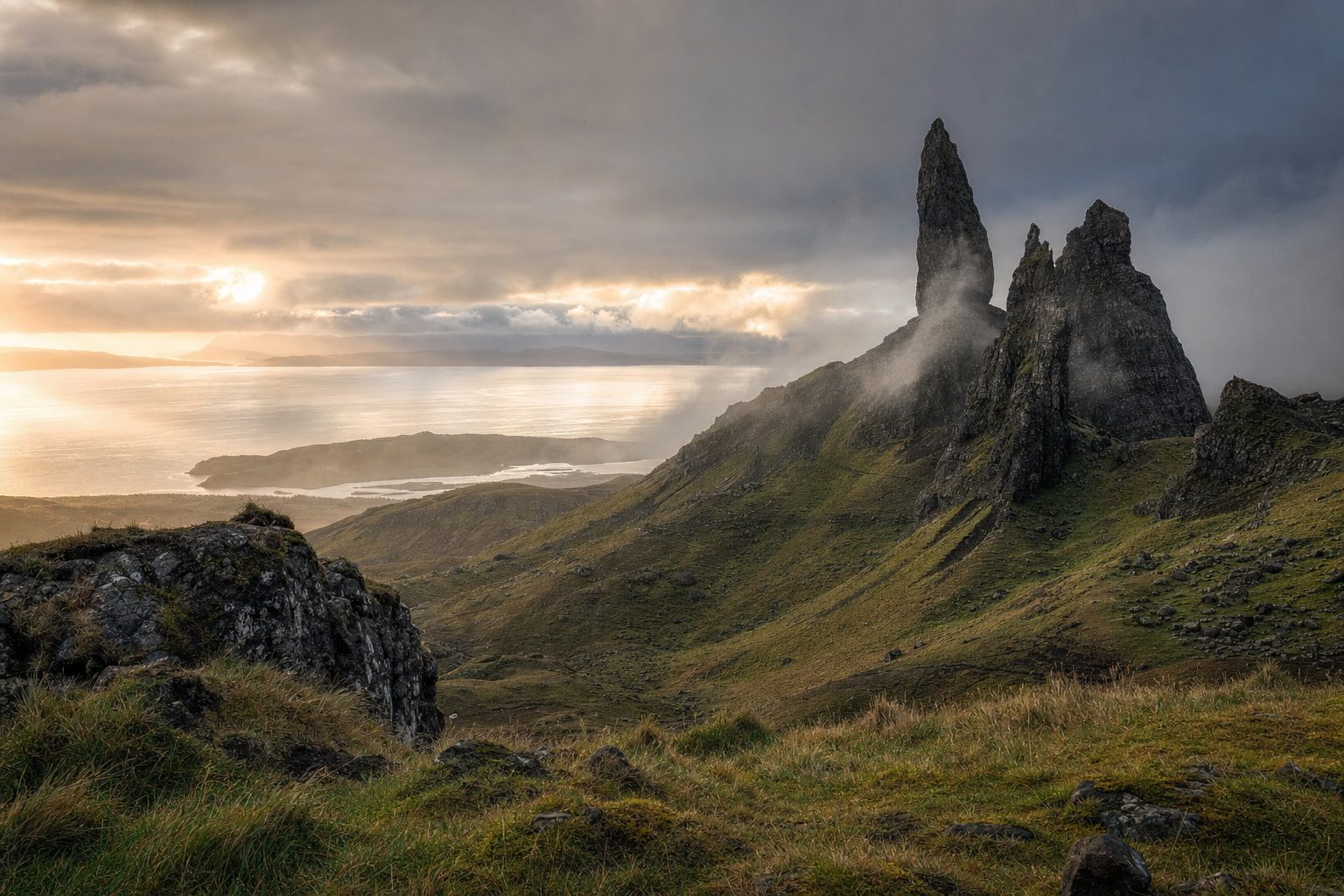
The Old Man of Storr, the Quiraing, and the Fairy Pools are the three stops that dominate Skye's Instagram feed, and all three now charge for parking with no advance reservation available. At the Old Man of Storr's official car park, which holds around 140 cars, the fee is £6 for up to six hours or £8 for up to twelve, payable at ticket machines by cash or card or through the RingGo app; motorhomes cannot use the main off-street car park due to height restrictions but have separate on-street provision. At the Quiraing, a car park holding roughly 100 vehicles charges £3 for up to three hours or £5 for up to six, again by card or coins, according to isleofskye.com's Quiraing walk guide. At the Fairy Pools in Glen Brittle, entry to the pools themselves is free, but the car park run by the Outdoor Access Trust for Scotland charges £6 for a car, rising to £8 for a campervan, motorhome, or other larger vehicle, with a £15 charge for tour minibuses.
As checked in July 2026, none of the Old Man of Storr, Quiraing, or Fairy Pools car parks accept advance bookings; all operate on a pay-on-arrival basis and can fill completely on summer days, particularly between mid-morning and early afternoon. [3]
Neist Point, the lighthouse walk at Skye's westernmost tip, is the exception: its car park at the end of the single-track road past Glendale remains free, though it is smaller and fills quickly around sunset, according to isleofskye.com's Neist Point guide. In Portree, the island's main town, on-street and short-stay parking such as the Somerled Square car park charges from £3 for up to two hours with a strict two-hour maximum stay, and the Highland Council's own parking-locations page confirms the tariff and hours; overstaying or parking on verges near these attractions risks a Penalty Charge Notice from the council, which has stepped up enforcement in recent years.
As checked in July 2026, Highland Council's Somerled Square car park in Portree charges £3.00 for up to two hours (the first 30 minutes free), operates 8am to 6pm daily, and has a strict two-hour maximum stay with 24 spaces. [6]
- Old Man of Storr: £6 up to six hours, £8 up to twelve, ~140-space car park, cash, card, or RingGo.
- The Quiraing: £3 up to three hours, £5 up to six, ~100-space car park, coins or contactless.
- Fairy Pools: £6 for a car, £8 for a campervan or motorhome, free admission to the pools themselves.
- Neist Point: free parking at the road end, but the smaller lot fills fast around sunset.
- Portree (Somerled Square): £3 for up to two hours, strict two-hour maximum, enforced by Highland Council.
Arriving early, or accepting you will queue
Because none of these car parks take reservations, the practical choice is between arriving before roughly 9am or after 4 to 5pm, or accepting that you may queue, circle, or walk further from an overflow spot in the middle of the day. July and August see the heaviest pressure, when car parks at the Storr, the Quiraing, and the Fairy Pools can fill by mid-morning and stay full for hours. An early start also tends to deliver calmer light and quieter paths at all three sites, which matters more than the extra sleep for anyone planning to photograph the Old Man of Storr's basalt pinnacle or the Quiraing's folded landslip terrain without a line of people in the frame. This is also the practical answer to the reel-worthy shot that draws many visitors to Skye in the first place: the crowds thin noticeably before breakfast and again in the last couple of hours before dusk, and the same light that photographs well is usually softer and less harsh than the midday sun most day-trippers arrive into.
Choosing when to visit: weather, midges, and daylight
Skye's climate is wet and changeable in any month, with average annual rainfall exceeding 2,000mm and the west coast catching the brunt of Atlantic weather systems, so waterproof layers matter regardless of season. The added seasonal complication is the Highland midge, a biting insect most active from late May through September and worst in June and July, particularly at dawn and dusk in still, humid conditions near boggy or sheltered ground. Glen Brittle, the Quiraing, and parts of Trotternish are commonly cited as midge-prone spots precisely because they combine damp terrain with sheltered pockets out of the wind.
Scotland's national midge advice notes that midges are most active during the warmer months, are worst around dawn and dusk in still, humid conditions, and are far less troublesome on breezy days or in direct sunshine, which is why exposed coastal stops tend to be more comfortable than sheltered glens in midge season.
— Paraphrased from VisitScotland's midge and outdoor planning guidance
April, May, and September offer a reasonable trade-off: daylight is still generous, the worst of the midge season has not started or has largely passed, and accommodation is less fully booked than in high summer. Anyone travelling in June, July, or August should pack an insect repellent such as a picaridin-based spray, favour breezy viewpoints over sheltered glens at dawn and dusk, and treat a head net as sensible rather than excessive for camping or lingering outdoors.
Where to base yourself
Portree, Skye's largest town, sits roughly central to the island and puts the Trotternish Ridge sights, including the Old Man of Storr and the Quiraing, within a 30 to 45-minute single-track drive, while also offering the widest choice of restaurants, shops, and fuel. Dunvegan, further west, shortens the drive to Neist Point and Dunvegan Castle but adds distance to Trotternish. Travellers who want to see both the Trotternish Ridge and the west coast's Fairy Pools and Neist Point in one trip without excessive daily driving typically split a stay between Portree and a western base, or accept longer single-day loops from Portree alone. Given the driving realities above, treating Skye as a place for a slower, base-and-loop itinerary rather than a single point-to-point circuit tends to produce a more relaxed trip, a similar principle to planning a longer multi-day Europe itinerary around fixed bases rather than nightly moves.
Skye's draw, ultimately, rests on landscape that has not been smoothed over for convenience: narrow roads, weather that changes by the hour, and car parks that fill up because everyone wants to stand in the same spot at the same time. Travellers weighing up a wider loop of dramatic, weather-exposed coastline elsewhere in the British Isles might also look at the Cliffs of Moher guide for a comparable set of access and safety trade-offs, or the broader roundup of lesser-known Europe finds for quieter alternatives once Skye's main sights are ticked off.
Sources & further reading
- 1. skye.scot: Driving on Single Track Roads
- 2. The Storr (official): Parking
- 3. Outdoor Access Trust for Scotland: Car Parking (Fairy Pools)
- 4. isleofskye.com: The Quiraing Walk
- 5. isleofskye.com: Neist Point Lighthouse Walk
- 6. Highland Council: Skye - Portree - Somerled Square Parking
- 7. Undiscovered Scotland: Skye Bridge
- 8. VisitScotland: Isle of Skye