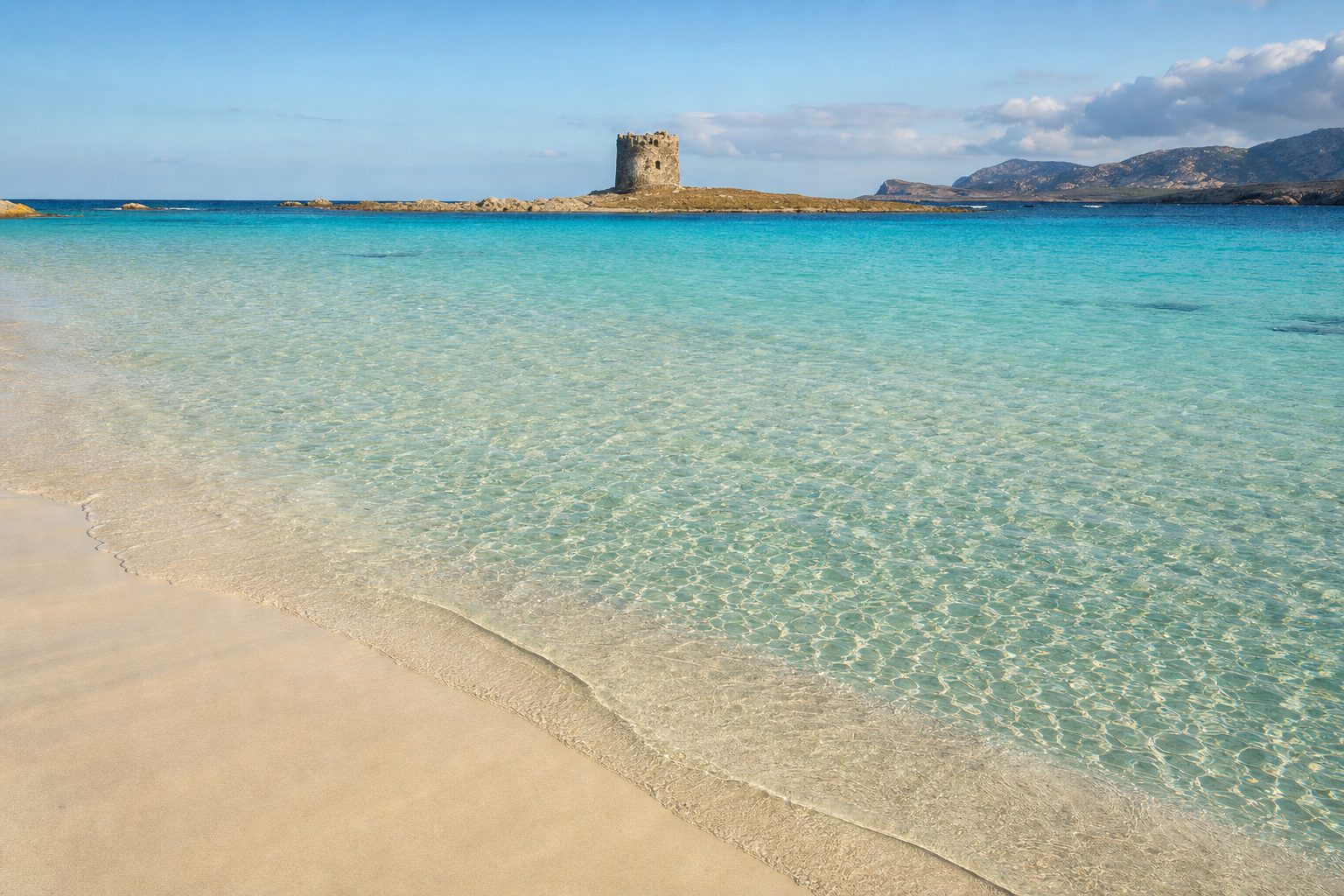
La Pelosa is the beach in the Stintino reel that looks almost edited: a shallow, pale-blue bay, white sand and the small Torre della Pelosa set beyond the water. The practical version is more exacting. In the regulated season, it is a finite day out with a booking system, a compulsory barrier between towel and sand, a car-park clock and rules that are worth treating as part of the destination rather than an inconvenience around it. The useful first decision is whether the aim is a full beach day, an early booking win, or an evening swim after the controls lift.
This guide turns the familiar image into a workable 2026 plan: where the 1,500 daily places go, when to try for the 48-hour release, what to put in the bag, and when an alternative beach is the better call. As checked on 17 August 2026, access arrangements and prices are time-sensitive; confirm the date on La Pelosa’s official booking portal before travelling. Its municipality-backed message is unusually clear: this is the only authorised channel for reservations, so a resale listing or similarly named site is not a shortcut.
Understand what is being protected before you book
La Pelosa’s water and sand make it feel like an open invitation, but the beach is being managed as a fragile place. Fine grains adhere to bare towels, footwear and everything that is shaken out later, so the daily system addresses both crowd pressure and gradual sand loss. That is why the rules begin before the shoreline: a numbered place, a QR-controlled entry and an item of beach equipment that would be optional almost anywhere else. The strongest visit is not one that finds a way around those measures; it is one that plans for them and leaves the beach as it was found.
For 15 May–15 October 2026, La Pelosa is regulated from 08:00 to 18:00, with a maximum of 1,500 visitors a day. The fee is €3.50 per person; children under 12 are free and are not included in the booking count. [1]
The cap explains a common summer disappointment: being in Stintino does not create a right of entry. It also explains why a shoulder-season visit can be more satisfying than the bluest possible August day. In late May, June, September and early October, the water-and-weather trade-off is real, but so is the prospect of less traffic, a more forgiving reservation search and a beach that does not have to be treated as an all-day conquest. July and August reward discipline: reserve, arrive early, and make a second plan before leaving accommodation.
Treat the reservation as a conservation measure as well as an admission: the beach’s capacity, entry control and equipment rules are designed to keep an exceptional stretch of coast usable rather than merely photogenic.
— Paraphrased from the official La Pelosa booking portal and booking instructions
Book the right pool of places, not just the date
There are two routes into the same daily cap. Five hundred places can be booked at any time across the season, which is the sensible route if La Pelosa is the fixed point of a flight-and-hotel itinerary. The remaining 1,000 are released 48 hours before the visit date. As checked on 17 August 2026, that rolling release opens at 09:00, so a midweek beach day on a fixed trip should have an alarm, a signed-in account and a backup date ready before the release minute arrives. Do not wait until the drive from Alghero to see what is left.
La Pelosa allocates 500 places to whole-season booking and releases 1,000 places 48 hours before the visit date. Reservations are limited to four people, each user may make one reservation per day, and the entry QR code is checked at the beach. [2]
That split changes the strategy. For a family or group whose dates cannot move, pay attention to the advance allocation rather than assuming the 48-hour window will be calmer. For travellers with several nights in the northwest, the rolling pool can work well: try first for the clearest forecast, then reserve a different beach day if it does not land. Keep the booking confirmation accessible without mobile signal, check every name and date before payment, and remember that under-12s are not added to the reservation even though they can enter free. A fourth adult cannot be slipped into a booking of three at the gate.
Use only the official how-to-book page to make that choice, and revisit it close to travel. It explains the reservation limits and QR-code process, while the booking portal carries the live availability. Third-party guides can be useful for orientation, but they cannot issue an authorised entry code. This is the same planning instinct that helps in other controlled Italian places: our Venice access-fee guide is a useful reminder that an online confirmation is not the same thing as an improvised day trip.
Pack for the mat rule and leave nothing behind
Put the rigid mat at the top of the packing list. A mat, or a towel with a backing, must sit under the towel or sheet used for lying down; the point is to stop La Pelosa’s fine sand clinging to fabric and travelling away with it. The rule is not an aesthetic preference and a folded thin towel directly on the sand is not a safe interpretation. Buy or borrow the right barrier in Stintino before reaching the beach, then keep it in use for the whole stay rather than treating it as a gate requirement.
A rigid mat is required at La Pelosa. Reporting on the 2026 beach restrictions states that placing towels directly on the sand can lead to a €100 fine. [4]
The narrower rule sits inside a much wider Sardinian principle: sand, shells and pebbles are not souvenirs. Regional Law 16/2017 makes unauthorised removal illegal, with fines of €500–€3,000. The BBC has reported airport and harbour checks, including X-ray checks on luggage containing bottled sand. That makes the practical instruction uncomplicated: do not collect, decant, rinse into a bag, or assume a handful is too small to matter. Shake towels over the beach, not into the boot; empty shoes carefully before leaving; and take ordinary litter with you.
Sardinian law prohibits taking, keeping or selling sand, stones and shells without permission, with fines from €500 to €3,000. [6]
The cautionary comparison is Spiaggia Rosa on Budelli, whose pink sand made it famous and vulnerable. It has been closed since 1994: visitors may view it from a distance, rather than land, walk on the beach or swim there. La Pelosa is not Spiaggia Rosa, and it should not be presented as one, but the comparison makes the logic of an inconvenient mat much easier to understand. A beach can move from controlled access to no access when accumulated damage gets ahead of protection.
Use the evening window, or arrive early for a full day
For a shorter visit, the most useful legal tactic is also the calmest one. The ticketed control ends at 18:00, and access after that time is free with no ticket. It is not a substitute for a booked full day if the plan involves umbrellas, children and a long swim, but it is excellent for the golden-hour version of La Pelosa: arrive after the day crowd has begun to thin, take a short dip, walk the shallows and leave before dusk without having made the beach the centrepiece of the entire holiday. Check conditions and daylight, especially outside high summer.
A ticketed daytime visit needs a more conventional arrival. Parking near La Pelosa is about €2.50 an hour and, in July and August, spaces are commonly full by about 09:00. Build the parking cost into a beach day rather than repeatedly moving the car, and do not make a late-morning arrival depend on a space beside the sand. If you are driving, plan to be settled before the heat and parking pressure build; if not, confirm local seasonal transport before committing to a booking. The beach reservation solves entry, not the last kilometre.
- Book only through spiaggialapelosa.it, save the QR code offline, and do not include children under 12 in the reservation count.
- Use the 500 advance places for immovable dates; otherwise be ready for the 1,000-place rolling release at 09:00, 48 hours before the visit.
- Pack a rigid mat or backed towel, water, shade and a bag for all rubbish; never lift sand, shells or pebbles as a keepsake.
- Arrive before the July–August car park fills, or use the free after-18:00 window for a deliberately short evening visit.
- Keep Le Saline and Ezzi Mannu in reserve so a sold-out date changes the beach choice, not the whole day.
Keep Stintino alternatives in the plan
A good La Pelosa plan has an alternative already chosen. Le Saline is a useful change of scene for a windier, more open coastal day, with a longer strand and a different relationship to the water than the protected-looking shallows at La Pelosa. Ezzi Mannu, further along the peninsula, offers another broad escape when the point is to spend time by the sea rather than reproduce a single photograph. Neither should be sold as a duplicate of La Pelosa; that is precisely their advantage. They allow a sold-out booking or a crowded morning to become a different kind of beach day rather than a frustrated wait by the road.
The season should shape that decision too. In the shoulder months, make La Pelosa the weather-led day and use the open alternatives when breeze or cloud changes the appeal of the shallow bay. In peak summer, reverse the instinct: book La Pelosa if it is genuinely the priority, then use Le Saline or Ezzi Mannu to create breathing space on the days around it. A base in Stintino is convenient, but the real luxury is leaving one day uncommitted. This is a coastline best enjoyed with choices, not a single non-refundable expectation.
Make the beach part of a wider Sardinian rhythm
La Pelosa rewards restraint: one well-timed booked day, one simple evening visit or one chosen alternative may be more memorable than trying to force every hour onto its sand. Verify the live rules, book early when the date matters, protect the beach with the correct mat and leave its grains where they belong. If the wider trip is moving through Italy rather than ending in Stintino, pair this lesson in planning with our Dolomites hiking guide, where another highly sought-after landscape also rewards reservations, shoulder-season timing and an itinerary with a backup plan.
Sources & further reading
- 1. La Pelosa official booking portal
- 2. La Pelosa official booking instructions
- 3. Blulume — La Pelosa booking, prices and rules 2026
- 4. Rental12 — Sardinia beach restrictions 2026
- 5. Sardinia Mobility — La Pelosa booking 2026
- 6. BBC News — Sardinia sand-souvenir fines
- 7. BBC News — Sardinian sand enforcement
- 8. Spiagge.it — Spiaggia Rosa, Budelli