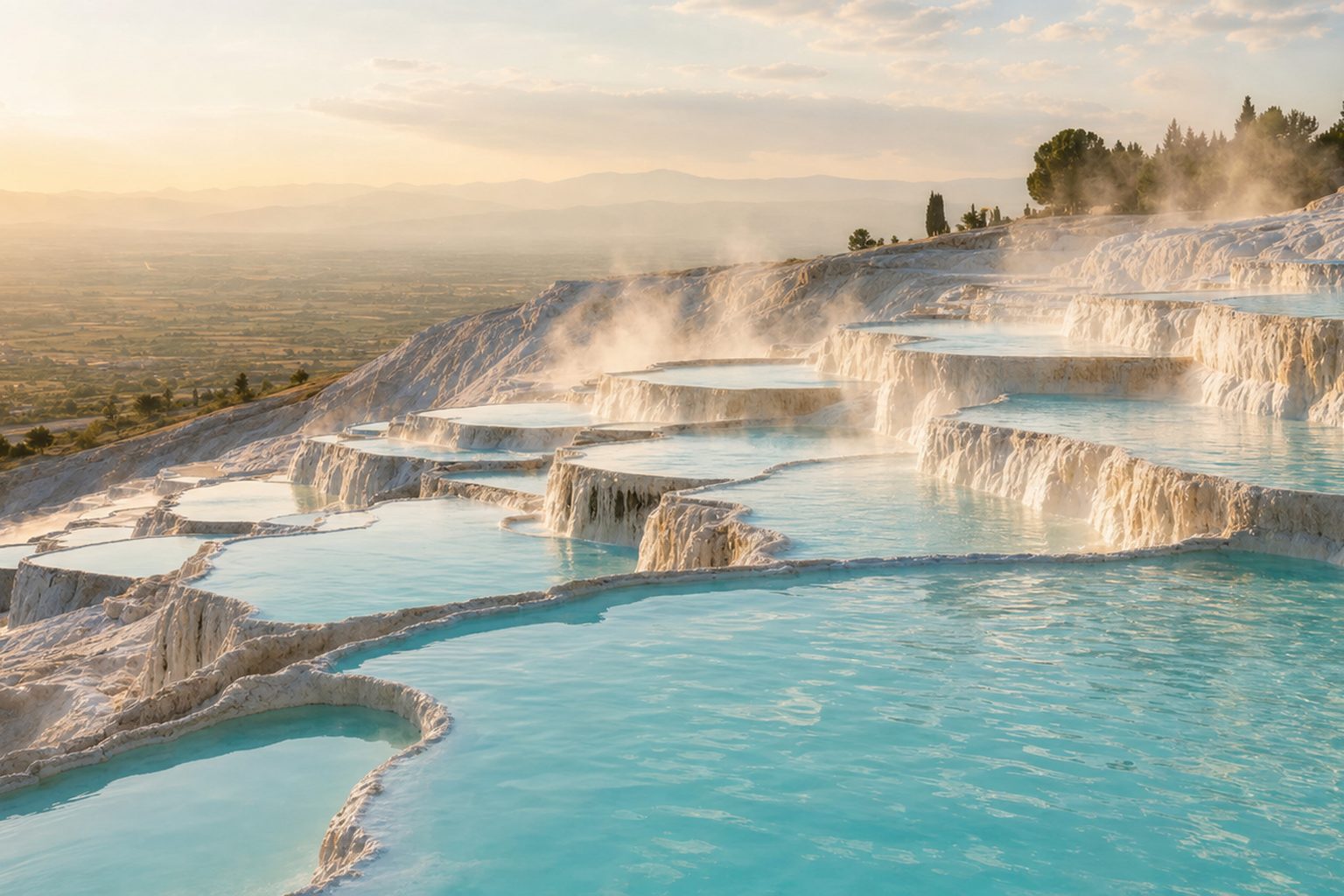
Pamukkale looks simple from a distance: a white hillside, blue water and an ancient city above it. The useful first-visit question is not whether to go, but how to use the few hours when the site feels legible rather than overrun. Your decisions are practical: whether to enter at the village, north or south gate; whether a swim in Cleopatra’s Antique Pool is worth an additional fee; and whether you can arrive before, or after, the organised day tours.
The terraces are also not a beach. Footwear comes off in the permitted travertine area, the water is for wading rather than swimming, and the gleaming surface can be slippery. Treat this as a protected landscape with a Roman city attached, not a quick photo stop. That approach makes room for Hierapolis’s theatre, bath complex and museum, and gives the barefoot rule a purpose beyond the reel hook.
What the barefoot rule actually changes
On the visitor route across the travertines, shoes must be removed and carried. The rule protects the pale calcite: footwear can mark, scratch and dirty a surface whose colour and structure require active conservation. Pack a small dry bag for shoes, socks and electronics, rather than trying to balance them in your hands on wet stone. Leave shoes on for Hierapolis, the museum and ordinary paths; the barefoot rule is for the terrace section, not a demand to cross the whole archaeological site unshod.
The UNESCO-listed property combines calcite terraces and thermal springs with the Greco-Roman and Byzantine remains of Hierapolis; UNESCO records that visitor access to the travertines is restricted to help sustain water flow and preserve their colour and structure. [2]
This is the central correction to many first-time expectations. The active pools along the route are shallow, sometimes with people sitting in them, rather than a chain of deep natural baths. The more comfortable you are with a slow, slightly awkward barefoot walk, the more enjoyable the visit becomes. Anyone with significant mobility concerns should choose the flatter upper approach and prioritise the museum and ruins rather than forcing the full village-to-top terrace climb.
Buy the combined ticket, then decide on the thermal pool
Do not split the headline sights into separate purchases. As checked in August 2026, the standard Hierapolis–Pamukkale admission is about €30 and covers the travertines, Hierapolis ruins and Hierapolis Archaeology Museum. Prices are set in Turkish lira and the euro figure is a useful equivalent, not a promise of the charge on your card. Buy through the Ministry’s official e-ticket portal or use the current entry product on muze.gov.tr; check the live amount and conditions before travelling because museum pricing changes.
As checked in August 2026, the single-site ticket is listed at about €30 for the terraces, Hierapolis ruins and archaeology museum; this is one ticketed complex rather than separate terrace and ruins admissions. [4]
Cleopatra’s Antique Pool is the separate decision. It is inside the wider site but swimming costs about €13 extra as checked in August 2026, normally paid in lira at the pool. The appeal is not an empty natural basin: it is a warm pool with ancient fragments beneath and around the water, often busy at the middle of the day. Choose it if you want a proper soak and can spare an unhurried hour; skip it if your priority is the terraces, theatre and museum in a tight visit. Take swimwear and a towel, and protect valuables with a locker where available.
As checked in August 2026, swimming in Cleopatra’s Antique Pool is an optional charge of roughly €13 and is not included in the main site ticket. Confirm the price at the venue on the day, particularly if a change in exchange rate makes the euro estimate look different from the lira charge.
Avoid buying a vague ‘skip-the-line’ bundle just for entry. A tour can make sense if it solves transport from Antalya, İzmir or a cruise stop, but the standard ticket remains the cleanest choice for an independent visitor. If you are building a longer Türkiye route, the more useful comparison is with Cappadocia’s weather-led planning: at Pamukkale, the crucial variable is not a cancellation-prone activity but the site’s daily crowd wave.
Choose a gate for the visit you want
Pamukkale has three useful approaches, and picking one before you arrive prevents a surprising amount of backtracking. The Town Gate starts in Pamukkale village and takes you uphill over the white slope, so it gives you the classic barefoot entrance but commits you to a wet, exposed ascent. South Gate sits near the upper terraces and ruins, making it the most efficient car-friendly choice when time is limited. North Gate feeds naturally into Hierapolis, which is sensible when you want to see the ancient city while it is still quiet.
- Use the Town Gate for the barefoot ascent and terrace-first photographs; allow 20–30 minutes for the gradual climb.
- Use South Gate for the shortest practical route to upper terraces, the museum and Cleopatra’s Antique Pool, particularly if you arrive by car.
- Use North Gate for a ruins-first route through Hierapolis; allow 45–60 minutes on foot to reach the central sights, or check the local shuttle arrangement.
- Enter at one gate and leave at another only if your vehicle or onward transport is planned for it; do not assume the site is a short loop.
The north-to-south line works well for a full visit: archaeological streets and necropolis first, theatre and museum in the middle, terraces last. The reverse works better at opening time if the terrace images matter most. Either way, leave enough time for the theatre rather than treating it as an optional detour. Hierapolis was a Roman and Byzantine spa city, and the physical pairing of city and mineral landscape is the point of the World Heritage listing.
Make a deliberate division between the spectacle and the archaeology. The terraced basins demand careful footing and attention to light; the city repays a slower, shoe-on walk. The main colonnaded street, bath structures, theatre and necropolis establish why this is not merely a thermal stop. The official site history places Hierapolis 18 kilometres north of Denizli and records its development from a Hellenistic foundation into a major Roman and Byzantine centre. Even visitors who are indifferent to ruins should allow enough time to climb into the theatre: it gives the white slope its historical scale and makes the combined ticket feel properly used.
Beat the buses by changing the clock, not rushing
The reliable strategy is simple: arrive at opening, or arrive roughly two hours before sunset. In the summer schedule, the gates are roughly 06:30–21:00, giving an early window that day tours rarely match. The light is softer, the stone cooler under bare feet and the pool area less pressured. If an early start is impossible, avoid trying to ‘squeeze in’ the terraces at midday. Spend the late afternoon at the site instead, when day-trippers begin to clear and low light brings definition to the white ridges.
As checked in August 2026, summer hours are roughly 06:30–21:00; the main coach-bus surge is reported from about 10:00 to 15:00, while 06:30 and late afternoon are the better crowd-avoidance windows. [7]
This timing changes how long you need. At opening, give the terraces their calm first hour, then move uphill to Hierapolis before the heat builds. Late in the day, do the reverse: ruins and museum first, then let the terraces become the finish. The separate Antique Pool is least appealing at noon, when it can become a queue-and-locker exercise. A weekday is preferable, but a weekday at 06:30 is much more useful than a weekend with no change of timing.
Do not confuse ‘beating the buses’ with racing the site. The protected, water-bearing sections are narrower than the aerial photographs suggest, and pausing for a clear stretch is safer than edging around people on a wet slope. The same low-friction logic helps at other high-demand landscapes: Antelope Canyon’s guided-entry system rewards choosing the right slot rather than simply arriving in the middle of the day.
If you only have a half-day, do not force every element. Pick one primary experience—quiet terraces at opening, a late-day terrace finish, or an unhurried Antique Pool soak—and build the rest around it. A full-day visitor can add the museum and broader city without haste. A visitor arriving in the 10:00–15:00 bus window should reverse the usual priorities: head for the wider archaeological areas, take a shaded pause where possible, and wait to approach the terraces later. The goal is not an empty landmark; it is to avoid spending the best light and coolest hours in a queue.
Expect shallow water, glare and uneven footing
Bring the right expectations for the water. The accessible terrace pools are generally 10–30 centimetres deep: enough to wade or sit in, not enough to swim. Water levels and which basins are open can vary with conservation and operations, so do not plan a visit around reproducing a particular social-media shot. Some areas are deliberately left dry or closed to recover, and the best-looking pool at a given moment may not be one visitors may enter.
The visitor guidance describes the walkable terrace pools as generally 10–30 cm deep and warns that travertine surfaces can be slippery in places; supervise children closely and walk slowly through algae-prone patches. [5]
Sun is the other physical constraint. White stone throws light back at the face and eyes, while summer heat can make barefoot rock uncomfortable even when the water feels pleasant. Carry drinking water, use high-factor sunscreen, wear a hat and put sunglasses in the bag for the non-barefoot sections. In wet weather, slow down further: a calm grey day can be beautiful, but it does not make polished mineral surfaces grippier.
Choose spring or autumn for the easier version
For most first-time visitors, April–June and September–October offer the best balance of walking weather, tolerable glare and daylight. They also make the barefoot route more comfortable than peak summer, when July and August are both hot and busy. September and October are particularly useful if you want warm conditions without the full high-summer intensity. A winter visit can be striking and quiet, especially if a warm pool matters to you, but shorter hours, wind and rain call for warmer layers and a more flexible plan.
Pamukkale’s seasonal planning guidance identifies April–June and September–October as the most comfortable weather windows, while July and August combine peak crowds with strong heat and reflected sunlight. Use that broad pattern rather than treating a single weather forecast as a guarantee: an early weekday in May can still be busy, and a late-afternoon September visit is often more comfortable than a midday slot in any month.
The value of Hierapolis-Pamukkale lies in the tight integration of its white travertine terraces, thermal springs and archaeological city, rather than in any one photograph.
— Paraphrased from the UNESCO World Heritage listing
That is why a good Pamukkale visit has two tempos: bare feet and slow footing on the terraces, then shoes back on for the story of the city above them. Book the official ticket, choose an early or late window, and let the Antique Pool be an intentional add-on rather than a default. If this kind of protected-water landscape is shaping a wider Europe route, continue with Lake Bled’s visitor-planning choices, where timing and a restrained itinerary matter just as much as the view.
Sources & further reading
- 1. Türkiye Ministry of Culture and Tourism: Hierapolis and Pamukkale Travertines ticket listing
- 2. UNESCO World Heritage Centre: Hierapolis-Pamukkale
- 3. Türkiye Ministry of Culture and Tourism: Hierapolis (Pamukkale) Archaeological Site
- 4. Travel Pamukkale: Tickets, entrance fee and opening hours
- 5. Şahinoğlu Turizm: Pamukkale hot springs guide
- 6. Travel Pamukkale: Best time to visit
- 7. Pamukkale Turkey: Problems and solutions guide
- 8. All Istanbul Tours: Cleopatra Antique Pool guide