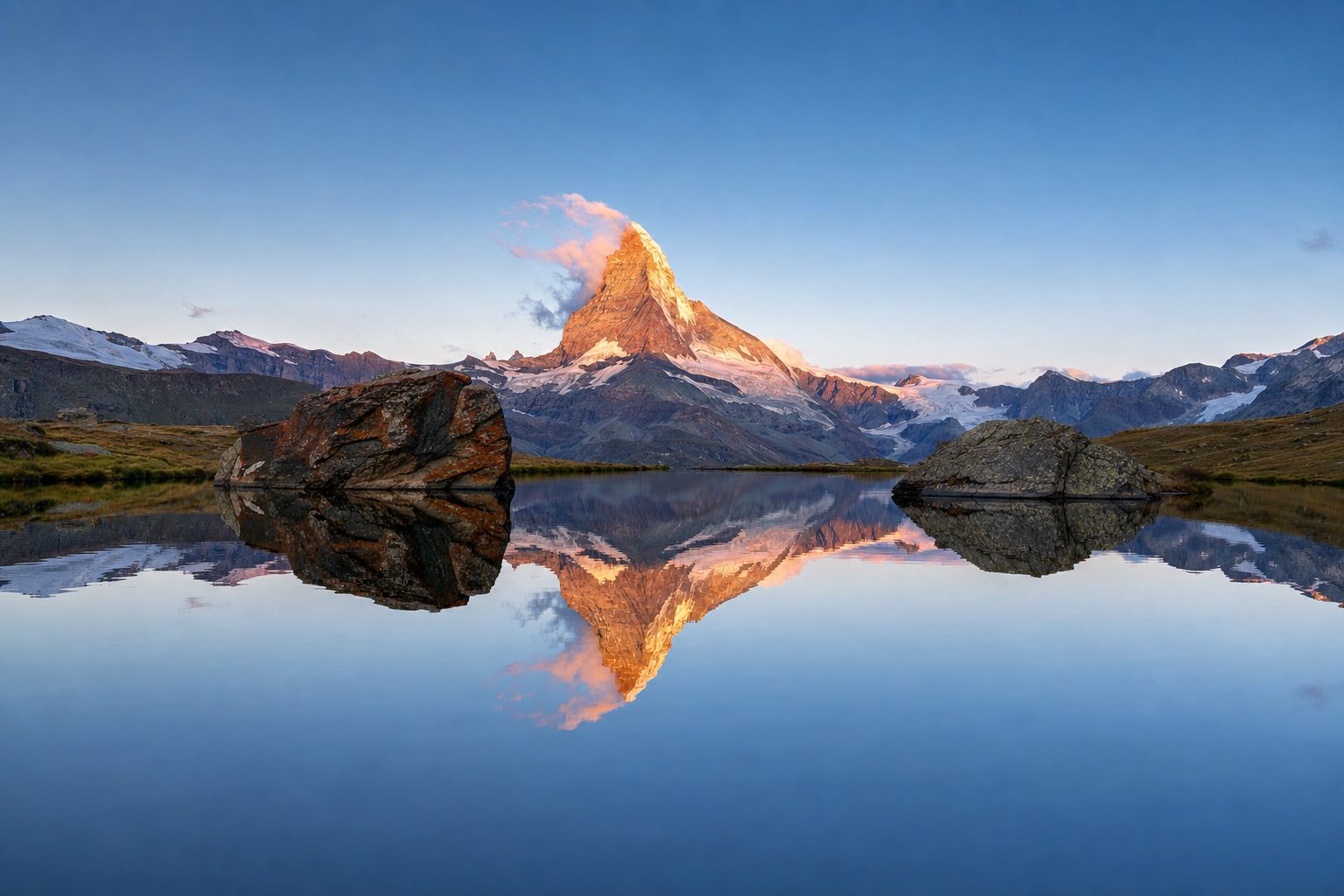
The image that pulls most travellers to Zermatt arrives long before the trip does: a pyramid of rock catching the first light, doubled in the still water of a mountain lake. Getting that view, or any of the Matterhorn's better angles, means making a handful of decisions before arrival. The first is unavoidable: Zermatt has no roads for private cars, so the way in is fixed. The rest are about money and timing — which viewpoint earns its price, which ticket window is cheaper, and which lake trail is worth the early alarm.
This guide sets out those decisions in order: how to arrive, which of the two big cable cars and cog railways to prioritise, when to buy the discounted afternoon tickets, how the Dolomites comparison might change your itinerary, and what a Swiss Travel Pass actually saves here versus elsewhere in the country.
How you get into a town with no cars
Zermatt has been car-free since long before that became a marketing line; private vehicles are only permitted as far as Täsch, five kilometres before the village. Anyone driving in leaves the car at the Matterhorn Terminal in Täsch, a 2,100-space covered car park attached directly to the railway station, and continues by shuttle train, taxi, or the Glacier Express onward to Zermatt, according to the official Zermatt arrival guide.
The Täsch–Zermatt shuttle train takes 12 minutes and runs every 20 minutes, arriving directly in the centre of car-free Zermatt, as stated on the official Zermatt arrival page. As checked in July 2026. [1]
This arrangement is not a recent restriction imposed to manage tourist numbers; Zermatt has never had public roads for private traffic, and the entire town plan, from hotel loading bays to rubbish collection, is built around electric and horse-drawn transport instead. Visitors coming by air usually fly into Zurich, Geneva, or Milan and continue by train via Visp or Brig, which removes the car question entirely and connects directly into the Täsch–Zermatt shuttle line without a change of station.
The Matterhorn Terminal in Täsch is built around the shuttle station so the transfer from car to train involves no road crossing, and luggage trolleys can be wheeled straight onto the train, per Matterhorn Gotthard Railway's own parking guidance. Inside Zermatt itself, movement is by electric taxi, a free e-bus on two routes, horse-drawn carriage, bicycle, or on foot — there is no alternative for private cars at any point past Täsch.
Choosing between Gornergrat and Matterhorn Glacier Paradise
Zermatt has two marquee mountain excursions, and first-timers often assume they are interchangeable. They are not. The Gornergrat railway climbs to roughly 3,089 metres on a cog railway with the Matterhorn directly ahead, a slow, scenic ascent suited to photography and a relaxed half-day. Matterhorn Glacier Paradise, reached by cable car via Furi and Trockener Steg, tops out at 3,883 metres at Europe's highest cable car station, with glacier ice, a viewing platform, and considerably thinner air.
A standard adult return ticket from Zermatt to Gornergrat runs from CHF 96 in the November-to-April season, rising in the summer months; Swiss Travel Pass, Half Fare, GA travelcard, and Swiss Flex Pass holders all receive a 50% reduction, according to the official Zermatt ticket booking page. As checked in July 2026. [4]
For travellers choosing only one, the decision usually comes down to what they want from the day: Gornergrat for an unobstructed, front-on Matterhorn portrait and an easier trip with young children or limited fitness; Glacier Paradise for glacier walking, higher altitude, and views stretching across three countries. Doing both in a single visit is possible but makes for a long day, since each excursion alone reasonably fills three to four hours including the ride.
Buying the Good Afternoon Ticket instead of the standard fare
Both mountain operators price a discounted afternoon ticket for travellers willing to go up later in the day, when tour groups and day-trippers have mostly departed. Gornergrat's version, sold only online and only up to the day before travel, is the clearest example of built-in savings that most visitors never use.
The Good Afternoon Ticket for the Gornergrat railway is a same-day return valid only on the date selected, priced at roughly 20 percent below the standard fare, for ascents from 3:35pm onward, purchasable online through the Gornergrat Railway webshop or SBB up to the day before travel.
— Paraphrased from the Gornergrat Railway's Good Afternoon Ticket page
The Gornergrat Good Afternoon Ticket costs CHF 105.60 against a standard fare of CHF 132.00, is valid from 1 May to 31 October 2026, and is non-exchangeable and non-refundable once booked, per the Gornergrat Railway. As checked in July 2026. [3]
Matterhorn Glacier Paradise runs a comparable model: an afternoon return to the summit from around 1:30pm is priced below the standard fare across the same summer season, listed alongside the full sightseeing fare schedule on the operator's tickets and prices page. Either discount is worth checking against your plans before defaulting to a morning departure, especially since afternoon light on the Matterhorn's north-east face is generally softer and less prone to the haze that can build by midday in high summer.
- Book Gornergrat's Good Afternoon Ticket online only, and only up to the day before travel — it is not sold at the counter.
- Check Matterhorn Glacier Paradise's own afternoon return fares on matterhornparadise.ch, which shift by season (winter, shoulder, and July–August peak pricing all differ).
- Carry a Swiss Travel Pass, Half Fare Travelcard, or GA Travelcard if visiting more than one mountain excursion — each cuts the fare by half.
- Confirm current opening hours before travelling in shoulder season, since both railways run shortened schedules around maintenance closures in early November.
Walking the Five Lakes Trail for the Stellisee reflection
The single most reproduced image from Zermatt — the Matterhorn mirrored on flat water — comes from Stellisee, a small lake at 2,537 metres reached by a 20-minute walk from the Blauherd cable car station. It is the first stop on the 5-Seenweg, or Five Lakes Walk, a roughly 9 to 11 kilometre route connecting Stellisee, Grindjisee, Grünsee, Moosjisee, and Leisee, three of which reflect the Matterhorn on calm mornings, according to Switzerland Tourism's official trail listing.
The trade-off is timing. The first cable cars up to Blauherd typically do not run before around 8:00am, well after sunrise for most of the hiking season, which means the calm, wind-free water most photographers want is usually gone by the time transport opens. Travellers determined to catch the reflection at first light generally either book an overnight stay at the Fluhalp mountain inn near the lake, open only in the summer months, or accept a walking approach from the valley in the dark. Either way, this is the clearest place in the guide where the reel-worthy shot and the easiest logistics pull in opposite directions.
Deciding whether a Swiss Travel Pass pays for itself here
The Swiss Travel Pass is frequently sold as a blanket discount for Switzerland, and in Zermatt specifically it is worth understanding precisely what it does and does not include. It gives unlimited travel on trains, buses, and boats nationwide, free travel on the Rigi, Stanserhorn, and Stoos mountains, and free admission to more than 500 museums — but Zermatt's excursions fall into a different, lower tier of benefit.
SBB's own description of the Swiss Travel Pass states that it offers a 50 percent discount on "other mountain excursions and leisure offers from RailAway" beyond the three fully included peaks, a category that covers both the Gornergrat railway and Matterhorn Glacier Paradise. As checked in July 2026. [8]
For a traveller spending most of a trip in and around Zermatt, that 50% discount is meaningful on the two headline excursions but does not make them free, unlike the pass's treatment of Rigi or Stoos elsewhere in the country. The maths favours the pass when a trip includes several travel days of unlimited train use plus at least one or two mountain excursions; a traveller staying put in Zermatt for a short break who only wants one Gornergrat ride may find a Half Fare Travelcard, which offers the same 50% discount at a lower one-off cost, the more economical choice.
The practical approach is to total the point-to-point train fares and mountain excursions actually planned before buying anything. A visitor arriving from Zurich, riding Gornergrat once, and walking the Five Lakes Trail once will spend very differently to one adding the Glacier Express or a side trip to Lucerne, and the pass's value scales with the number of travel days used rather than with any single attraction.
When to go
Both major excursions run year-round, but the Five Lakes Walk does not: it depends on snow clearance and is generally only fully open from June to late September, per Switzerland Tourism's route notes. Visitors set on combining the lake hike with the cable cars should plan within that window rather than assuming the whole region operates on the same calendar. Summer (July–August) brings the longest daylight and the busiest lifts, with the highest ticket prices of the year on both Gornergrat and Glacier Paradise; the shoulder months of May-June and September-October combine lower fares with thinner crowds, though some higher trails may still be snow-affected early or late in that window.
Winter shifts the calculation entirely toward skiing and the Glacier Paradise ski area, which is one of the few in Europe open essentially year-round, while the Five Lakes Walk is inaccessible under snow cover. Anyone weighing Zermatt against a similarly dramatic but very different Alpine base should also read the case for the Dolomites, where lift networks and rifugio culture solve the same access problem in a different way.
Fitting Zermatt into a wider trip
Because Zermatt's own footprint is compact and almost entirely vertical, it rewards a focused two- to three-night stay rather than a rushed day trip from a larger circuit. Travellers building a longer Alpine or European itinerary can use the Europe itinerary planning guide to work out how many days the Matterhorn region reasonably deserves against other stops, and the broader guide to getting around Europe is useful for working out train connections into Täsch or Visp from wherever the rest of the trip begins. Given that arrival itself is one of the more distinctive parts of a Zermatt trip, treating the Täsch shuttle and the mountain railways as part of the itinerary rather than a logistics afterthought tends to produce a smoother visit.
Sources & further reading
- 1. Zermatt Tourism — Planning Your Trip to Zermatt (arrival)
- 2. Matterhorn Gotthard Railway — Parking Matterhorn Terminal Täsch
- 3. Gornergrat Railway — Good Afternoon Ticket
- 4. Zermatt Tourism — Book Gornergrat Ticket Online
- 5. Matterhorn Paradise — Sightseeing Tickets & Prices
- 6. Zermatt Tourism — Stellisee
- 7. Switzerland Tourism — 5-Seenweg Zermatt
- 8. SBB — Swiss Travel Pass